🏞️ Rodrigues Giant Tortoise
🌍 What It Was
The Rodrigues Giant Tortoise was a large tortoise species native to Rodrigues, an island in the Indian Ocean. These tortoises were known for their impressive size and distinctive dome-shaped shells. They played a crucial role in their ecosystem as herbivores, feeding on a variety of vegetation and helping to shape the plant community.
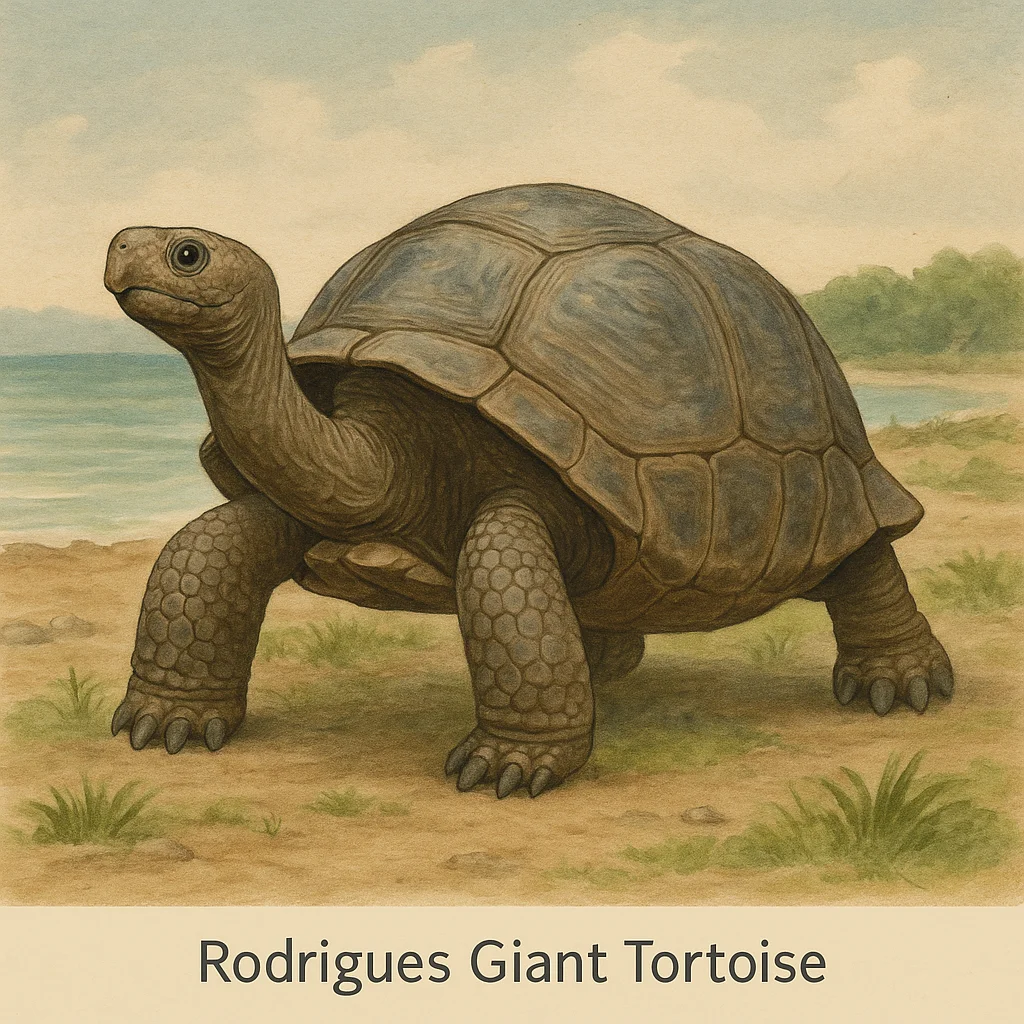
Closely related to other Indian Ocean tortoises, such as the Aldabra Giant Tortoise, Rodrigues Giant Tortoises were part of the rich biodiversity of island ecosystems. Within their habitat, they acted as mega herbivores, influencing the structure and dynamics of their environment.
In this article, you'll learn about the tortoise's habitat and daily life, what made them unique, and the factors that led to their extinction. It will also discuss efforts for conservation and any surviving relatives today.
🧭 Where It Lived
The Rodrigues Giant Tortoise was endemic to Rodrigues Island, located in the western Indian Ocean. Being endemic means it was found nowhere else in the world. The island's isolated geographic position led to unique evolutionary paths for its native species.
Rodrigues Island was characterized by its diverse habitats which included forests, grasslands, and coastal areas. These habitats provided an abundance of resources which supported the various stages of the tortoises' life cycle.
Being an island-native species, the Rodrigues Giant Tortoise faced intrinsic risks associated with limited geographic range and habitat diversity. Such isolation makes species particularly vulnerable to environmental changes and human impacts.
The tortoises adapted to the island's conditions but could not easily relocate if their habitat was altered, contributing to their eventual extinction when their environment changed too drastically.
🌿 Habitat and Daily Life
Rodrigues Island had a tropical climate with warm temperatures throughout the year. The island experiences distinct wet and dry seasons which affected the availability of food resources for the tortoises.
These tortoises were primarily herbivores, grazing on grasses and forbs, and browsing on shrubs and small trees. Their feeding patterns helped maintain the balance of vegetation on the island and allowed for the dispersal of certain plant seeds.
Rodrigues Giant Tortoises had a slow-paced lifestyle, spending much of their time foraging to meet their nutritional needs. Socially, they were relatively solitary but would gather in herds during the breeding season, which helped increase the chances of successful reproduction.
The tortoises laid eggs that incubated over several months before hatching. Hatchlings required favorable conditions to survive, particularly stable temperatures and sufficient ground cover for protection from predators.
🧬 What Made It Unique
The Rodrigues Giant Tortoise was easily recognizable due to its large size and domed shell, which was an adaptation to the island's environment. This physical trait helped the tortoises regulate their body temperature in varying weather conditions.
They played a significant ecological role as seed dispersers, aiding in the reproduction of various plant species through their eating habits. Additionally, their presence influenced the island's ecology by controlling the growth of certain vegetation types.
There are indications that the tortoises were part of local folklore, but concrete evidence of cultural significance is limited. Nonetheless, these animals were an integral part of the island's natural history.
⏳ When It Disappeared
The extinction timeline of the Rodrigues Giant Tortoise is not precisely determined due to scant historical records. Confident estimates suggest the early to mid-18th century for their last sightings, after extensive human exploitation.
The declaration of extinction occurred when there were no reliable sightings or evidence of survival in their natural habitat. This declaration is based on exhaustive surveys and historical accounts, though uncertainty exists about the exact year.
Rodrigues Giant Tortoises are considered "Extinct," meaning no individuals remain anywhere on Earth, unlike "Extinct in the Wild," where a species might survive in captivity.
⚠️ Why It Went Extinct
Several factors contributed to the extinction of the Rodrigues Giant Tortoise. One primary driver was habitat loss due to human activities, including deforestation and land conversion for agriculture. This fragmentation reduced the availability of food and nesting sites.
Overexploitation also played a crucial role as these tortoises were hunted extensively for their meat. Sailors visiting the island found them a convenient food source, rapidly depleting their numbers.
Introduced species, such as cats and rats, further threatened the tortoises by preying on eggs and hatchlings. These invasive species disrupted the ecological balance of the island, making survival and reproduction increasingly difficult.
While disease and climate events may have also influenced their extinction, the multi-factorial impact of habitat destruction and human exploitation are considered the most significant causes.
🧩 How We Know (Evidence and Records)
Our knowledge about the Rodrigues Giant Tortoise comes from various sources, including fossil and subfossil remains, which offer insights into their physical structure and historical presence.
Museum specimens, collected by explorers and naturalists, provide critical evidence of their existence. These specimens allow scientists to study the tortoises' physical characteristics in detail.
Field notes, historical records, and oral histories collected by early settlers and visitors give narrative evidence about their behavior and interactions with humans.
Genetic analyses and comparisons with related species have also helped confirm their taxonomic identity and evolutionary history.
🛡️ Could It Have Been Saved
In retrospect, several conservation measures could have aided in the survival of the Rodrigues Giant Tortoise. Protecting their natural habitat, restricting hunting, and controlling invasive species early on might have improved their chances.
However, conservation awareness and practices were limited during the time of their decline. The lack of timely intervention often contributed to their extinction before actions could be implemented.
Some unsuccessful late attempts were made at captive breeding, but these efforts came too late to prevent extinction, underscoring the importance of proactive conservation strategies.
🔁 Are There Any Survivors or Close Relatives Today
Although the Rodrigues Giant Tortoise is extinct, its closest living relatives include other Indian Ocean tortoises, such as the Aldabra Giant Tortoise and the Seychelles Giant Tortoise.
These relatives share a similar ecological role on their respective islands, contributing to seed dispersal and vegetation management.
While no reintroduction programs exist for the Rodrigues species specifically, general efforts to protect related species highlight the importance of conservation across the Indian Ocean islands.
❓ Common Questions and Misconceptions
Was it hunted to extinction? Yes, hunting significantly contributed to their extinction as sailors consumed them for food.
Why didn’t it adapt or move? Island species often cannot move to new habitats due to geographic isolation, limiting their adaptability.
Could it still be alive somewhere? Given the thoroughness of surveys and the absence of sightings, it is highly unlikely.
What does 'declared extinct' actually mean? It means no living members are known to exist, despite exhaustive searches.
What is the difference between endangered and extinct? Endangered species still exist but face high risk of extinction; extinct species have no surviving members.
Why are island species so vulnerable? Due to their limited range, small populations, and sensitivity to environmental changes and invasive species.
📌 Summary
- The Rodrigues Giant Tortoise was a large, herbivorous tortoise endemic to Rodrigues Island.
- It lived exclusively on Rodrigues Island in the Indian Ocean.
- Habitat included forests and grasslands, contributing to its ecological role.
- The tortoise mainly fed on island vegetation, aiding in seed dispersal.
- Its distinctive domed shell was an adaptation to its climate.
- The species last survived until the early to mid-18th century.
- Extinction drivers included habitat loss, hunting, and introduced species.
- Understanding comes from fossils, museum specimens, and historical records.
- Closest relatives are other Indian Ocean tortoises like the Aldabra Giant Tortoise.
- Acting sooner on habitat protection could have improved their survival.
- Illustrates the fragility of island ecosystems under human impact.
- A lesson in the need for early conservation action to protect vulnerable species.