🏞️ Cape Verde Giant Skink
🌍 What It Was
The Cape Verde giant skink was a remarkable reptile that inhabited the Cape Verde archipelago. It was a large lizard known to be part of the skink family. Skinks are characterized by their smooth-scaled skin and elongated bodies, and the giant skink was notably different due to its larger size compared to many of its relatives.
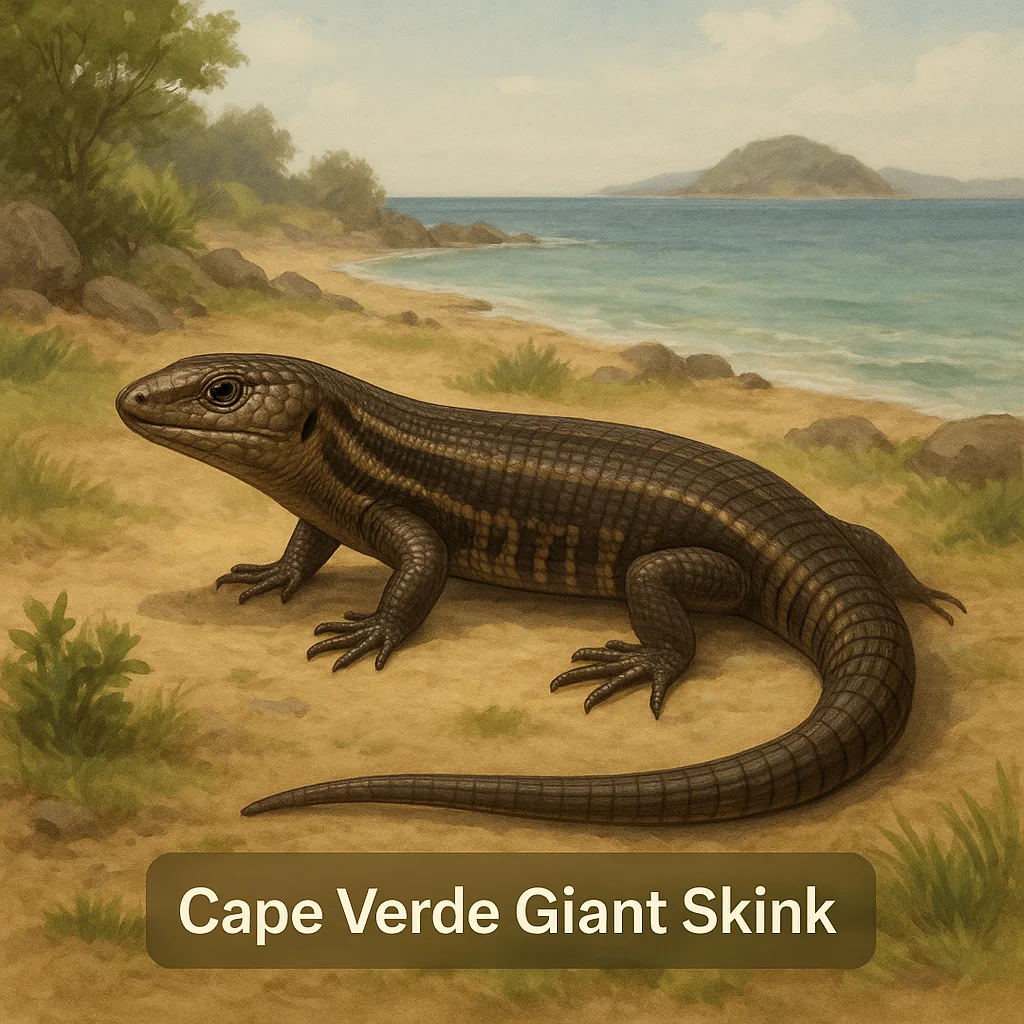
This skink is thought to have been closely related to other skinks in the Macaronesian islands, a group which includes areas such as the Canary Islands and Madeira. While its closest living relatives aren't precisely known due to its extinct status, it was part of an ecosystem greatly influenced by such species.
In this article, you'll learn about the habitat the Cape Verde giant skink depended on, its daily life and interactions with other species, the reasons for its eventual extinction, and what we can infer from the remaining evidence. We'll also discuss the factors that made it unique and why its disappearance gives us important insights into conservation efforts today.
🧭 Where It Lived
As its name suggests, the Cape Verde giant skink was endemic to the Cape Verde Islands, a group of islands located in the central Atlantic Ocean off the west coast of Africa. The term "endemic" means that it was found nowhere else in the world.
The skink's habitat was primarily limited to certain islands within the archipelago where its ecological needs could be met. These needs included access to sandy and rocky terrains, which were ideal for its foraging and nesting habits.
Being island-limited meant that the giant skink was at a higher risk of extinction. Island species often face greater vulnerabilities due to their restricted geographic range and inability to migrate when environmental conditions change. The isolation can disrupt their ability to access resources, avoid predators, and maintain a sufficient gene pool for survival.
🌿 Habitat and Daily Life
The Cape Verde Islands have a generally arid climate, with sparse rainfall and high temperatures being a common characteristic. Despite the harsh conditions, the skink was well-adapted to thrive in such environments.
The diet of the Cape Verde giant skink likely consisted of plants, insects, and possibly small invertebrates. Its foraging habits were adapted to the dry conditions, which might involve scraping vegetation and finding hidden sources of moisture.
The giant skink's reproductive habits remain less documented, but like other skinks, it might have laid eggs and had specific breeding seasons. Its behavior towards offspring care is assumed to be minimal, following the typical skink pattern where parental involvement is limited.
As a part of its ecosystem, the skink may have played a role as both predator and prey. It had to contend with native predators, possibly including birds and mammals, and compete with other species for resources.
🧬 What Made It Unique
The Cape Verde giant skink was notable for its size, which was larger than many other skink species. This adaptation may have provided certain advantages, such as territorial dominance and increased ability to hunt and forage.
Its coloration and scale texture would have been adapted to its environment, offering camouflage against predators and aiding in temperature regulation. The scales not only provided protection but also helped in minimizing water loss in the arid climate.
Little is known about any cultural or historical significance the skink may have had to humans, but reptiles in general are often important in indigenous folklore and local beliefs, which could be true for this giant skink as well.
⏳ When It Disappeared
The Cape Verde giant skink was last confirmed through collected specimens in the late 1800s. Subsequent searches for living individuals have yielded no results, leading researchers to consider it extinct.
The declaration of extinction follows specific criteria, including exhaustive surveys of its known habitats and the absence of any verifiable sightings for a considerable period. Misidentifications and lack of continuous monitoring contribute to uncertainty.
The term "extinct" differs from "extinct in the wild," with the former indicating complete disappearance while the latter suggests survival only in captivity or other constrained settings. Unfortunately, the Cape Verde giant skink falls into the first category with no known individuals remaining.
⚠️ Why It Went Extinct
The extinction of the Cape Verde giant skink can be attributed to several interrelated factors. Habitat loss and fragmentation played a significant role, as human activities led to the alteration of its natural habitat, reducing its living space and resources.
Overexploitation also contributed to its decline. As with many island species, the skink might have been collected excessively for food or trade, diminishing its population over time.
Introduced species posed another threat. Non-native animals, such as rats and cats, could have preyed upon skinks or competed for resources, further stressing the species.
While climate shifts and extreme events could have exacerbated these issues, the exact impact remains speculative. The combination of these factors resulted in the diminished survival and reproductive success of the species.
🧩 How We Know (Evidence and Records)
The knowledge about the Cape Verde giant skink stems largely from museum specimens, historical records, and occasional field notes. Studies of collected specimens have allowed scientists to examine morphological features and establish its classification.
However, the challenge of verification arises for many extinct species due to limited preserved evidence and incomplete records. In some cases, species might be difficult to confirm because of their elusive nature or because they inhabited remote or inaccessible areas.
Scientific approaches to verify identities often involve comparisons with existing collections, cross-referencing historical texts, and, where possible, genetic analyses. The Cape Verde giant skink's evidence provides a clearer picture of its past, but leaves questions about its exact ecological role and complete historical range.
🛡️ Could It Have Been Saved
Theoretically, several conservation actions might have changed the fate of the Cape Verde giant skink. Protective measures for its habitat could have sustained its population by preserving essential resources and limiting human interference.
Regulating collection and hunting practices might have mitigated the decline in numbers, while controlling invasive species could have reduced competition and predation pressures.
Captive breeding programs, if established early enough, might have served as a refuge for maintaining genetic diversity and reintroducing individuals into the wild, though such attempts are often challenging and resource-intensive.
Nevertheless, action often came too late, particularly in cases where species decline goes unnoticed until considerable damage has occurred. Conservation programs require timely, sustained efforts and adequate resources to succeed.
🔁 Are There Any Survivors or Close Relatives Today
The closest living relatives to the Cape Verde giant skink are likely other skinks found within the Macaronesian Islands and African regions. These species share similar ecological roles, though they vary significantly in size and behavior.
Ecological replacements, such as other lizard species or even certain mammals, might occupy similar niches by fulfilling roles in seed dispersion or serving as prey to larger predators.
Currently, there are no known reintroduction or captive breeding efforts for the Cape Verde giant skink, emphasizing the finality of its extinction and the loss of its genetic contribution to biodiversity.
❓ Common Questions and Misconceptions
Was it hunted to extinction? The skink may have been collected frequently, which contributed to its decline, but it wasn't the sole cause.
Why didn’t it adapt or move? Island species like the giant skink have limited range and adaptability due to geographic isolation.
Could it still be alive somewhere? Extensive searches have found no evidence of surviving individuals; it is considered extinct.
What does 'declared extinct' actually mean? A species is declared extinct after thorough surveys and lack of evidence for a prolonged period.
What is the difference between endangered and extinct? Endangered species are at high risk of extinction but still have surviving individuals.
Why are island species so vulnerable? Islands have limited resources and isolation, making species more susceptible to environmental changes and human impacts.
Were there any conservation efforts? Direct conservation efforts specific to the Cape Verde giant skink are not well-documented, indicating action wasn't sufficient or timely.
Did it have any natural predators? Native predators likely included birds, while invasive species like cats could have posed additional threats.
📌 Summary
- The Cape Verde giant skink was a large, now-extinct lizard from the Cape Verde Islands.
- It lived uniquely on this archipelago, making it endemic to the region.
- Primarily inhabited arid island habitats with rocky and sandy terrain.
- Its diet included plants, insects, and small invertebrates, following a typical skink foraging style.
- Notable for its larger size among skinks, utilizing its body for survival in its environment.
- Last known existence ranged from confirmed records in the late 1800s to early 1900s.
- Main extinction causes included habitat loss, overexploitation, and introduced species.
- Evidence comes from museum specimens and historical records.
- Closest relatives might include other skinks from nearby regions or islands.
- Conservation efforts could have focused on habitat protection and managing human impacts.
- The giant skink's extinction highlights the vulnerability of isolated species and the critical need for early intervention in conservation efforts.