🏞️ Velociraptor
🌍 What It Was
The Velociraptor was a small to mid-sized dinosaur that lived approximately 75 to 71 million years ago during the Late Cretaceous period. It belonged to the dromaeosaurid family, known for their agile build and carnivorous diet. Velociraptors are one of the most recognizable dinosaurs, thanks in part to their portrayal in popular media, though sometimes inaccurately.
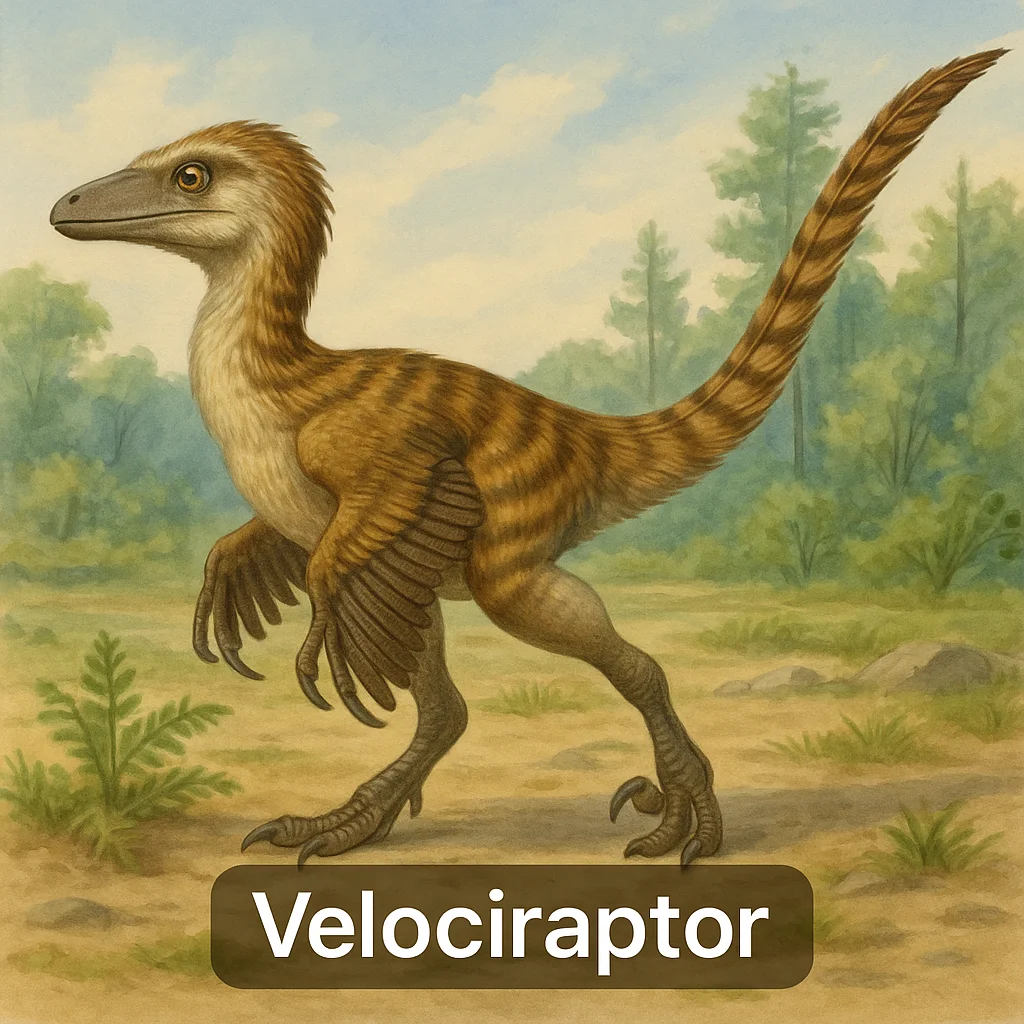
These dinosaurs were closely related to birds, and modern birds are considered the closest living relatives of dinosaurs, especially small theropods like the Velociraptor. This connection is evident through shared characteristics, such as hollow bones and, as evidence suggests, the presence of feathers.
Throughout this article, we will explore where Velociraptors lived, their daily lives, unique characteristics, and the factors that led to their extinction. This offers a broader understanding of their ecological role and the extinction processes that affected countless prehistoric species.
🧭 Where It Lived
Velociraptors roamed across what is now the Gobi Desert in Mongolia and parts of China. These regions provided the arid and semi-arid environments that Velociraptors were adapted to. Fossil evidence primarily from these areas helps pinpoint their geographic range and suggests that they were widely distributed within these territories.
The Velociraptor's habitat consisted of dry plains and sand dunes, offering a challenging environment to navigate. It's believed that these landscapes were a mix of open grounds and the occasional sparse vegetation, contributing to the Velociraptor's reputation as an agile and stealthy hunter.
Unlike many island species that face risks due to limited geographic range, the Velociraptor's mainland habitat did not make it particularly vulnerable to extinction by this factor alone. However, their specific environmental needs still played a role in their survival challenges as their climate and ecosystem changed over time.
🌿 Habitat and Daily Life
The Late Cretaceous period was warmer than today's climate, with less variation between temperatures at the poles and equator. The Velociraptor's habitat experienced seasonal variations, although its arid environment meant limited vegetation.
Velociraptors were carnivorous, likely preying on smaller reptiles, mammals, and possibly scavenging from carcasses left by larger predators. They possessed a sickle-shaped claw on each hind foot used for hunting and capturing prey. Fossil evidence suggests that they hunted in packs, which would have been a strategic advantage.
Reproduction involved laying eggs in nests, similar to modern birds. While not all specifics are understood, it's possible that like some birds, they may have cared for their young after hatching. The presence of feathers suggests they could have been used for display during mating rituals or for warmth.
🧬 What Made It Unique
The Velociraptor was relatively small, with an average length of around two meters and a height of half a meter at the hip. Its most distinctive physical traits included a long, tapered tail for balance, strong legs for running, and sharp talons for grasping prey.
One of its remarkable features was its probable covering of feathers, a feature solidified by fossil impressions showing evidence of quill knobs — points where feathers would attach to bones. These feathers likely had insulating and display functions, although they were not used for flight.
In terms of cultural significance, Velociraptors surged into the public consciousness through movies and literature, where they were often dramatized as intelligent pack hunters, although some artistic liberties were taken regarding their size and appearance.
⏳ When It Disappeared
The Velociraptor, along with many other dinosaur species, went extinct during the Cretaceous-Paleogene extinction event approximately 66 million years ago. This mass extinction is marked by a significant geologic boundary, distinguishing the end of the Mesozoic Era.
Although exact details can be elusive due to gaps in the fossil record, the disappearance of both land and marine species over this period is well established. This mass extinction wiped out nearly three-quarters of plant and animal species on Earth at the time.
In paleontology, a species is declared extinct if there have been no confirmed sightings or evidence of survival, typically over a lengthy period that allows for the possibility of re-emergence.
⚠️ Why It Went Extinct
The extinction of Velociraptors was part of a broader mass extinction event. The leading hypothesis involves a massive asteroid impact off the coast of present-day Mexico, creating the Chicxulub crater. This would have led to drastic climate shifts.
These shifts included dramatic cooling due to particulates blocking sunlight and subsequent warming. Such drastic changes would have disrupted food chains by affecting both flora and fauna.
It's possible that volcanic activity during the Deccan Traps period also contributed to their demise by further altering the climate and environment. This extinction event underscores the complexity and interconnectivity of extinction drivers.
🧩 How We Know (Evidence and Records)
Evidence for Velociraptors primarily comes from fossil records, which include bones, teeth, and more recently, feather imprints. Paleontologists use these remains to reconstruct appearance, behavior, and ecology.
Beyond fossil bones, field notes and interpretations help scientists understand these animals' roles within their ecosystems. Fossilized trackways sometimes provide insights into their movement and group behavior.
Identifying fossils requires precise examination to differentiate closely related species. This is often difficult because only fragmented remains are found and because of the natural wear and alterations of fossilized materials.
🛡️ Could It Have Been Saved
Theoretical discussion on conservation is more challenging with prehistoric species. Still, if humans had existed alongside dinosaurs and possessed current scientific knowledge, habitat preservation would have been paramount.
Preventive measures like establishing protected areas could have mitigated some environmental changes they faced. However, given the unprecedented global changes caused by the asteroid impact, human intervention might not have fully prevented their extinction.
In modern conservation, lessons from such mass extinction events guide efforts to protect species from both rapid and gradual ecological changes.
🔁 Are There Any Survivors or Close Relatives Today
Birds, specifically those classified within the clade Avialae, are the direct descendants of theropod dinosaurs, making them the closest relatives of species like the Velociraptor.
Birds share several features with the Velociraptor such as hollow bones and a similar hip structure, further solidifying their evolutionary connection.
Although no direct descendants of Velociraptors exist today, their ecological niche as agile predators is somewhat carried on by modern birds of prey, which share some behavioral and anatomical traits.
❓ Common Questions and Misconceptions
Was it hunted to extinction? No, Velociraptor's extinction was due to natural events at the end of the Cretaceous period.
Why didn’t it adapt or move? Drastic, rapid climate and environmental changes were likely too severe for adaptation or migration.
Could it still be alive somewhere? Given current geological and biological evidence, Velociraptors, like all dinosaurs except birds, are extinct.
What does 'declared extinct' actually mean? It means there have been no confirmed evidences or sightings of the species for a significant period.
What is the difference between endangered and extinct? Endangered species still have surviving members but are at risk of extinction.
Why are island species so vulnerable? Limited geographic range and resources can make them susceptible to environmental changes and other threats.
📌 Summary
- Velociraptor was a small, carnivorous dinosaur from the Late Cretaceous.
- They lived in what is now Mongolia and parts of China.
- Their habitat consisted of arid plains and sand dunes.
- Velociraptors were carnivorous, likely hunting in packs.
- Feathers and a sickle-shaped claw were among their unique adaptations.
- They disappeared around 66 million years ago.
- Main extinction drivers include asteroid impact and volcanic activity.
- Fossils, including bones and feather imprints, provide evidence of their existence.
- The closest living relatives are modern birds.
- Their story teaches the importance of understanding extinction factors.
- Velociraptors are a prime example of how species can be connected through evolutionary history.