🏞️ Spinosaurus
🌍 What It Was
Spinosaurus was a remarkable dinosaur known for its distinctive sail-like structure on its back. This giant predator roamed the Earth during the Cretaceous period, about 112 to 93 million years ago. Spinosaurus is classified as a theropod dinosaur, meaning it was bipedal and primarily carnivorous.
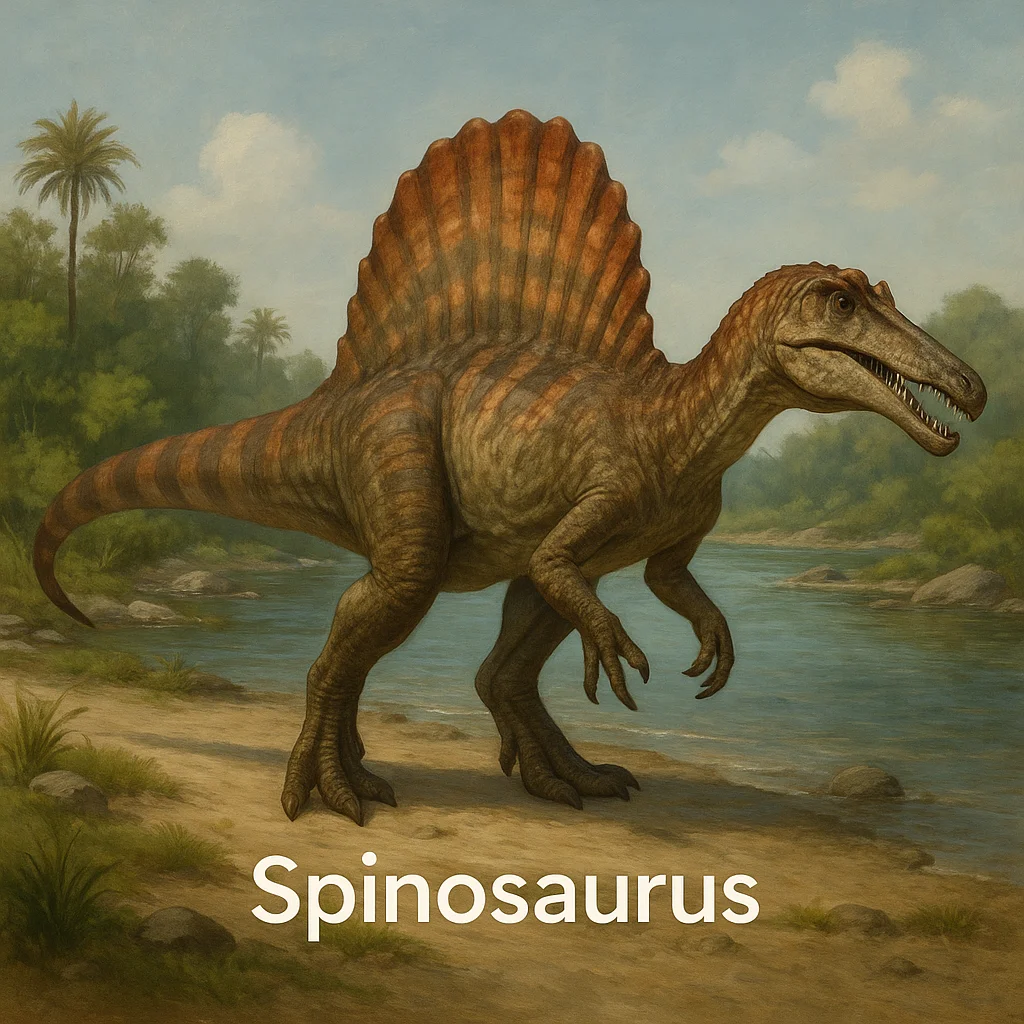
Unlike many of its dinosaur cousins, Spinosaurus was adapted to an aquatic lifestyle, making it a unique member of the dinosaur world. Its closest living relatives today are birds and crocodilians, which are distant cousins in the evolutionary tree. Spinosaurus played a vital role in its ecosystem as a top predator.
Through this article, you will explore where the Spinosaurus lived, its distinctive features, its decline, and the factors contributing to its extinction. Understanding these aspects provides insights into past ecosystems and the dynamics of extinction.
🧭 Where It Lived
The Spinosaurus inhabited what is now known as North Africa, with fossil evidence found in countries like Egypt and Morocco. This region of the world was drastically different during the time of Spinosaurus, featuring extensive river systems and lush, swampy environments.
These ancient wetlands were teeming with life, providing abundant resources for this large predator. The rivers and deltas offered rich fishing grounds, where Spinosaurus could hunt aquatic prey.
Being restricted to such specific wetland habitats might have made Spinosaurus vulnerable to environmental changes. Changes in climate or geographical shifts could have led to the loss of habitat, impacting its survival chances significantly.
🌿 Habitat and Daily Life
The climate during the time of Spinosaurus was likely warm and humid, conducive to the development of vast river networks. These rivers would experience seasonal changes, affecting the resources available to the Spinosaurus.
Spinosaurus primarily fed on fish, utilizing its elongated jaw and conical teeth adeptly for catching slippery prey. Its foraging style was perhaps akin to that of modern crocodiles, lying in wait near the water's edge.
Reproduction in Spinosaurus, like many other dinosaurs, likely involved laying eggs. Young Spinosaurus would hatch after a period of incubation, growing rapidly to survive in a predatory world. Interactions with other species would have included both competition and predation.
🧬 What Made It Unique
One of the most striking features of the Spinosaurus was its sail, believed to be used for thermoregulation or display to attract mates. The sail was formed by elongated vertebral spines covered with skin.
The Spinosaurus's body was adapted for both swimming and walking on land; it possessed features like webbed feet and a long, narrow snout for hydrodynamic efficiency. These adaptations allowed it to exploit a niche that few other theropods could.
The cultural impact of Spinosaurus, although reconstructed late in paleontological history, has intrigued scientists and the public alike, often highlighted in media and exhibitions, showcasing its distinctiveness among dinosaurs.
⏳ When It Disappeared
The exact timeline for Spinosaurus's extinction is uncertain, but it presumably disappeared around 93 million years ago, towards the end of the Cenomanian stage of the Late Cretaceous. Fossil evidence helps outline its existence but does not provide precise extinction details.
The absence of newer fossils indicates that the species no longer existed shortly after its known period. As with many extinct species, confirmation relies heavily on the fossil record, which is inherently incomplete and speculative.
The declaration of extinction for species like Spinosaurus is based on the absence of surviving individuals beyond a certain geological layer, supported by extensive paleontological surveys.
⚠️ Why It Went Extinct
Extinction drivers for the Spinosaurus remain largely speculative due to the prehistoric context. However, several plausible factors can be inferred. One significant factor likely involved habitat loss due to climate changes that altered the ecosystems in North Africa.
Fragmentation of waterways could have limited access to its primary food sources, impacting its ability to hunt efficiently. Predators often rely on abundant prey, and the scarcity could have led to malnutrition or reduced reproductive success.
Other potential factors include competition with other large predators and possibly extreme climatic events that could have caused drastic shifts in available habitats, ultimately contributing to its demise.
🧩 How We Know (Evidence and Records)
The knowledge about Spinosaurus comes from fragmentary fossil discoveries, primarily in Saharan Africa. These include bones and teeth that inform us about its size and diet.
Fossil sites undergo extensive dating processes using geological and radiometric methods to determine the age of the fossils found. This establishes a timeline for the existence of Spinosaurus.
Challenges in confirming Spinosaurus's life history include its remote and harsh fossil sites, which limit access and preservation, making it difficult for researchers to piece together a complete picture of its biology and ecology.
🛡️ Could It Have Been Saved
Hypothetically, conservation actions such as habitat protection and ensuring the abundance of food sources might have helped Spinosaurus populations to recover or sustain themselves longer.
During its era, direct human influence was absent, but even natural conservation strategies would require addressing the species' vulnerability due to ecological changes. Most extinction dynamics in such cases remain hypothetical for past species.
The realization of Spinosaurus's extinction only occurred through paleontological reconstructions much later, highlighting how action often comes too late when evidence of existence is limited to historical eras.
🔁 Are There Any Survivors or Close Relatives Today
The closest living relatives of Spinosaurus are birds, sharing a distant lineage from the theropod branch of the dinosaur family tree. Crocodiles, although not direct relatives, share some ecological similarities.
Ecological replacements do not directly exist for Spinosaurus, as its niche was unique. However, large modern reptiles like crocodiles occupy somewhat similar aquatic predatory roles in today's ecosytems.
There are no known reintroduction programs for species like Spinosaurus, given its status as a prehistoric creature and the absence of living specimens to work from in contemporary conservation biology.
❓ Common Questions and Misconceptions
Was it hunted to extinction? No, human activities did not influence Spinosaurus extinction as it lived millions of years before humans.
Why didn’t it adapt or move? Ecological shifts likely happened rapidly or reduced available habitats entirely, leaving little room for adaptation or migration.
Could it still be alive somewhere? This is very unlikely, as extensive fossil surveys indicate it disappeared millions of years ago.
What does 'declared extinct' actually mean? It means there's no reasonable doubt remaining that the species is gone, based on available scientific evidence.
What is the difference between endangered and extinct? Endangered species are at risk of extinction, whereas extinct species have no known surviving members.
Why are island species so vulnerable? They are often isolated, with small populations and limited resources, making them highly susceptible to changes.
📌 Summary
- Spinosaurus was a large, sail-backed theropod dinosaur.
- It lived primarily in North Africa during the Cretaceous period.
- Its habitat comprised vast river systems and wetlands.
- Aquatic, hunting mainly fish using specialized jaws and teeth.
- Unique for its adaptations to both water and land environments.
- Disappeared around 93 million years ago.
- Main extinction drivers likely include habitat changes and resource scarcity.
- Our knowledge is based on fossils and geological evidence.
- Closest living relatives are birds and possibly shared ecological traits with crocodiles.
- A lesson in adaptability and vulnerability to habitat changes.
- Spinosaurus's distinctive sail and aquatic lifestyle make it a notable dinosaur.