🏞️ Diplodocus
🌍 What It Was
Diplodocus was a genus of long-necked, herbivorous dinosaurs that lived during the late Jurassic period. Known for its impressive size and elongated neck and tail, Diplodocus is one of the most recognizable dinosaurs. It belonged to a group known as sauropods, which are characterized by their large size, pillar-like legs, and long necks and tails.
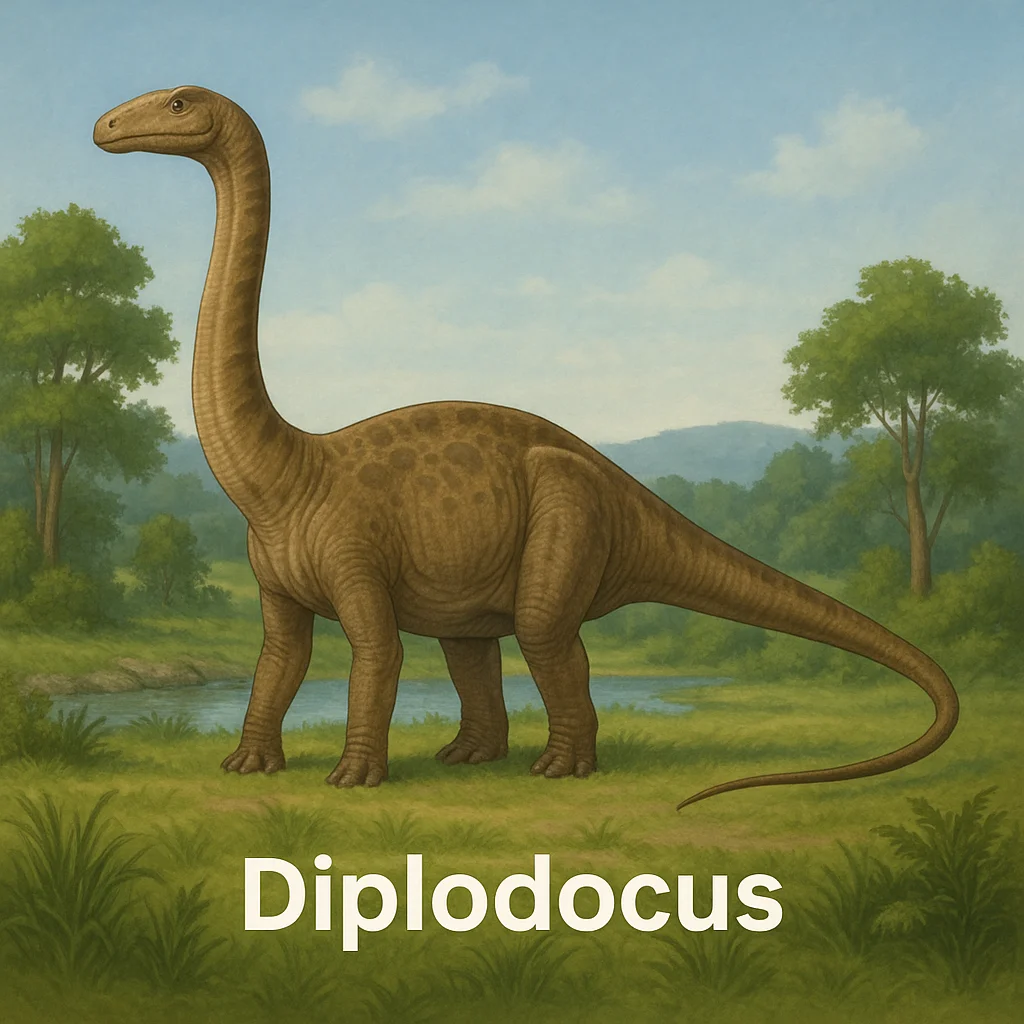
Despite its massive size, Diplodocus was likely a gentle giant. Its closest living relatives are birds, which share a distant ancestry with all dinosaurs. Within its ecosystem, Diplodocus would have played the role of a giant browser, consuming vast amounts of plant material to sustain its energy needs.
In this article, we will explore where Diplodocus lived, how it thrived in its environment, when it disappeared, and the reasons behind its extinction. Our journey into the past will shed light on this fascinating creature and the world it inhabited.
🧭 Where It Lived
Diplodocus roamed what is now known as North America. Fossil evidence, especially from the Morrison Formation, indicates that these dinosaurs primarily inhabited the western part of the continent. The area provided a vast expanse that offered the diverse plant life these giants required.
During the late Jurassic period, the climate was warmer than today, and there were no polar ice caps. Diplodocus thrived in environments that included vast floodplains and fern prairies. Such ecosystems were ideal for supporting large populations of herbivores due to their abundant vegetation.
The geographic range of Diplodocus was extensive but primarily localized to certain regions conducive to its survival. These environments allowed them to exist with minimal travel, as food was plentiful where they roamed.
🌿 Habitat and Daily Life
The environment Diplodocus lived in was marked by a warm climate with seasonal variations in rainfall. These conditions supported dense plant life, which was essential for the diet of such a large animal. Diplodocus primarily fed on low-lying vegetation but could potentially reach higher plant material thanks to its long neck.
This dinosaur likely spent a significant amount of its day foraging, using its peg-like teeth to strip foliage from branches. Diplodocus might have traveled in herds, offering protection against predators like the fearsome Allosaurus. Herding also facilitated social interaction among these gentle giants.
Reproduction for Diplodocus involved laying eggs, likely in nests on the ground. Once hatched, young Diplodocus would grow rapidly, decreasing their vulnerability to predators as they increased in size. Their life cycle aimed for maturity at a faster rate than many smaller contemporaries.
🧬 What Made It Unique
Diplodocus stood out due to its remarkable size, with estimates suggesting lengths of up to 80 feet (roughly 24 meters). Its elongated neck and tail served as significant adaptations, potentially for foraging high and low vegetation, and for defense against predators and rivals.
Its tiny head housed a mouth equipped with tooth adaptations suited for a herbivorous diet. Researchers believe it had a relatively lightweight body structure for its size, with hollowed bones that reduced its weight and allowed for better mobility.
Culturally, Diplodocus has captured human imaginations, appearing in many forms of media and museum exhibits. Its fame highlights the public fascination with the idea of such an imposing, yet gentle, creature existing millions of years ago.
⏳ When It Disappeared
Diplodocus lived during the late Jurassic period, around 150 million years ago, alongside other iconic dinosaurs. Fossil records are the primary source of insight into its existence, revealing a timeline that spans millions of years before it vanished.
The extinction of Diplodocus, like many dinosaurs, occurred before the Cretaceous-Paleogene extinction event. Evidence points to their disappearance well before the mass extinction that wiped out many dinosaur species around 66 million years ago.
While records are concrete when it comes to the existence of Diplodocus through fossilized skeletons, the exact reasons for its gradual disappearance remain an area of scientific research and debate.
⚠️ Why It Went Extinct
The extinction of Diplodocus was likely caused by a combination of environmental changes and natural evolutionary processes. Shifts in climate would have affected plant life, reducing food availability. This kind of habitat loss or fragmentation can have severe effects on large herbivores.
Competition with other herbivorous dinosaurs for food resources also might have contributed. Over time, natural evolutionary pressures favored species better adapted to changing conditions, possibly leading to Diplodocus being outcompeted.
The eventual disappearance of Diplodocus mirrors what many extinct species faced: a multi-causal integration of environmental change, competition, and possibly volcanic or other geological activities that altered their landscape irreversibly.
🧩 How We Know (Evidence and Records)
Our understanding of Diplodocus comes from a blend of fossil discoveries, museum curation, and scientific analysis. Fossils, such as bones and vertebrae, provide detailed insights into the anatomy and size of these creatures.
Paleontologists meticulously document and verify fossils to ensure accurate species identification and dating. These records are supported by stratigraphic analysis and radiometric dating, securing their place in the Jurassic period.
The study of sauropods like Diplodocus requires careful interpretation as the fossil record can be incomplete. Combining various evidence forms helps build the most accurate picture of the life and times of Diplodocus.
🛡️ Could It Have Been Saved
Imagining conservation in the context of Diplodocus might include preserving its extensive habitat and managing vegetation to sustain such a large herbivore. However, given the natural changes over millions of years, this remains speculative and retrospective.
No direct conservation attempts were possible due to the time frame, but studying its extinction can guide current conservation efforts for large species today. Protecting habitats and ensuring ecological balance are key lessons drawn from such ancient extinctions.
Diplodocus’s fate underscores the importance of proactive environmental management to preserve biodiversity in the modern world, learning from past extinctions to shape our approach to preservation today.
🔁 Are There Any Survivors or Close Relatives Today
Birds are considered the closest living relatives of dinosaurs, including sauropods like Diplodocus. While vastly different in form and size, birds share a common ancestry with these ancient creatures.
There are no direct descendants or ecological replacements for Diplodocus today, as their specific ecological niche was unique. However, large herbivores such as elephants play somewhat similar roles in terms of ecosystem impact, albeit in different environments.
The connection between ancient dinosaurs and modern birds serves as a reminder of life's adaptability and continuity, illustrating evolution's long and complex pathways over millions of years.
❓ Common Questions and Misconceptions
Was it hunted to extinction? No evidence suggests humans or other species hunted Diplodocus to extinction.
Why didn’t it adapt or move? Diplodocus lived in a rapidly changing environment where adaptation may have been outpaced by ecological shifts.
Could it still be alive somewhere? Given the age of the fossils, it is highly unlikely that Diplodocus or any descendants survive today.
What does "declared extinct" actually mean? It means there is widespread, scientific consensus that a species no longer exists on Earth.
What is the difference between endangered and extinct? Endangered species still exist but are at high risk of extinction, while extinct species no longer exist.
Why are island species so vulnerable? Island species often have limited ranges and resource pools, making them highly susceptible to changes.
📌 Summary
- Diplodocus was a giant herbivorous dinosaur from the late Jurassic period.
- It lived in North America, particularly in what is now the United States.
- Its habitat included floodplains and fern prairies with abundant vegetation.
- Feeding mainly on low-lying plants, Diplodocus was an essential browser.
- Remarkably long neck and tail set it apart physically.
- Its last known period was around 150 million years ago.
- Main extinction drivers include habitat loss and natural competition.
- Evidence comes from fossil records meticulously analyzed by paleontologists.
- Closest living relatives are modern birds, showcasing evolutionary links.
- A critical lesson is the impact of ecological changes over time.
- The sheer size and iconic status of Diplodocus make it a memorable symbol of prehistoric life.