🏞️ Overhunting(How Fast Extinction Can Happen)
🌍 What It Was
The Dodo bird, known scientifically as Raphus cucullatus, was a flightless bird native to Mauritius. It stood about a meter tall and was characterized by its large, hooked beak, stout legs, and plump body. The Dodo was especially distinctive due to its inability to fly, an adaptation that came about due to the absence of predators on its island home.
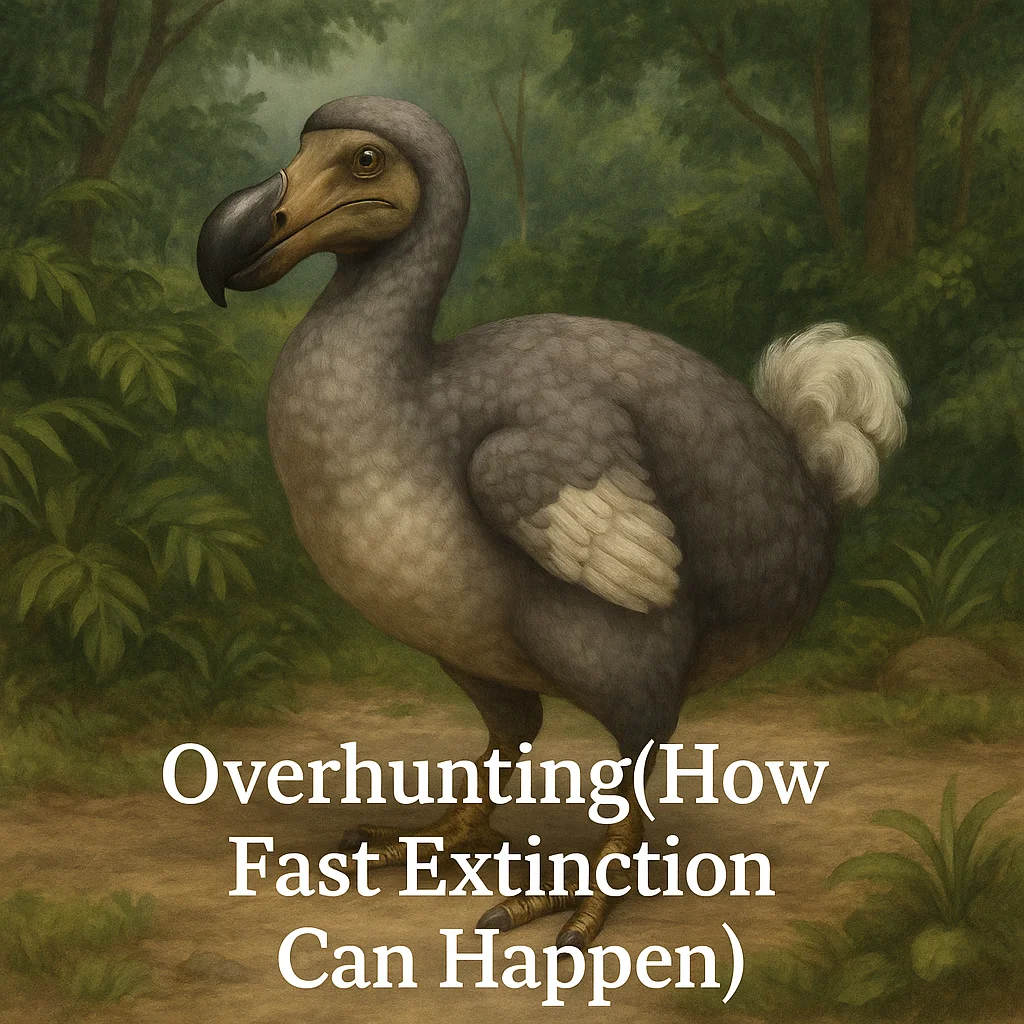
The Dodo's closest living relatives are pigeons and doves. Despite its comical appearance in cultural depictions, the Dodo played a crucial role in its ecosystem, likely aiding in seed dispersal on Mauritius. In this article, we will explore where the Dodo lived, how it thrived, when it vanished, and the reasons leading to its extinction.
This narrative aims to provide insights into the life of the Dodo, the unique environment it inhabited, and the subsequent demise that serves as a classic example of the impact of overhunting and introduced threats.
🧭 Where It Lived
The Dodo was endemic to the island of Mauritius, located in the Indian Ocean. As an island species, the Dodo was restricted geographically, which inevitably increased its vulnerability. Endemic species, those found only in a specific place, are particularly at risk when their habitats face sudden changes or disturbances.
Mauritius, during the time of the Dodo, was covered with lush forests that provided ample food resources and nesting grounds. The island’s forested areas, filled with a variety of fruit-bearing trees, were crucial for the Dodo’s survival. The presence of these dense forests meant that the Dodo rarely needed to venture far from its nesting sites to find food.
The island's isolation had protected the Dodo from predators for centuries. However, this seclusion also presented a double-edged sword. When humans arrived, along with various introduced animals, the Dodo's lack of defense mechanisms against these new threats became a fatal flaw.
🌿 Habitat and Daily Life
Mauritius enjoys a tropical climate, characterized by warm temperatures and seasonal rains. This climate supported the dense, green environments that the Dodo relied upon. The island’s seasonal changes likely regulated their breeding and foraging habits.
The Dodo foraged primarily on fruits, seeds, and possibly small land vertebrates or marine life washed ashore. Their foraging behavior was likely facilitated by their strong, hooked beaks, which could crack hard shells and seeds. The absence of flight meant that the Dodo lived primarily on the forest floor.
The breeding behavior of the Dodo was likely similar to that of its closest relatives, the pigeons, which tend to have a long nesting period and produce small numbers of offspring. This slow reproductive rate made the species particularly susceptible to rapid population declines.
🧬 What Made It Unique
The Dodo bird had several unique features; its large, hooked beak was a notable adaptation for its diet, allowing it to manipulate a variety of fruits and seeds with ease. Its sturdy legs allowed it to move effectively through underbrush and forested terrain despite its bulky frame.
Ecologically, the Dodo may have played a role in seed dispersal, helping to maintain the health and diversity of Mauritius's forests. By consuming fruits and passing the seeds through their digestive systems, they potentially aided in ecosystem sustainability.
Historically, the Dodo gained notoriety through sailors’ tales during the Age of Exploration. Seen as a curiosity due to its ungainly appearance and inability to fly, the Dodo became a symbol in literature and art as an emblem of human-induced extinction.
⏳ When It Disappeared
Records indicate that the last confirmed sightings of the Dodo occurred in the late 1600s. The most accepted view is that the Dodo was declared extinct by the end of the 17th century, with the last reliable accounts dating to the 1660s.
The exact timeline of the Dodo’s extinction remains somewhat uncertain due to inconsistent record-keeping at the time. Remote and limited in range, the island habitat of the Dodo meant that discoveries or rediscoveries would have been challenging, compounding the uncertainty around exact disappearance dates.
The distinction between "Extinct in the Wild" and "Extinct" is a key concept to understand, with the Dodo being classified as Extinct, indicating that no truly wild populations have existed since those last sightings.
⚠️ Why It Went Extinct
The extinction of the Dodo was driven by several factors, primarily human activity. Habitat loss occurred as forests were cleared for agriculture and settlements, displacing the Dodo from their natural habitat.
Overhunting by sailors and settlers also contributed significantly to the Dodo’s demise. The flightless birds were easy targets, and their meat reportedly not particularly palatable, suggesting overhunting was more sport and opportunism than necessity.
Introduced species, such as rats, cats, and pigs, posed severe threats by preying on Dodo eggs and young, thus drastically reducing their reproductive success. Disease brought by these invasive species and humans may have also played a role, although records are less clear on this point.
🧩 How We Know (Evidence and Records)
Our understanding of the Dodo comes from a variety of evidence sources, including skeletal remains, museum specimens, and historical accounts from early travelers and settlers. These remains have provided critical information about the Dodo’s physical attributes and adaptations.
Scientists verify the identity and dates of extinction through methods like radiocarbon dating of remains and analysis of contemporary field notes and artworks that describe the Dodo. These records help establish a timeline of existence and disappearance.
The challenges in confirming the existence of the Dodo were compounded by its rarity and eventual isolation on Mauritius. Such difficulties highlight the complexity of studying extinct island species where habitat and range are both limited and remote.
🛡️ Could It Have Been Saved
There are realistic conservation actions that might have helped prevent the Dodo’s extinction. Protected habitat areas could have provided safe zones for the Dodo to nest and forage without threat from human expansion and invasive species.
Hunting restrictions could have decreased the direct human impact on their populations, allowing natural reproduction to sustain their numbers. Controlling invasive species early on might have reduced pressures on Dodo eggs and chicks.
Unfortunately, conservation actions were scant or nonexistent during the Dodo's time, as awareness and understanding of ecological balance and species impact were minimal or ignored. Today, these lessons underscore the importance of early intervention in species conservation.
🔁 Are There Any Survivors or Close Relatives Today
The Dodo's closest living relatives are pigeons and doves, part of the same avian family, Columbidae. These birds share with the Dodo traits such as a herbivorous diet and ground foraging behavior.
Although no reintroduction or captive programs exist, efforts to understand the Dodo better inform conservation strategies for other endangered island species. Pigeons and doves have successfully adapted to various environments, offering hope that conservation efforts can benefit similarly vulnerable species.
Understanding these living relatives helps us appreciate the Dodo's place in avian evolution and highlights the important roles its family members continue to play in modern ecosystems.
❓ Common Questions and Misconceptions
Was it hunted to extinction? While hunting contributed significantly, it was a combination of factors, including habitat loss and invasive species.
Why didn’t it adapt or move? The Dodo evolved without predators, and rapid changes didn’t allow time for adaptation or relocation.
Could it still be alive somewhere? It is unlikely. Surveys and explorations have found no evidence of living Dodos.
What does “declared extinct” actually mean? It means sufficient evidence suggests there are no surviving individuals of a species.
What is the difference between endangered and extinct? Endangered species are at risk of extinction, while extinct species have no surviving individuals.
Why are island species so vulnerable? They often evolve without significant threats, making them vulnerable to sudden changes like introduced predators or habitat loss.
📌 Summary
- The Dodo was a flightless bird endemic to Mauritius.
- It lived primarily in the forested regions of the island.
- The Dodo's habitat was lush and tropical.
- Its diet consisted of fruits and seeds.
- The Dodo had a distinctive hooked beak and stout legs.
- Last living periods were in the mid to late 1600s.
- Extinction drivers included overhunting and invasive species.
- Evidence includes skeletal remains and historical records.
- Closest relatives are pigeons and doves.
- Conservation lessons highlight early intervention needs.
- The Dodo is an iconic example of human impact on biodiversity.