🏞️ How Demand Shapes Extinction Risk
🌍 What It Was
The Moa was a group of flightless birds native to New Zealand, known for their impressive size. Some species could reach up to 12 feet in height, making them one of the tallest birds ever. Unlike other large birds, Moas did not have wings; their closest living relatives today are birds like the ostrich and emu.
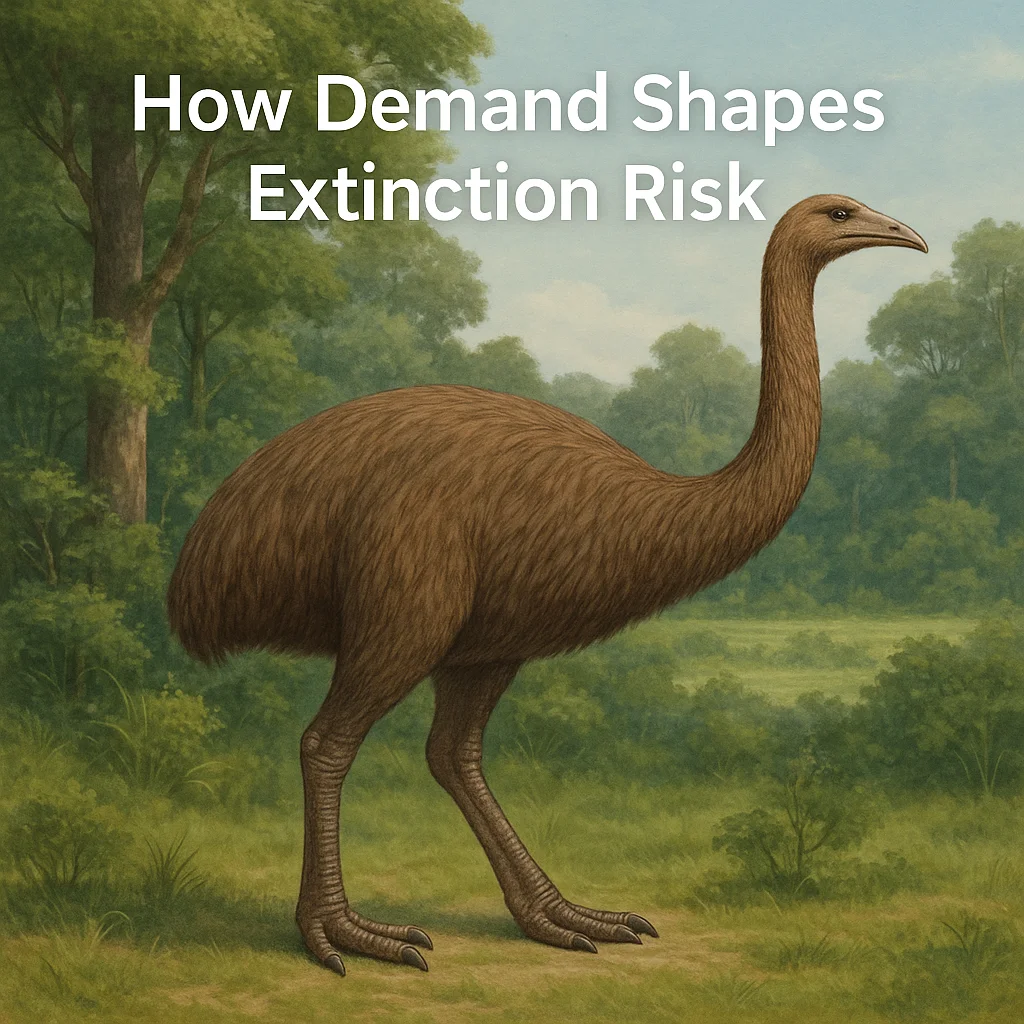
Moa species were integral parts of their ecosystems, acting as dominant herbivores in the forested regions of New Zealand where they lived. These birds helped maintain plant biodiversity by feeding on a variety of vegetation.
This article explores the Moa’s habitat, lifestyle, its eventual decline, and the larger lessons we can draw about extinction risks tied to human demand and ecosystem change.
🧭 Where It Lived
The Moa inhabited the islands of New Zealand, which provided a unique environment isolated from other landmasses. These islands included both North Island and South Island, which supported differing species due to their varied environmental conditions.
Moas relied on New Zealand's diverse habitats ranging from dense forests to subalpine grasslands. Their wide distribution across these habitats made them critical to the island's ecological balance.
This island confinement increased the Moas' risk of extinction for several reasons. Isolation limited their ability to escape threats, such as natural disasters and introduced predators, by relocating to other regions.
🌿 Habitat and Daily Life
New Zealand's climate during the Moas' existence featured mild temperatures and ample rainfall, supporting lush, diverse forests and grasslands. These environments offered plentiful food resources, crucial for their survival.
Moas were primarily herbivorous, feeding on leaves, stems, and fruits. They used their beaks to strip vegetation, impacting plant growth and facilitating nutrient cycling in their ecosystem. Their feeding habits were beneficial to forest regeneration.
The breeding habits of Moas included laying eggs in ground nests, where they faced predation risks from native species and later, invasive species. Parental care was likely provided to ensure the survival of offspring, although detailed behaviors remain speculative.
🧬 What Made It Unique
Moas were characterized by their impressive height and lack of wings, adaptations that allowed them to forage on tall vegetation. Their strong legs supported their large bodies and facilitated movement through dense forests.
They played a unique role as herbivores on the islands, affecting seed dispersal and forest dynamics. Their extinction left a significant ecological gap, influencing plant and animal interactions.
While Moas were not of great cultural significance in prehistoric times, they later became a focus for Maori hunting. They also sparked European interest, leading to paleontological studies that defined much of New Zealand's natural history understanding.
⏳ When It Disappeared
The exact timeline of the Moas' extinction is debated, but evidence suggests they disappeared around the late 1300s to early 1400s. Last reliable sightings and archaeological records indicate human hunting as a factor around this time.
Declaring extinction involved analyzing subfossil remains discovered in marshlands and caves, indicating that Moas persisted longer in some areas than others. The remoteness of some habitats led to speculation on continued existence, but no confirmed evidence has been found.
Because Moas are extinct, not "Extinct in the Wild," no known individuals exist anywhere, unlike species that survive in captivity.
⚠️ Why It Went Extinct
The Moas faced multiple extinction drivers, with habitat loss and fragmentation playing significant roles. Human settlement led to deforestation and land conversion, reducing available habitats.
Overhunting became a substantial pressure once humans arrived in New Zealand. The demand for meat and resources likely led to their rapid population decline.
Introduced predators like dogs and rats further increased the Moas' vulnerability by preying on eggs and young chicks, decreasing survival rates.
Together, these factors created an unsustainable situation where the Moa could no longer reproduce quickly enough to maintain viable populations.
🧩 How We Know (Evidence and Records)
Our understanding of Moas largely comes from subfossil remains, such as bones found in sand dunes, caves, and swamp environments. These remains offer crucial insights into their physiology and extinction.
Museum specimens have been essential for scientific study, enabling DNA analysis and comparisons with other ratites like ostriches and emus. Field notes from early explorers and fossils alongside Maori oral histories provide a record of their historical presence.
These collective evidences allow scientists to confirm species identity and establish timelines, though gaps exist due to the Moas' secretive lifestyle and the challenges of prehistoric recordkeeping.
🛡️ Could It Have Been Saved
Several conservation efforts might have altered the Moas' fate, such as establishing protected habitats and enforcing hunting restrictions. These measures could have stabilized populations by reducing direct and indirect human impacts.
Controlling invasive species might have also played a critical role, as reducing predation pressure and competition could have allowed Moas some recovery chances. However, these efforts were largely absent at the critical time.
Late conservation attempts in the present focus more on restoring ecosystems and preventing similar extinctions rather than reviving the Moa, underscoring the importance of timely actions.
🔁 Are There Any Survivors or Close Relatives Today
The closest living relatives of the Moa are the ratites, including ostriches, emus, and kiwis. These birds share some features such as their flightlessness and large size but differ significantly in habitat and behavior.
While no species perform the exact ecological roles that Moas did, other herbivores on New Zealand islands now help fill parts of the ecological niche Moas once occupied.
There are currently no reintroduction programs focused on Moas, as their extinction gap period was too lengthy for revival, unlike cases where immediate conservation can facilitate species recovery.
❓ Common Questions and Misconceptions
Was it hunted to extinction? Yes, hunting played a significant role, but it combined with habitat loss and other factors.
Why didn’t it adapt or move? Moas were adapted to their specific environment and lacked the ability to migrate off isolated islands.
Could it still be alive somewhere? Given the extensive search and evidence collection, it's unlikely any Moas remain alive.
What does 'declared extinct' actually mean? It means no individuals are known to exist in the wild or captivity after thorough investigation.
What is the difference between endangered and extinct? Endangered species have few remaining individuals, while extinct species have none surviving.
Why are island species so vulnerable? Island species often have limited ranges and specialized adaptations, making them susceptible to changes.
📌 Summary
- What it was: The Moa was a large, flightless bird from New Zealand.
- Where it lived: It inhabited the North and South Islands of New Zealand.
- Habitat type: Ranges from dense forests to subalpine grasslands.
- Diet/behavior: Herbivorous, impacted plant diversity and growth.
- Unique adaptations: Lacked wings, strong legs for foraging.
- Last known period alive: Late 1300s to early 1400s.
- Main extinction drivers: Overhunting and habitat destruction.
- How we know (evidence): Subfossil remains and DNA analysis.
- Closest living relatives: Ostriches, emus, kiwis.
- Key lesson for conservation: Importance of timely protective actions.
- Memorable takeaway: The Moa's extinction highlights how human demand influences biodiversity loss.