🏞️ Thylacine (Tasmanian Tiger)
🌍 What It Was
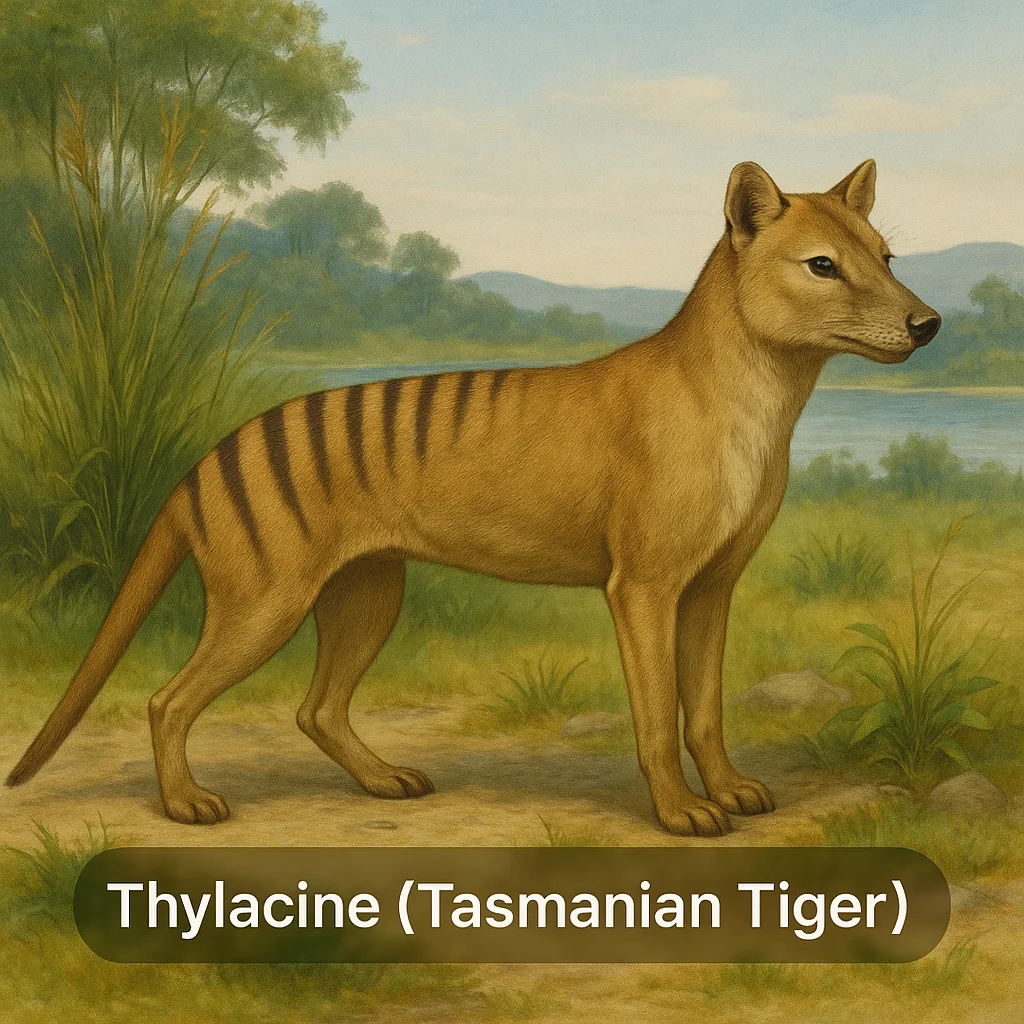
The Thylacine, commonly known as the Tasmanian Tiger, was a carnivorous marsupial that once roamed the forests of Tasmania, as well as parts of mainland Australia and New Guinea. It was distinctive for its dog-like appearance, notable stripes across its back, and a pouch similar to that of kangaroos, which males also possessed.
Its closest living relatives are the Tasmanian Devil and quolls, which also belong to the marsupial family. The Thylacine occupied a unique niche in its ecosystem as a top predator, controlling populations of smaller animals and maintaining a balanced environment.
This article will guide you through the history of the Thylacine, where it lived, its daily life, and the reasons behind its extinction. The aim is to provide a comprehensive look at the life and disappearance of this fascinating species.
🧭 Where It Lived
The Thylacine was initially widespread across the Australian mainland, Tasmania, and New Guinea. However, by the time European settlers arrived, its populations were primarily limited to Tasmania. Its disappearance from mainland Australia likely occurred thousands of years ago, largely due to the introduction of the dingo, a wild dog species.
In Tasmania, the Thylacine thrived in a variety of habitats, including dense forests, shrublands, and open grasslands. These areas provided ample cover and hunting grounds, essential for its survival as a nocturnal predator.
Island habitats like Tasmania are particularly susceptible to population declines and extinctions. The limited geographic range increases the vulnerability of species to external threats, such as overhunting and habitat destruction. The isolation makes it more difficult for species to recover from declines, which contributed significantly to the Thylacine's extinction.
🌿 Habitat and Daily Life
The climate in Tasmania varies, with cooler temperatures and more rainfall than mainland Australia. Such conditions supported lush vegetation and a rich variety of prey species for the Thylacine, such as wallabies and small mammals. The Thylacine was predominantly a solitary animal, hunting alone and relying on stealth and surprise to catch its prey.
Thylacines hunted mostly at night, using their acute senses to locate and capture food. As experienced hunters, they showed a preference for ambush tactics rather than chasing. Their exact diet is still debated, but it likely included birds, lizards, and other available small animals.
Reproduction involved a brief breeding season, during which a female would give birth to several young, which she would carry in her pouch. The burden of caring for the offspring fell entirely on the mother, who nurtured them until they could survive independently.
🧬 What Made It Unique
The Thylacine displayed several unique physical attributes. It had a slender, dog-like body covered in distinctive dark stripes, which served as camouflage in its forested habitats. Males and females both had pouches, which is unusual among marsupials.
Its jaw could open extraordinarily wide, an adaptation believed to help subdue struggling prey. While debate exists about its vocalizations and sounds, records suggest it may have used growls and hisses to communicate, primarily during hunting and defense.
Culturally, the Thylacine was significant to the Aboriginal people of Tasmania, who depicted it in rock art. These relationships reflect an ancient understanding and coexistence with this unique marsupial predator.
⏳ When It Disappeared
The last known Thylacine in Tasmania died in captivity at the Hobart Zoo on September 7, 1936. The exact date of extinction in the wild is less clear, as sightings were often sporadic and poorly documented. The lack of confirmed evidence eventually led scientists to declare the species extinct in 1982.
Determining the exact timeline of extinction is complicated by the remote and dense habitats the Thylacine occupied, which made sightings rare. Misidentification was also a common issue, with various animals sometimes mistaken for the Thylacine in less visible areas.
Status classifications differentiate between "Extinct in the Wild"—a term suggesting no known individuals survive outside captivity—and "Extinct," meaning no individuals are known to exist at all. The Thylacine falls into the latter category.
⚠️ Why It Went Extinct
Several factors contributed to the Thylacine's extinction. Firstly, habitat loss played a significant role, as forests and grasslands were cleared for agricultural expansion, reducing available living and hunting spaces. This habitat fragmentation made it harder for the few remaining Thylacines to find food and mates.
Overhunting by European settlers further exacerbated their decline. A bounty system introduced by the Tasmanian government led to indiscriminate killing, motivated by the belief that Thylacines threatened livestock. This unregulated harvesting severely reduced their numbers.
Introduced species, such as dogs, competed with the Thylacines for food and sometimes preyed upon their young. Furthermore, diseases introduced by non-native animals may have weakened their populations, though evidence of specific illnesses remains inconclusive.
Climate shifts and extreme weather events also contributed by impacting the availability of prey animals. The cumulative effects of these factors created insurmountable pressures, ultimately leading to their extinction.
🧩 How We Know (Evidence and Records)
Knowledge about the Thylacine comes from various sources, including museum specimens, historical photographs, and written records from early European settlers. Skeletal remains and subfossils have provided additional clarity on their physical characteristics and behavior.
Naturalists and scientists have verified the identity and dating of these remains through careful examination and comparison with other marsupials. Advancements in genetic techniques have allowed some degree of analysis, although no viable DNA has yet been obtained for cloning or de-extinction efforts.
The elusive nature and wide-ranging habitats of the Thylacine made consistent documentation challenging. Oral histories from Indigenous Tasmanians offer additional context, though they seldom provide scientifically verifiable information.
🛡️ Could It Have Been Saved
Realistic conservation actions such as protected reserves and restricted hunting laws might have helped preserve the Thylacine population. Awareness of its ecological role and cultural significance could have prompted more conservation support and public interest.
Unfortunately, conservation efforts were minimal and often too late. The belief that they were a threat to livestock overshadowed potential protective measures. Additionally, efforts to breed and maintain a viable captive population were unsuccessful, partly due to limited understanding at the time.
In hindsight, timely action across governmental and societal platforms might have made a difference and provided the Thylacine a fighting chance to survive.
🔁 Are There Any Survivors or Close Relatives Today
The Thylacine's closest living relatives are other carnivorous marsupials, such as the Tasmanian Devil and quolls. These animals share several features, including nocturnal habits and carnivorous diets, but none fill the exact niche left by the Thylacine.
Ecologically, no species has replaced the Thylacine as a top predator. Its absence has arguably affected the dynamics of prey populations, although the specific ecological impacts remain debated.
There have been no confirmed reintroduction programs due to the Thylacine's extinction, but initiatives focused on preserving related species highlight the importance of conserving Australia's unique biodiversity.
❓ Common Questions and Misconceptions
Was it hunted to extinction? Hunting significantly contributed, particularly through bounty systems. However, lack of habitat and competition also played roles.
Why didn’t it adapt or move? The Thylacine faced rapid and multiple pressures that likely outpaced its ability to adapt or relocate effectively.
Could it still be alive somewhere? Despite occasional unverified sightings, no scientific evidence supports the existence of surviving Thylacines today.
What does 'declared extinct' actually mean? It means no individuals have been confirmed to exist through scientific evidence for a significant period.
What is the difference between endangered and extinct? Endangered species are at high risk of extinction but still have surviving individuals, unlike extinct species.
Why are island species so vulnerable? Islands have limited resources and isolation, making their species more susceptible to changes and threats.
📌 Summary
- The Thylacine was a carnivorous marsupial known as the Tasmanian Tiger.
- It lived in Tasmania, mainland Australia, and New Guinea.
- The Thylacine occupied forests, shrublands, and grasslands.
- It had a solitary night-time hunting lifestyle.
- Distinctive physical adaptations included stripes and wide jaw opening.
- Last known alive in 1936, officially extinct by 1982.
- Extinction drivers included habitat loss, overhunting, and introduced species.
- Evidence comprises museum specimens, records, and subfossils.
- Closest relatives are the Tasmanian Devil and quolls.
- Conservation underscores the importance of timely intervention.
- The Thylacine's tale is a somber reminder of human impact on biodiversity.