🏞️ Steller’s Sea Cow
🌍 What It Was
Steller's Sea Cow was a large marine mammal belonging to the order Sirenia. It was related to the living dugongs and manatees. These animals were as bulky as they were unique, with a docile nature and no known natural predators in their habitat. Their presence within the marine ecosystem was crucial, primarily as they fed on large amounts of algae and kelp.
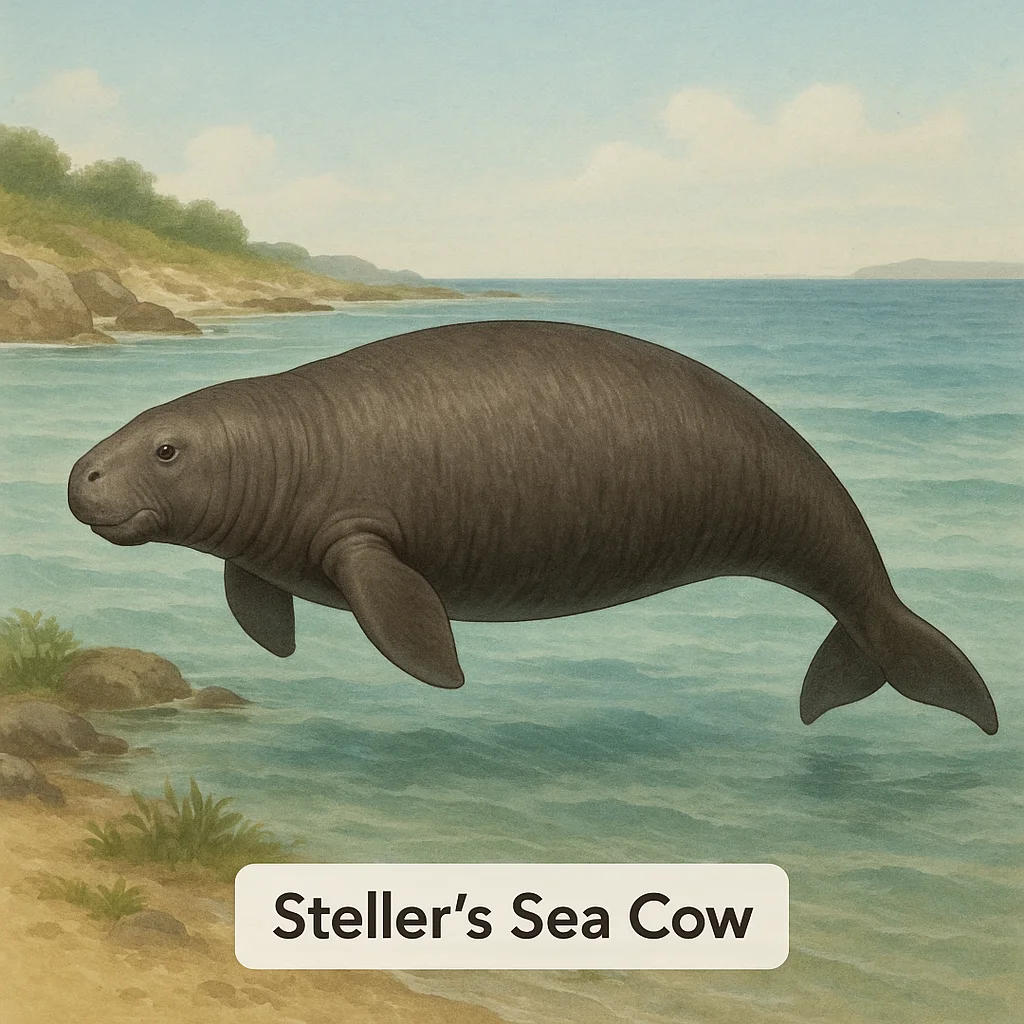
Being distant relatives of today's dugongs and manatees, Steller's Sea Cows were much larger and inhabited the colder regions of the North Pacific Ocean. Their role in the ecosystem was vital, as they kept the growth of sea vegetation in check, which also affected other marine life and habitats.
This article will guide you through a journey to understand where Steller's Sea Cow lived, how they survived in the wild, the reasons behind their extinction, and what, if anything, remains of their legacy today.
🧭 Where It Lived
Steller’s Sea Cow was primarily found around the Commander Islands in the Bering Sea, particularly near Bering Island, located between Russia and Alaska. This small and specific geographic range made them vulnerable to external changes and threats.
Their habitat consisted mainly of shallow coastal waters, where they grazed on abundant kelp beds. These areas were characterized by cold temperatures and a rich supply of the sea vegetation that was central to their diet.
Due to their specialized habitat requirements and limited range, Steller's Sea Cow was more susceptible to extinction threats, as any significant environmental changes or human activities in their limited territory could have devastating impacts on their population.
🌿 Habitat and Daily Life
The climate around the Commander Islands was cold and temperate, with long winters. The sea temperatures were chilly throughout the year, yet these creatures were well-adapted to thrive in their environment. The extensive kelp forests found in their habitat provided both food and shelter.
Steller’s Sea Cow was herbivorous, feeding mainly on kelp and algae. Their foraging behavior involved slowly cruising through shallow waters, uprooting and consuming large quantities of seaweed with their massive bodies.
They were social animals, often seen in groups, which provided protection and enhanced foraging success. Breeding likely occurred during the warmer months, and mothers were thought to care for their young for extended periods, ensuring they were nurtured and protected in the dangerous, open sea environment.
🧬 What Made It Unique
One of the most distinguishing features of Steller's Sea Cow was its sheer size, with adults reaching lengths of up to 30 feet and weighing as much as 11,000 pounds. Their skin was thick and rough, offering protection and insulation against the cold waters, while a layer of blubber kept them buoyant and warm.
Their flippers, which were more akin to paddles, aided them in graceful, although slow, movement through the water. They did not possess teeth but instead had horny pads in their mouths to help grind down their food.
Steller’s Sea Cow held cultural significance, particularly to indigenous communities and early explorers, who saw these animals as an important food resource during their challenging voyages.
⏳ When It Disappeared
Steller’s Sea Cow was last observed in the wild in the late 1700s, with the final confirmed sightings occurring around 1768. Its extinction followed nearly three decades of overexploitation by humans. Extinction declarations rely on consistent absence from historical and contemporary records, alongside subsisting on reports and observations made during that era.
There is uncertainty surrounding the exact timeline due to the sparsity of earlier records and potential confusion with other marine mammals. However, it is widely accepted that within a few short decades after discovery by Europeans, the Steller's Sea Cow went extinct entirely.
⚠️ Why It Went Extinct
Several factors contributed to the extinction of Steller’s Sea Cow. The primary cause was overhunting by humans who sought their meat, fat, and hides. The species’ slow reproduction rate could not compensate for the rapid depletion of its population.
Habitat degradation was another factor, as increased human activity in the region may have disturbed their natural environment and reduced the kelp beds they depended on. Additionally, being restricted to such a limited range made them particularly vulnerable to environmental changes or stochastic events.
Though not directly impacted by invasive species, the introduction of competitive species that disrupted their food supply could have further strained their already limited resources.
🧩 How We Know (Evidence and Records)
Our knowledge of Steller’s Sea Cow stems from various sources, including the meticulous field notes of naturalist Georg Wilhelm Steller, who first described them scientifically in 1741. These records remain vital historical sources for understanding the biology and ecology of this extinct species.
Preserved remains, such as bones still found on the islands where they once lived, help scientists obtain genetic material to study. These remains enable scientists to verify historical observations and integrate new findings with the historical record.
Additionally, indigenous oral histories and historical accounts support the evidence, offering a broader perspective on the encounters between humans and these massive creatures during the brief overlap in their existence.
🛡️ Could It Have Been Saved
Conservation measures, if implemented earlier, might have saved Steller’s Sea Cow. Establishing protected marine areas or imposing strict hunting regulations could have helped preserve their population. Slowing down the rate of exploitation could have allowed them time to recover.
Unfortunately, during the 18th century, awareness of extinction was limited, and the impacts of human activities were not well understood. This lack of knowledge meant that action came too late, and the opportunity for meaningful intervention was missed.
No known late attempts at conservation were made, reflecting both the historical period’s limitation in scientific understanding and the geographical remoteness of the species’ habitat.
🔁 Are There Any Survivors or Close Relatives Today
The closest living relatives of Steller's Sea Cow are the dugongs and manatees. These smaller sirenians share some characteristic features, such as their slow-moving, herbivorous lifestyle, adapted for thriving in sheltered coastal waters.
No direct descendants or ecological replacements for Steller's Sea Cow exist today. However, the conservation efforts focused on dugongs and manatees highlight the importance of protecting related species to prevent similar extinctions.
Despite their extinction, the study of Steller's Sea Cow offers valuable lessons for protecting existing marine species and understanding the intricate connections within marine ecosystems.
❓ Common Questions and Misconceptions
Was it hunted to extinction? Yes, overhunting for its meat, fat, and hides was a significant factor in its extinction.
Why didn’t it adapt or move? Its specialized diet and the limited range made it challenging to adapt quickly or migrate to new areas.
Could it still be alive somewhere? No confirmed sightings have occurred since the late 1700s, so it is considered extinct.
What does 'declared extinct' actually mean? It means scientists have concluded that no living individuals remain based on systematic searches and historical records.
What is the difference between endangered and extinct? Endangered means very few individuals remain, while extinct means no known individuals are left alive.
Why are island species so vulnerable? Island species often have limited ranges and specific habitat requirements, making them more prone to the impacts of environmental changes and human activity.
📌 Summary
- Steller's Sea Cow was a large marine mammal, related to dugongs and manatees.
- It lived in the Bering Sea around the Commander Islands.
- The habitat was shallow coastal waters rich in kelp beds.
- It was herbivorous, feeding on algae and kelp.
- Unique adaptations included large size and thick skin for cold water.
- Last confirmed to exist in the late 1700s.
- Extinction driven by overhunting and habitat degradation.
- Research relies on historical accounts, bones, and oral histories.
- Closest relatives today are dugongs and manatees.
- The story emphasizes the need for early conservation action and awareness.
- A key lesson is how quickly human activities can affect vulnerable species.