🏞️ Pig-footed Bandicoot
🌍 What It Was
The pig-footed bandicoot was a small marsupial native to Australia. This creature belonged to the family of bandicoots, known for their long pointed noses and perky ears. However, the pig-footed bandicoot stood out due to its distinctive foot structure, having hooved-like toes, which is rare among marsupials.
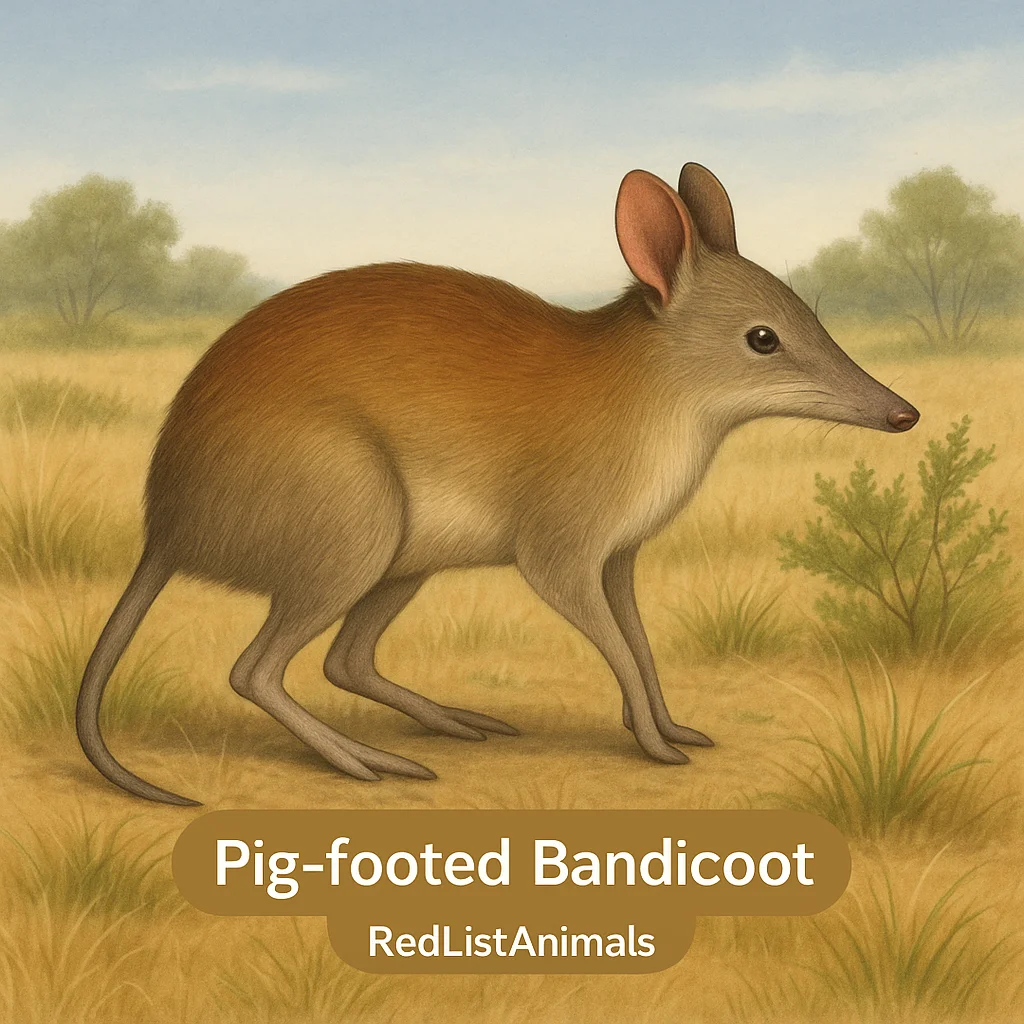
Its closest living relatives include other bandicoots and bilbies, which share certain ecological roles in their environments. The pig-footed bandicoot was an important part of its ecosystem, contributing to soil health and seed dispersal through its foraging activities.
In this article, you will learn about the regions it inhabited, its unique lifestyle, the timeline of its disappearance, and the factors contributing to its extinction. Understanding these topics can shed light on the broader challenges of extinction and conservation.
🧭 Where It Lived
The pig-footed bandicoot was primarily found across the arid and semi-arid regions of Australia. Its range extended from Western Australia to Victoria, spanning large expanses of dry terrain.
This bandicoot preferred habitats such as open woodlands, grasslands, and shrublands. These areas provided both the cover and the food resources it required. The modification and degradation of these habitats were significant threats due to their limited availability.
Because it inhabited specific environments within Australia, the pig-footed bandicoot's geographical confinement increased its vulnerability. Limited to certain ecological niches, any change in habitat conditions significantly impacted its survival prospects.
🌿 Habitat and Daily Life
The dry regions it called home were characterized by sporadic rainfall and high temperatures. The pig-footed bandicoot adapted to survive the challenging climate by becoming mostly nocturnal, avoiding the daytime heat.
This marsupial fed on a variety of foods, including insects, tubers, and seeds. Foraging under the cover of darkness helped it to remain safe from predators and efficiently gather its resources.
Regarding its life cycle, little is known, but it likely followed a reproductive pattern similar to other bandicoots, producing small litters and providing maternal care in pouches. Its interactions with other species included competition with other ground-dwelling mammals and predation pressures from native predators.
🧬 What Made It Unique
The pig-footed bandicoot was uniquely adapted with small, pig-like hooves instead of typical toes. This adaptation might have helped it traverse its grassy habitat more efficiently. Its cover of light, sandy-colored fur provided camouflage against the arid landscape.
This bandicoot played a crucial role in its ecosystem by consuming seeds and small invertebrates, assisting with both seed dispersal and soil aeration through its digging behavior.
The pig-footed bandicoot holds a place in historical records, as indigenous Australians were familiar with it and had cultural knowledge regarding its behaviors and ecology, which aided early researchers.
⏳ When It Disappeared
The decline of the pig-footed bandicoot began in the late 19th century, with the last confirmed records dating to the early 1900s. Its extinction was formally recognized after extensive surveys failed to locate any individuals.
Due to its elusive nature and the vast, inaccessible habitats of Australia, there were uncertainties in recording its exact last appearance. Nonetheless, the consensus is that it vanished by the 1950s.
Like many species that go extinct in the wild, the pig-footed bandicoot's complete disappearance means no populations remain, neither in their natural habitat nor in captivity.
⚠️ Why It Went Extinct
The extinction of the pig-footed bandicoot was driven by a combination of factors. Habitat loss and fragmentation significantly reduced its living spaces due to agricultural expansion and settlement development.
Introduced species, like cats and foxes, posed serious predatory threats that the bandicoot’s defenses could not withstand, leading to high mortality rates. Overgrazing by livestock further degraded its habitat, stripping away vegetation cover and food sources.
While less documented, climatic changes could have compounded these challenges, making their arid landscapes even harsher and less accommodating for survival.
🧩 How We Know (Evidence and Records)
Understanding the history of the pig-footed bandicoot comes from various evidence sources. These include preserved museum specimens, early explorer field notes, genetic studies, and indigenous knowledge captured through oral histories.
Scientists use these records to verify the identities and historical distributions of extinct species. Challenges in confirming their status often arise with species that were naturally rare or those inhabiting obscure areas.
🛡️ Could It Have Been Saved
Theoretically, conservation actions such as habitat protection, enforcing hunting limits, and controlling invasive species might have helped preserve the pig-footed bandicoot population.
However, these measures were either not implemented in time or were insufficient to counteract the complex pressures it faced. Conservation awareness and technological capabilities at the time were not advanced enough to foresee or address its decline effectively.
🔁 Are There Any Survivors or Close Relatives Today
Although the pig-footed bandicoot no longer exists, its closest living relatives are other bandicoots and bilbies, which continue to inhabit Australian landscapes. These animals share some ecological roles necessary for their environments.
While no direct reintroduction programs exist for the bandicoot, protecting other similar species provides insight into preserving ecosystems that once supported it.
❓ Common Questions and Misconceptions
Was it hunted to extinction? Hunting was not a primary factor in its extinction, though habitat competition with introduced species played a role.
Why didn’t it adapt or move? Its specialized adaptations and confined habitat made it difficult to relocate or adapt quickly.
Could it still be alive somewhere? Extensive surveys suggest it is indeed extinct, though remote areas always magnify uncertainties.
What does 'declared extinct' actually mean? It means there have been no confirmed sightings despite thorough searches, and reproduction is no longer possible.
What is the difference between endangered and extinct? Endangered species are at risk of extinction but still have viable populations, whereas extinct species have no surviving members.
Why are island species so vulnerable? Island species often have limited ranges and specific habitat needs, making them highly sensitive to environmental changes.
📌 Summary
- The pig-footed bandicoot was a small marsupial native to Australia.
- It lived across arid regions from Western Australia to Victoria.
- Preferred habitats included open woodlands and grasslands.
- Its diet consisted of insects, seeds, and tubers.
- Unique adaptations included hooved toes and nocturnal habits.
- Last confirmed sightings occurred in the early 1900s to 1950s.
- Main drivers of extinction include habitat loss and introduced species.
- Evidence comes from specimens, field notes, and indigenous knowledge.
- Closest relatives include other bandicoots and bilbies.
- A lesson in the importance of timely conservation efforts.
- A memorable takeaway is its unique foot structure among marsupials.