🏞️ Falkland Islands Wolf (Warrah)
🌍 What It Was
The Falkland Islands Wolf, also known as the Warrah, was a unique carnivorous mammal indigenous to the Falkland Islands. It was remarkably distinct as the only native land mammal of the islands. The species was characterized by its dog-like appearance, with a bushy tail, sharp teeth, and a thick fur coat to protect it from the harsh island climate.
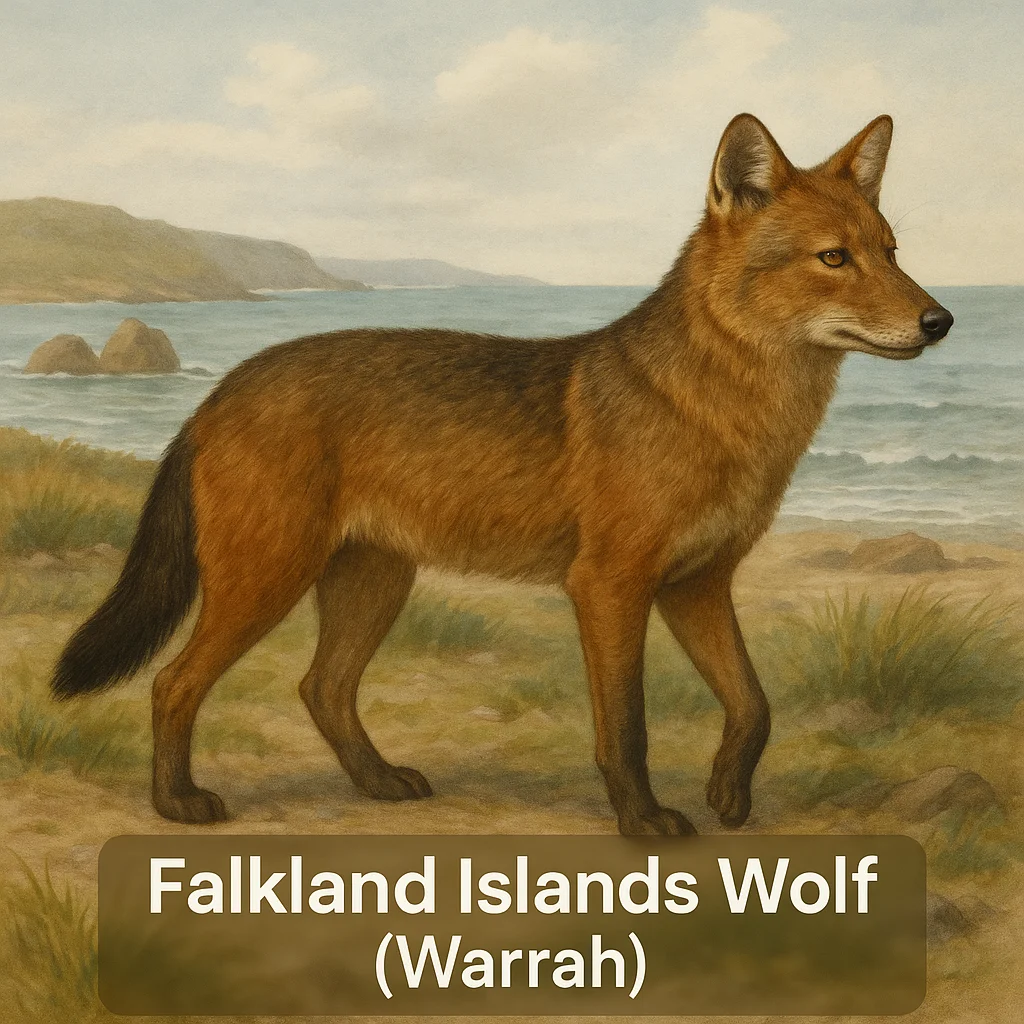
The Warrah is believed to be most closely related to the maned wolf and other members of the Canidae family, making it a distant cousin to domestic dogs, foxes, and wolves. Its ecological role on the islands was similar to that of a top predator, influencing the population dynamics of its prey species.
In this article, you will learn about the Falkland Islands Wolf's habitat, behavior, disappearance, and the factors that led to its extinction. By exploring its story, we can gain insights into extinction science and the importance of biodiversity conservation.
🧭 Where It Lived
The Falkland Islands Wolf was exclusively found on the Falkland Islands, an archipelago located in the South Atlantic Ocean. This restricted geographic range made it highly vulnerable to extinction, as island species often face unique threats due to their limited distribution.
The islands are characterized by rugged terrains, including grasslands, heathlands, and coastal areas. These varied habitats supported a diverse ecosystem, providing the Warrah with ample opportunities for foraging and hunting.
The isolation of the Falkland Islands meant that the Warrah had no natural predators and could uniquely adapt to its surroundings. However, this same isolation contributed to its vulnerability, as it had limited options for relocation or adaptation in response to changes or threats introduced to the islands.
🌿 Habitat and Daily Life
The Falkland Islands have a cool, temperate climate with relatively mild temperatures due to their maritime location. Rainfall is consistent throughout the year, with the islands experiencing strong winds and occasional snowfall during winter. The climate influenced the Warrah's thick fur, which was well-suited to withstand cold and wet conditions.
The Warrah primarily hunted seabirds, penguins, and other small mammals that inhabited the islands. It likely had a solitary lifestyle, foraging alone or in pairs for food. Its ability to forage along the coastline and inland areas made it a versatile predator within its range.
Little is known about the reproductive habits of the Falkland Islands Wolf, but it is assumed to have had similar breeding patterns to other canids. Breeding probably took place once a year, with the female caring for a small litter of pups until they were capable of fending for themselves.
🧬 What Made It Unique
The Falkland Islands Wolf was distinctive in its physical characteristics, possessing a robust build, a bushy tail, and small rounded ears. Its fur, dense and reddish-brown, provided camouflage against the island's vegetation and terrain.
Adapted for the island life, the Warrah displayed abilities such as efficient hunting strategies that did not rely solely on speed but rather on stealth and surprise. Its sense of smell and acute hearing enabled it to detect prey with ease.
Historically, the Warrah held cultural significance to early European explorers and settlers, who were fascinated by its existence on such a remote island. Stories and myths about the animal were recorded in the journals of explorers like Charles Darwin, adding to its historical legacy.
⏳ When It Disappeared
The extinction of the Falkland Islands Wolf was confirmed in the late 1800s. The last known specimen was collected in 1876, which marked the end of the species in the wild. This declaration followed multiple records and observations that documented a steady decline in the Warrah's population.
Uncertainty surrounds the exact timeline of its extinction, as records from the remote islands were often sparse. The distinction between 'Extinct in the Wild' and 'Extinct' does not apply to the Warrah, as there were no captive populations remaining.
The isolated nature of the Falkland Islands, coupled with limited communication with the outside world during the 19th century, means that records from this period are somewhat fragmented.
⚠️ Why It Went Extinct
The primary drivers behind the extinction of the Falkland Islands Wolf include overhunting by humans, habitat loss, and competition with introduced species. Early settlers and explorers viewed the Warrah as a threat to livestock, prompting targeted hunts that drastically reduced their population.
Habitat fragmentation also played a role, as human activities such as farming and settlement disturbed the natural landscapes, limiting the available territory for the Warrah to hunt and thrive.
Furthermore, the introduction of domestic animals like sheep and dogs to the islands added pressure on the Warrah, both as competitors for resources and vectors for diseases that could affect the native wolf.
🧩 How We Know (Evidence and Records)
The existence and extinction of the Falkland Islands Wolf are supported by several types of evidence, including fossils, preserved museum specimens, and historical accounts. Specimens of the Warrah can be found in several natural history museums around the world, providing tangible proof of its former existence.
Field notes and journals from 19th-century explorers, such as Charles Darwin, offer detailed descriptions of the Warrah's physical characteristics and behavior. These records, combined with genetic analyses of remaining specimens, have helped scientists verify the animal's identity and confirm the timeline of its extinction.
The remote and isolated nature of the Falkland Islands has made it challenging to gather comprehensive data, but the existing evidence provides a robust foundation for understanding the Warrah's history.
🛡️ Could It Have Been Saved
The conservation actions that might have saved the Falkland Islands Wolf include establishing protected areas on the islands, implementing hunting restrictions, and controlling the introduction of invasive species. Such efforts could have preserved the natural habitats and resources necessary for the Warrah’s survival.
Unfortunately, awareness of conservation issues was limited during the 19th century, and there was little understanding of the importance of protecting endangered species. By the time actions could have been implemented, the Warrah’s population had already declined significantly.
There are no records of any concerted conservation attempts specifically aimed at the Warrah, highlighting the challenges of initiating effective conservation measures at a time when such efforts were not yet common practice.
🔁 Are There Any Survivors or Close Relatives Today
The closest living relatives of the Falkland Islands Wolf are other members of the Canidae family, particularly the maned wolf found in South America. While these relatives share some genetic and behavioral traits, they do not occupy the same ecological niche as the Warrah did on the Falkland Islands.
There are no known ecological replacements for the Falkland Islands Wolf, meaning that its unique role in the island ecosystem remains unfilled. This absence can have long-lasting impacts on the island’s ecological balance, affecting prey populations and overall biodiversity.
No reintroduction or captive breeding programs exist for the Falkland Islands Wolf, as the species was declared extinct with no living individuals remaining to support such efforts.
❓ Common Questions and Misconceptions
Was it hunted to extinction? Yes, overhunting was a major factor in its extinction due to being seen as a threat by settlers.
Why didn’t it adapt or move? As an island species with limited range, the Warrah had few options for range expansion or adaptation to new threats.
Could it still be alive somewhere? No, extensive searches and lack of sightings since the 1800s confirm its extinction.
What does 'declared extinct' actually mean? It means no living individuals are believed to exist, confirmed by thorough searches and lack of sightings over a prolonged period.
What is the difference between endangered and extinct? Endangered species are at risk of extinction, while extinct species no longer exist.
Why are island species so vulnerable? They often have limited ranges and resources, making them less adaptable to changes and threats.
📌 Summary
- The Falkland Islands Wolf was the only native land mammal of the Falkland Islands.
- It lived exclusively on the Falkland Islands in the South Atlantic Ocean.
- The habitat ranged from grasslands to coastal areas.
- Its diet consisted mainly of seabirds and small mammals.
- It had a bushy tail and thick fur, well-suited for the island climate.
- The last known specimen was collected in 1876.
- Extinction drivers included overhunting, habitat loss, and invasive species.
- Evidence comes from fossils, museum specimens, and historical records.
- Closest living relatives are members of the Canidae family.
- The story highlights the importance of early conservation efforts.
- The Warrah’s unique role and legacy continue to be subjects of scientific interest.