🏞️ Caribbean Monk Seal
🌍 What It Was
The Caribbean monk seal was a marine mammal known for its distinct appearance and behavior. It belonged to the seal family and was recognized for its smooth, grayish coat. This seal played a critical role in the marine ecosystems it inhabited, contributing to maintaining a balance within the food chain.
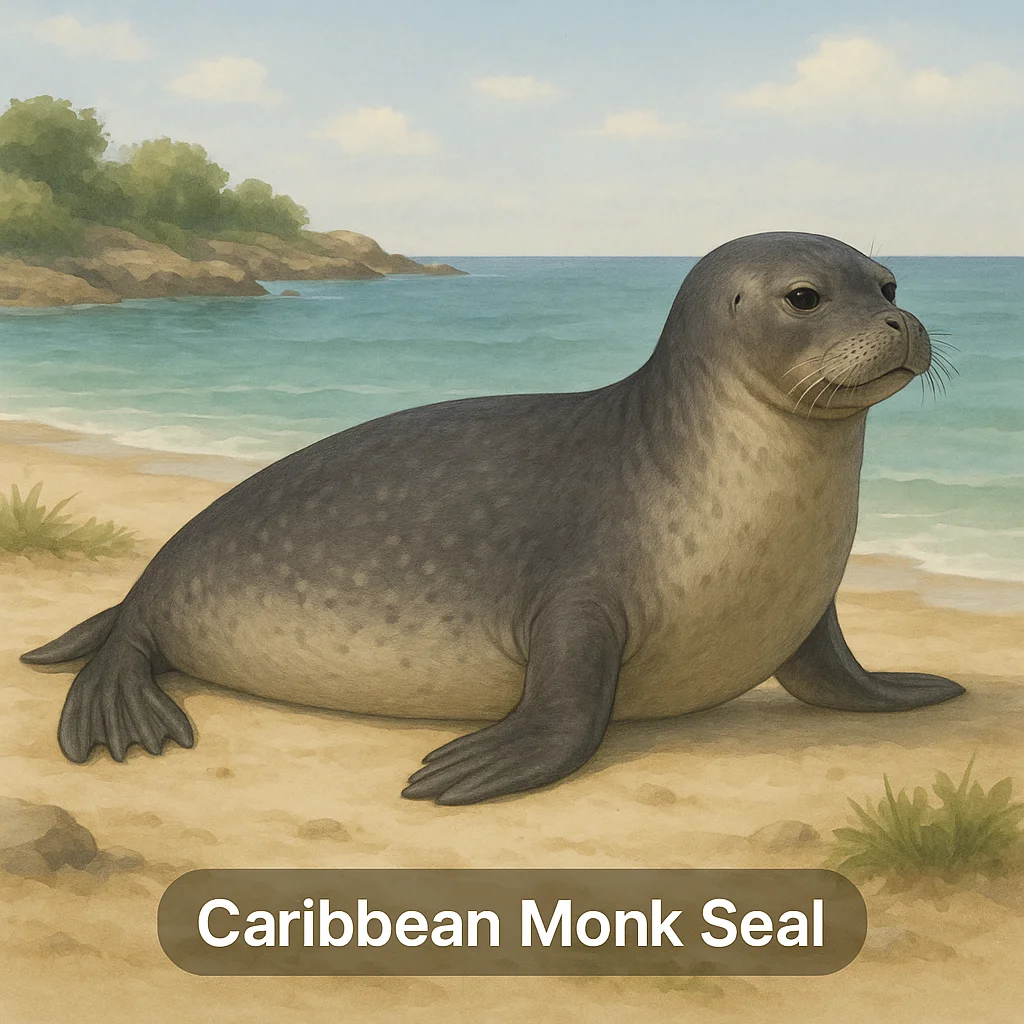
The Caribbean monk seal's closest living relatives are the Hawaiian monk seal and the Mediterranean monk seal. These seals share a similar body shape and marine lifestyle. The Caribbean monk seal adapted well to its environment, primarily spending time in coastal waters and on sandy beaches.
In this article, you will learn about the Caribbean monk seal's habitats, behaviors, and the unfortunate factors that led to its extinction. We will explore how it lived, where it was found, when it disappeared, and the reasons behind its decline.
🧭 Where It Lived
The Caribbean monk seal once roamed the warm waters of the Caribbean Sea and the Gulf of Mexico. Its geographic range included areas around various Caribbean islands, from Jamaica to the Bahamas, as well as the southern coastlines of Florida and Mexico.
The habitat of the Caribbean monk seal was primarily centered around coastal areas. It favored sandy beaches and mangrove forests, which provided it with safe places to rest and reproduce. Such habitats also offered easy access to nearby coral reefs, where the seal could forage for food.
The limited distribution of the Caribbean monk seal severely increased its vulnerability to environmental changes and human activities. Island species are often at greater risk of extinction due to their isolated habitats and limited access to alternative environments.
🌿 Habitat and Daily Life
The Caribbean monk seal thrived in a tropical climate where temperatures were consistently warm and rainfall was moderate. It adapted to a life both in the water and on land but was primarily dependent on the marine environment for food and survival.
Its diet consisted mainly of fish, cephalopods like squid, and crustaceans. The seal exhibited a foraging style where it dived into the waters around coral reefs and coastal areas to hunt for prey. Its keen eyesight and agility made it a proficient hunter in the ocean.
Reproduction for the Caribbean monk seal was seasonal, with females giving birth to a single pup which they nursed and cared for on secluded beaches. The seals were generally social animals, often seen in small groups, which helped them protect young pups and defend against threats.
🧬 What Made It Unique
One of the key physical traits of the Caribbean monk seal was its streamlined body, which allowed it to maneuver swiftly in water. Its silvery-gray fur provided camouflage against the sandy ocean floor, helping it evade predators and ambush prey.
The seal had well-developed sensory abilities, particularly keen hearing and eyesight suited for underwater environments. These adaptations made it an adept hunter and a crucial part of the reef ecosystem, where it helped control fish populations.
Historically, the Caribbean monk seal held cultural significance among native Caribbean peoples, who revered it as part of their maritime heritage. However, interactions with humans often led to its decline, as seals were occasionally hunted for their oil and skins.
⏳ When It Disappeared
The last confirmed sighting of the Caribbean monk seal occurred in the early 1950s. Despite sporadic unconfirmed reports afterwards, the seals were officially declared extinct by the International Union for Conservation of Nature (IUCN) in 2008.
Uncertainties about the exact timing of its extinction stem from the remoteness of its habitats and occasional misidentifications with other seal species. The absence of sightings over several decades, however, led scientists to conclude its extinction in the wild and globally.
Unlike some other species, there are no known surviving populations in captivity, making the Caribbean monk seal fully extinct rather than extinct in the wild.
⚠️ Why It Went Extinct
The extinction of the Caribbean monk seal can be attributed to multiple factors, each contributing to its decline. One significant cause was habitat loss and fragmentation, driven by human activities such as coastal development and tourism.
Overhunting was another critical driver, as humans hunted the seals extensively for their oil, meat, and skins. This overexploitation significantly reduced their population and reproductive success, making it difficult for numbers to recover.
Additionally, introduced species, such as dogs and rats, impacted the seal's nesting sites, further reducing their ability to reproduce. This was coupled with fishing practices that depleted their food sources, leaving them with inadequate nutrition.
Overall, the cumulative effect of these threats resulted in a drastic decline in their numbers, ultimately leading to their disappearance.
🧩 How We Know (Evidence and Records)
Our understanding of the Caribbean monk seal's existence and extinction is drawn from various evidence sources, including museum specimens, field notes from early explorers, and occasional photographic records.
These records have been corroborated by oral histories passed down through generations, offering insights into the seal's historical range and behaviors. Modern scientists use these diverse records to confirm the species' identity and assess its extinction timeline.
Challenges in verifying the species' status included the cryptic nature of its habitat and the remote locations it favored, leading to limited direct observations, particularly in its later years.
🛡️ Could It Have Been Saved
Realistic conservation efforts for the Caribbean monk seal could have included establishing protected marine areas to safeguard habitats and enforce limits on hunting practices. Early intervention might have stabilized populations if combined with efforts to preserve food resources.
Efforts to control invasive species on nesting beaches could have improved reproductive success rates. However, by the time conservation action was seriously considered, population numbers had already reached critically low levels, limiting the potential impact.
No significant late-stage conservation programs were successfully implemented for the Caribbean monk seal, showcasing the importance of proactive, timely efforts in conservation to prevent extinctions.
🔁 Are There Any Survivors or Close Relatives Today
The closest living relatives of the Caribbean monk seal are the Hawaiian monk seal and the Mediterranean monk seal. Both of these species share similar physical and ecological characteristics and face ongoing conservation challenges.
While there are no surviving Caribbean monk seals, these relatives continue to fulfill similar ecological roles in their respective habitats, such as maintaining balance within their marine ecosystems.
Currently, there are no efforts to introduce a related species to the Caribbean region; however, lessons learned from the Caribbean monk seal's extinction have informed conservation efforts for its relatives.
❓ Common Questions and Misconceptions
Was it hunted to extinction? Human hunting was a major contributing factor, as the seals were hunted for oil and skins, severely reducing their population.
Why didn’t it adapt or move? The specialized nature of the seal's habitat and food sources made it ill-equipped to adapt to rapid changes or relocate.
Could it still be alive somewhere? It is widely considered extinct, with no verified sightings since the early 1950s.
What does 'declared extinct' actually mean? It indicates that exhaustive surveys have failed to find any remaining individuals in the wild or captivity.
What is the difference between endangered and extinct? Endangered species are at high risk of extinction, while extinct species have no surviving members.
Why are island species so vulnerable? Island species often have limited ranges and are sensitive to environmental changes, making them more prone to extinction.
Were there any captive programs? No captive breeding programs were established for the Caribbean monk seal before it went extinct.
Do its relatives face the same threats? Yes, similar threats challenge the Hawaiian and Mediterranean monk seals, but conservation efforts aim to mitigate these threats.
📌 Summary
- The Caribbean monk seal was a marine mammal with a unique appearance.
- It lived in the Caribbean Sea and the Gulf of Mexico.
- The seal depended on coastal habitats like sandy beaches and coral reefs.
- Its diet included fish, squid, and crustaceans.
- Streamlined body and camouflage coloring were key adaptations.
- Last known confirmed sightings occurred in the early 1950s.
- Main extinction drivers included overhunting and habitat loss.
- Evidence includes museum specimens, field notes, and oral histories.
- Closest living relatives are the Hawaiian and Mediterranean monk seals.
- Key conservation lesson: act early and proactively to protect species.
- Memorable takeaway: The Caribbean monk seal's story highlights the delicate balance of island ecosystems.