🏞️ Aurochs
🌍 What It Was
The aurochs was a large wild bovine known for its impressive stature and strength. It is considered the ancestor of domestic cattle. Distinctive with its robust body and curved horns, it was a key species in its ecosystem.
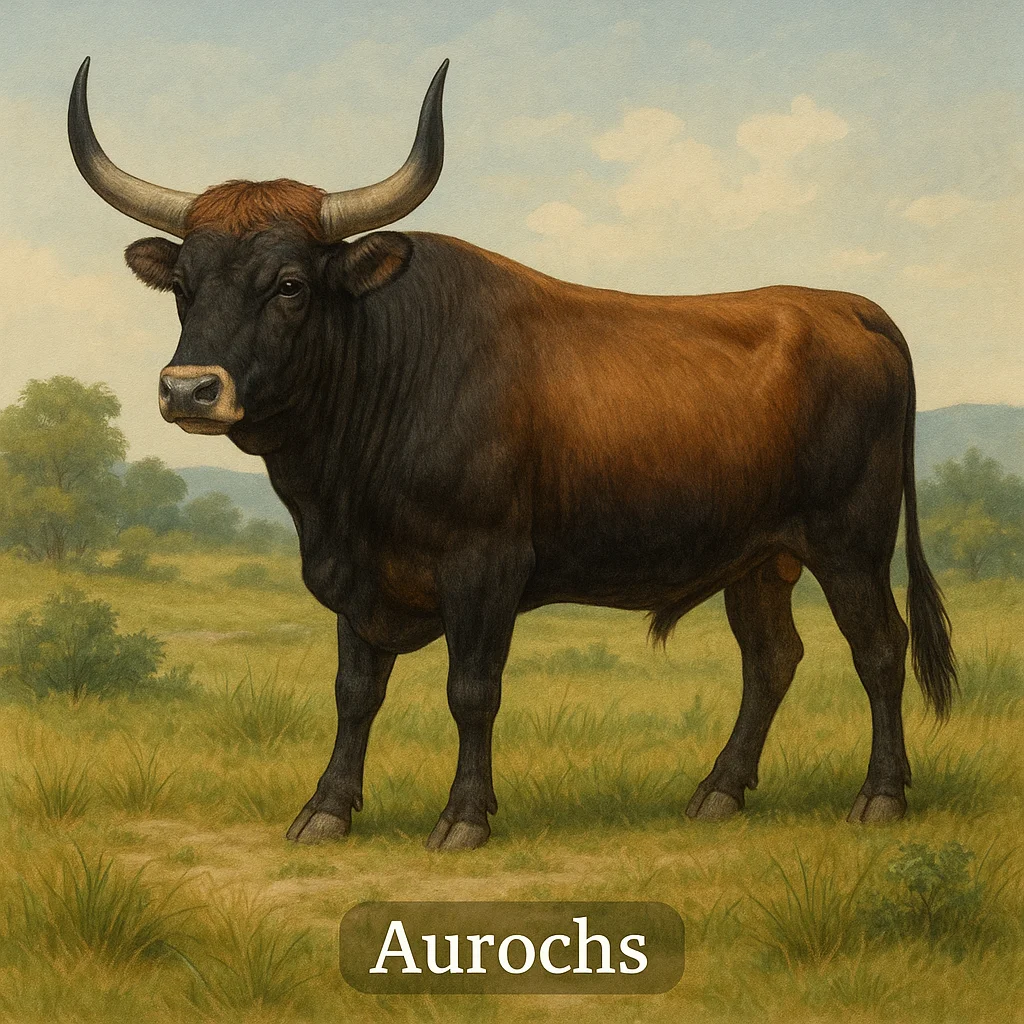
Its closest living relatives are the various breeds of domestic cattle that we have today. The aurochs played a critical role in its environment by grazing, which helped maintain balanced vegetation and provided food for predators.
This article will explore where the aurochs lived, how they thrived in their habitats, when and why they vanished, and what we can learn from their extinction for the conservation of current species.
🧭 Where It Lived
The aurochs roamed across a vast area spanning Europe, Asia, and North Africa. Its geographic range was extensive, and the species thrived in various regions from the open plains of Europe to the dense forests of the Caucasus.
The habitat preferences of the aurochs were diverse, including forests, grasslands, and wetlands. These environments provided the necessary food and shelter, playing a crucial role in their survival and reproductive success.
Its wide range and habitat adaptability might suggest a robustness in survival; however, the increasing pressures of human expansion and changing landscapes significantly contributed to the species' decline over time.
🌿 Habitat and Daily Life
The climates in which aurochs thrived were varied. In Europe, they experienced temperate climates with moderate rainfall, while in parts of Asia and North Africa, they lived in more arid zones.
Aurochs were herbivores, primarily grazing on grasses, shrubs, and young trees. They moved in herds, which provided protection against predators and facilitated social interactions critical for their survival and reproduction.
Reproduction in aurochs followed seasonal patterns, with calving occurring in the spring. Offspring were cared for by the herd, which enhanced their chances of survival through collective vigilance and nurturing behaviors.
🧬 What Made It Unique
The aurochs were known for their large size, with bulls standing up to 1.8 meters tall at the shoulder. They had prominent curved horns and a thick, muscular build that helped them defend against predators.
Their coloration varied, usually dark with a lighter dorsal stripe, which may have helped with camouflage in dense forests and open landscapes. Aurochs had a vital ecological role, functioning as mega-grazers that shaped vegetation patterns.
Culturally, they held significance in many ancient societies, depicted in prehistoric cave art and revered by some cultures for their strength and endurance.
⏳ When It Disappeared
The decline of the aurochs began as early as the late Middle Ages, with the last known individual dying in the early 1600s in Poland. Their extinction was a gradual process influenced by several factors over time.
Though records are sparse and sometimes inconsistent, extinction is declared based on the absence of sightings or evidence in natural habitats. The aurochs’ extinction was almost complete before conservation became a focus.
It's essential to differentiate between "extinct" and "extinct in the wild"; the aurochs fall into the former as there are no remaining individuals in captivity or the wild.
⚠️ Why It Went Extinct
One primary driver of aurochs extinction was habitat loss and fragmentation. Human agricultural expansion reduced and isolated the areas they could inhabit, effectively shrinking their home range.
Another significant cause was overhunting, as aurochs were prized for their meat and horns. This unsustainable removal from the population eroded their numbers over time.
The introduction and competition with domestic cattle likely altered ecosystems and diminished food availability, further stressing remaining aurochs populations.
🧩 How We Know (Evidence and Records)
The existence and details of aurochs are known through various evidence types, including subfossils, ancient art, and historical accounts. These records allow scientists to piece together their physical characteristics and behaviors.
Researchers utilize genetics from preserved remains to understand relations to modern cattle and confirm the timeline of their disappearance.
Despite these methods, the absence of live specimens often leads to uncertainties in precise behaviors and population details.
🛡️ Could It Have Been Saved
In theory, conservation efforts such as establishing protected areas or imposing hunting limitations could have improved their chances of survival. However, these ideas were not priorities during the period of their decline.
Late attempts might have focused on breeding in captivity, akin to modern conservation methods for endangered species, but they lacked the necessary resources and scientific understanding at that time.
Unfortunately, action for the aurochs came too late, emphasizing the need for early intervention in contemporary conservation efforts.
🔁 Are There Any Survivors or Close Relatives Today
The closest living relatives of the aurochs are domestic cattle, which share some genetic and physical similarities. Efforts have been underway to breed cattle that resemble aurochs, demonstrating a form of ecological replacement.
These efforts attempt to recreate their role in ecosystems, particularly those requiring grazing to maintain biodiversity.
While no direct descendants of the aurochs exist, these modern breeds offer a glimpse into their past role in ecosystems.
❓ Common Questions and Misconceptions
Was it hunted to extinction? While hunting played a significant role, it was one of several factors leading to their extinction.
Why didn’t it adapt or move? The rapid changes in land use and competition made adaptation slower than the threats they faced.
Could it still be alive somewhere? Given extensive evidence and lack of sightings for centuries, experts agree they are extinct.
What does "declared extinct" actually mean? It means no living individuals are known to exist anywhere on Earth after thorough surveys.
What is the difference between endangered and extinct? Endangered species are at risk of extinction; extinct species have no living members.
Why are island species so vulnerable? Island species are often more isolated and have smaller populations, making them more susceptible to extinction pressures.
📌 Summary
- The aurochs were large wild cattle ancestors to domestic cattle.
- They roamed across Europe, Asia, and North Africa.
- Preferred habitats included forests and grasslands.
- They primarily grazed on grasses and small shrubs.
- Unique adaptations included large size and curved horns.
- The species was last known alive in the early 1600s in Poland.
- Main extinction drivers included habitat loss and overhunting.
- Knowledge comes from fossils, genetics, and historical accounts.
- Closest living relatives are domestic cattle.
- Conservation requires early intervention to prevent similar extinctions.
- Aurochs shaped ecosystems through their grazing patterns.