🏞️ Rocky Mountain Locust
🌍 What It Was
The Rocky Mountain Locust was an insect known for its massive swarms that plagued the agricultural regions of North America during the 19th century. This extinct species of grasshopper shared similarities with modern grasshoppers and locusts, being a member of the Acrididae family. Its incredible swarming behavior is what made it distinctive and infamous among settlers and farmers of the past.
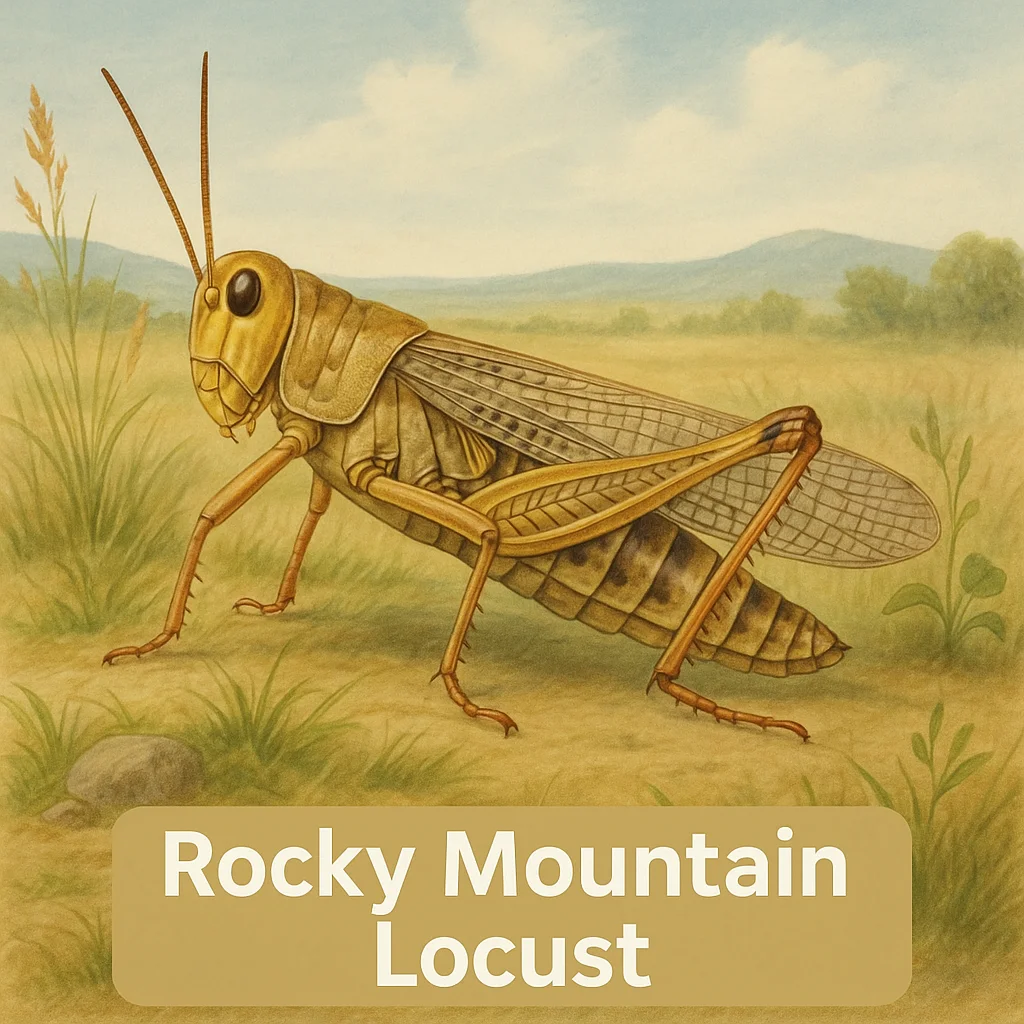
Closely related to the migratory locusts found today, the Rocky Mountain Locust played a significant role in its ecosystem. These insects were both a prey species for various birds and mammals and a voracious consumer of plant matter. Their swarming behavior was not just a spectacle but an ecological force that reshaped landscapes.
In this article, we will explore the life of the Rocky Mountain Locust, detailing its habitat, daily activities, and interactions within its ecosystem. We will also delve into the intriguing story of its extinction, examining the causes and lessons it holds for conservation efforts today.
🧭 Where It Lived
The geographic range of the Rocky Mountain Locust stretched across much of North America. These insects were primarily found in the central plains and intermountain regions covering parts of Canada and the United States. They thrived in areas known today as the Great Plains, extending from southern Canada down into the Rocky Mountains of the United States.
The Rocky Mountain Locust was highly dependent on grassland habitats. These regions were characterized by open spaces with abundant grasses, which provided ample food resources. The locusts favored areas that experienced periodic disturbances such as fires or grazing by large herbivores, which helped maintain the open grassland environments they relied upon.
While they occupied extensive areas, their range was not confined to any isolated or island environments. However, their distribution was indeed dictated by the availability of suitable grassland habitat, which made them vulnerable to environmental changes and human activities that altered these ecosystems.
🌿 Habitat and Daily Life
The climate in which the Rocky Mountain Locust thrived was variable, depending on the region. Generally, these environments experienced moderate to low rainfall with hot summers and cold winters. These conditions were conducive to maintaining the grassland habitats that supported the locusts' needs.
The diet of the Rocky Mountain Locust primarily consisted of grasses and other herbaceous plants. They were known for their swarming behavior, forming enormous gatherings that would migrate en masse to new feeding grounds once they depleted an area. This migration was a key aspect of their behavior, allowing them to exploit different resources over time.
Reproduction for these locusts was seasonal, with breeding typically occurring in the warmer months. Females would lay eggs in the soil, where they developed and hatched as the temperatures rose. The locust life cycle from egg to adult could occur relatively quickly, contributing to their capacity for rapid population growth under favorable conditions.
These locusts interacted with numerous other species within their ecosystem. They served as prey for birds such as meadowlarks and sparrows and were also targeted by various mammals. As herbivores, they competed with other grazing species for plant resources, influencing plant community compositions through their feeding habits.
🧬 What Made It Unique
The Rocky Mountain Locust varied in size, typically reaching lengths of around 1.5 to 2 inches as adults. Their coloration was adapted for their grassland environment, featuring shades of brown and green that aided in camouflage among the grasslands.
One of their most remarkable characteristics was their ability to form large swarms, sometimes numbering in the billions. These swarms were an evolutionary adaptation allowing them to efficiently exploit resources over great distances, responding to food scarcity by relocating.
Culturally and historically, the Rocky Mountain Locust was a significant agricultural pest during the 1800s. Swarms often devastated crops, leading to substantial economic impact on farming communities of the time. The locusts were feared and documented extensively in historical records, serving as both a challenge and a marvel to human observers.
⏳ When It Disappeared
The disappearance of the Rocky Mountain Locust is a fascinating aspect of extinction science. The last confirmed swarms were seen in the late 1800s, with the exact timing of their extinction remaining somewhat uncertain. The absence of any swarming events after the 1870s eventually led scientists to declare the species extinct.
Although there were some unconfirmed sightings following their decline, these were largely attributed to other locust species or misidentifications. The inability to confirm the presence of true Rocky Mountain Locusts through extensive searches and studies contributed to the conclusion of their extinction by the early 20th century.
The declaration of extinction was not based on a single event but rather the culmination of evidence over time, including the lack of sightings and specimens in areas where they were once abundant.
⚠️ Why It Went Extinct
The extinction of the Rocky Mountain Locust was likely the result of multiple factors. Habitat loss and fragmentation played a significant role as agricultural expansion destroyed the grasslands they depended on. The conversion of prairies into farmland and the subsequent changes in land use severely reduced their available habitat.
Overharvesting and changes in farming practices also contributed to their decline. Plowing and tilling fields destroyed the soil environments necessary for their eggs to develop, interrupting their life cycle. Furthermore, the removal of native vegetation in favor of crops reduced their food sources.
While introduced species and diseases are common causes of decline in many other species, these factors were less influential in the case of the locust. Changes in climate or extreme weather events may have impacted their populations, but these elements were compounded by human-induced alterations.
The combination of environmental changes and direct human activities created a tipping point from which the locust populations could not recover, leading to their eventual extinction.
🧩 How We Know (Evidence and Records)
The primary evidence for the Rocky Mountain Locust comes from historical accounts, museum specimens, and early scientific studies. Fossil records and subfossil remains provide additional insights into their past abundance and distribution.
Scientists have used these pieces of evidence to verify the identity and timeline of the locust. By examining preserved specimens and recorded observations, researchers have been able to distinguish the Rocky Mountain Locust from other similar locust species.
The challenge in confirming their extinction arose from their once vast range and the difficulty of monitoring such large areas. However, the consistent absence of new swarms or individuals over many decades has provided a strong basis for the conclusion that the species is indeed extinct.
🛡️ Could It Have Been Saved
Several conservation actions might have altered the fate of the Rocky Mountain Locust. Protecting and restoring grassland habitats could have sustained their populations. Limiting agricultural impacts through altered farming practices such as reduced tilling might have maintained suitable breeding environments.
Unfortunately, at the time, conservation biology was not as developed, and awareness of the ecological importance of the locusts was limited. Trade-offs included the need to balance agricultural productivity with ecological preservation, a complex consideration for settlers dependent on farming for survival.
Although there are no records of late conservation attempts for this locust species, the increased understanding of species' ecological roles and conservation principles today offers lessons in preventing similar extinctions in the future.
🔁 Are There Any Survivors or Close Relatives Today
The closest living relatives of the Rocky Mountain Locust are other grasshopper species within the Acrididae family, which includes various locusts and grasshoppers found worldwide. Species like the migratory locust share ecological and physical traits.
While there are no direct descendants or reintroduction projects for the Rocky Mountain Locust, other grasshopper species fulfill similar ecological roles within grassland ecosystems. These living relatives offer important insights into locust biology and behavior.
The knowledge gained from studying related insects helps entomologists understand how environmental changes influence locust populations, informing current conservation efforts to protect grassland habitats.
❓ Common Questions and Misconceptions
Was it hunted to extinction? No, direct hunting wasn't a primary factor, but agricultural practices indirectly contributed to its decline.
Why didn’t it adapt or move? The rapid habitat changes outpaced their ability to adapt or migrate effectively.
Could it still be alive somewhere? It's extremely unlikely, as consistent searches have failed to find any surviving populations.
What does 'declared extinct' actually mean? It means there’s sufficient evidence that the species no longer exists anywhere in the wild.
What is the difference between endangered and extinct? Endangered species are at risk of extinction, while extinct species no longer exist.
Why are island species so vulnerable? Island species have limited ranges and resources, making them more susceptible to changes.
Did climate have an impact? Climate changes may have contributed, but were compounded by human activities.
Can conservation help similar species today? Yes, implementing habitat protection and sustainable practices can aid other at-risk species.
📌 Summary
- The Rocky Mountain Locust was a swarming grasshopper species.
- It lived across the Great Plains of North America.
- Its habitat was primarily open grasslands.
- The locusts were herbivores, consuming large amounts of plant material.
- Their ability to form massive swarms was a unique adaptation.
- They were last reliably recorded in the late 1800s.
- Habitat destruction, agricultural practices, and ecological changes led to extinction.
- Evidence includes historical records, museum specimens, and fossil remains.
- Related species include various grasshoppers in the Acrididae family.
- Conservation lessons emphasize the importance of habitat protection.
- The extinction of this species highlights the complex interplay of ecological factors and human impact.