🏞️ Pahrump Ranch Pupfish
🌍 What It Was
The Pahrump Ranch pupfish was a small, freshwater fish endemic to the Pahrump Valley Ranch in Nevada, USA. Characterized by its resilience and adaptability to harsh desert environments, this pupfish was part of a family known for thriving in isolated and challenging habitats.
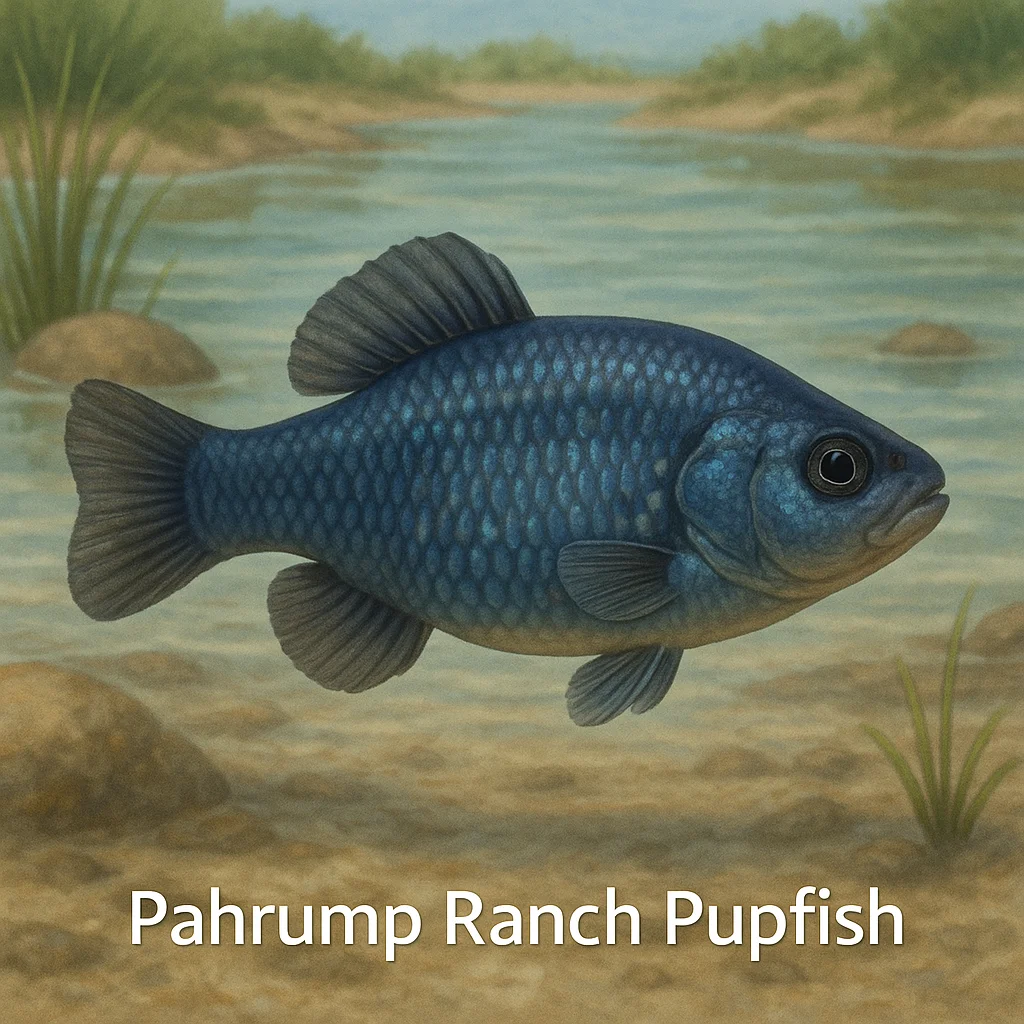
Closely related to other desert pupfishes, like the Devils Hole pupfish, the Pahrump Ranch pupfish played a crucial role in its limited ecosystem by contributing to nutrient cycling and the food web.
In this article, we will explore the habitat and daily life of the Pahrump Ranch pupfish, along with an examination of its disappearance and the factors leading to its extinction.
🧭 Where It Lived
The Pahrump Ranch pupfish was found exclusively in the Pahrump Valley Ranch, located in the Mojave Desert region of Nevada. Its existence was limited to a single spring system that provided the unique combination of conditions it needed to survive.
This spring-fed habitat, isolated within the arid desert landscape, offered permanently flowing waters and a relatively stable temperature, which is essential for the pupfish's survival.
The highly localized nature of its habitat increased its vulnerability to extinction. When a species is confined to such a small area, any changes to its environment can have catastrophic consequences.
🌿 Habitat and Daily Life
The climate of the Pahrump Valley Ranch is characterized by hot summers and mild winters, typical of desert environments, with scarce rainfall throughout the year. Despite these harsh conditions, the spring system provided a year-round water supply.
The Pahrump Ranch pupfish's diet primarily consisted of algae, small invertebrates, and detritus, which it foraged for on the substrate of its spring habitat.
Breeding generally occurred in warmer months when food availability was at its peak. The fish engaged in simple courtship displays, with females laying eggs in protected areas where they would hatch after a short incubation period.
As a part of its ecosystem, the Pahrump Ranch pupfish helped maintain the balance by being both predator and prey. It interacted with various aquatic species, including invertebrates and other fish that cohabited the spring system.
🧬 What Made It Unique
The Pahrump Ranch pupfish was distinguished by its small size, vibrant coloration, and adaptability to limited and fluctuating water conditions. Its physical adaptations enabled it to survive in high salinity and temperature variations that would be inhospitable to many other fish species.
Their ability to survive in such extreme conditions also highlighted their role as an indicator species, reflecting the ecological health of their habitat.
Culturally, pupfish are sometimes referenced as symbols of resilience and perseverance, demonstrating how life can thrive even in the harshest conditions.
⏳ When It Disappeared
The last confirmed sighting of the Pahrump Ranch pupfish occurred in the mid-20th century. As with many highly localized species, declines were noted when their specific environmental conditions began to degrade.
While records indicate that the pupfish was officially declared extinct in the late 20th century, factors such as limited accessibility and isolated location contributed to the uncertainty and delay in documentation.
Once declared extinct, it marked the complete loss of this unique species, as no individuals were known to exist either in the wild or in captivity.
⚠️ Why It Went Extinct
The extinction of the Pahrump Ranch pupfish was driven by a combination of factors, with habitat loss and fragmentation playing a pivotal role. Groundwater extraction for agricultural and urban development significantly altered the spring system.
Introduced species, such as predatory fish, further compounded the pressure on the already dwindling pupfish population by increasing competition and predation levels.
Climate change and associated shifts, although not as influential during the pupfish's decline, added to the long-term environmental stress, contributing to its extinction.
🧩 How We Know (Evidence and Records)
The primary evidence for the existence and extinction of the Pahrump Ranch pupfish comes from field notes, preserved specimens in museums, and ecological studies conducted during the last sightings.
Scientists use comparative morphology, genetics, and records to verify the identity and timelines associated with extinction events. Unfortunately, due to the pupfish's remote and restricted habitat, comprehensive data was often lacking.
Limited access to the region and historical oversight made it difficult to conduct extensive studies, which has left gaps in our knowledge about the full extent of its range and ecology.
🛡️ Could It Have Been Saved
Conservation efforts for the Pahrump Ranch pupfish could have focused on habitat protection, water management, and preventing the introduction of predatory species into its isolated environment.
However, by the time the pupfish's situation was deemed critical, the necessary actions to preserve its habitat came too late, and the opportunities for intervention had significantly diminished.
While there were some late-stage discussions about captive breeding and habitat restoration, no substantial actions were implemented prior to the species' extinction.
🔁 Are There Any Survivors or Close Relatives Today
The Pahrump Ranch pupfish had close relatives, most notably the Devils Hole pupfish, which continues to survive in another restricted habitat within Nevada.
These relatives share similar adaptability traits, like resilience in extreme conditions, which serve as an ecological insight into the pupfish lineage.
There are no current reintroduction programs for the Pahrump Ranch pupfish, given its extinction and lack of captive populations or viable habitat remaining.
❓ Common Questions and Misconceptions
Was it hunted to extinction? No, hunting was not a direct factor; habitat alteration played a larger role.
Why didn’t it adapt or move? Its highly specific habitat needs and isolation made adaptation or migration unfeasible.
Could it still be alive somewhere? Extensive searches and habitat loss make rediscovery unlikely.
What does "declared extinct" actually mean? It means there is no reasonable expectation of finding the species alive.
What is the difference between endangered and extinct? Endangered species are at risk of extinction, while extinct species no longer exist.
Why are island species so vulnerable? Limited range, specific habitat needs, and isolation increase their risk.
What is an "indicator species"? A species that reflects the ecological health of its environment.
Why is museum specimen preservation important? It allows for future study and confirmation of species characteristics.
📌 Summary
- The Pahrump Ranch pupfish was a small, freshwater fish endemic to Nevada.
- It lived in the isolated spring system in the Mojave Desert, USA.
- Its habitat was a critical spring-fed desert ecosystem.
- The pupfish's diet included algae, invertebrates, and detritus.
- Unique adaptations included resistance to high salinity and temperature flux.
- Last seen in the mid-20th century, declared extinct later that century.
- Habitat loss and introduced species were primary extinction drivers.
- Evidence includes preserved specimens and field notes.
- Closest living relative is the Devils Hole pupfish.
- Conservation requires early action and habitat protection.
- A memorable takeaway: habitat preservation is crucial for species survival.