🏞️ Pathogens + Stress: A Deadly Combo
🌍 What It Was
The Tasmanian tiger, also known as the Thylacine, was a fascinating carnivorous marsupial that once roamed the wild landscapes of Tasmania, an island south of Australia. It bore a striking resemblance to a medium-to-large-sized dog, with distinctive black stripes running across its back that earned it its tiger nickname.
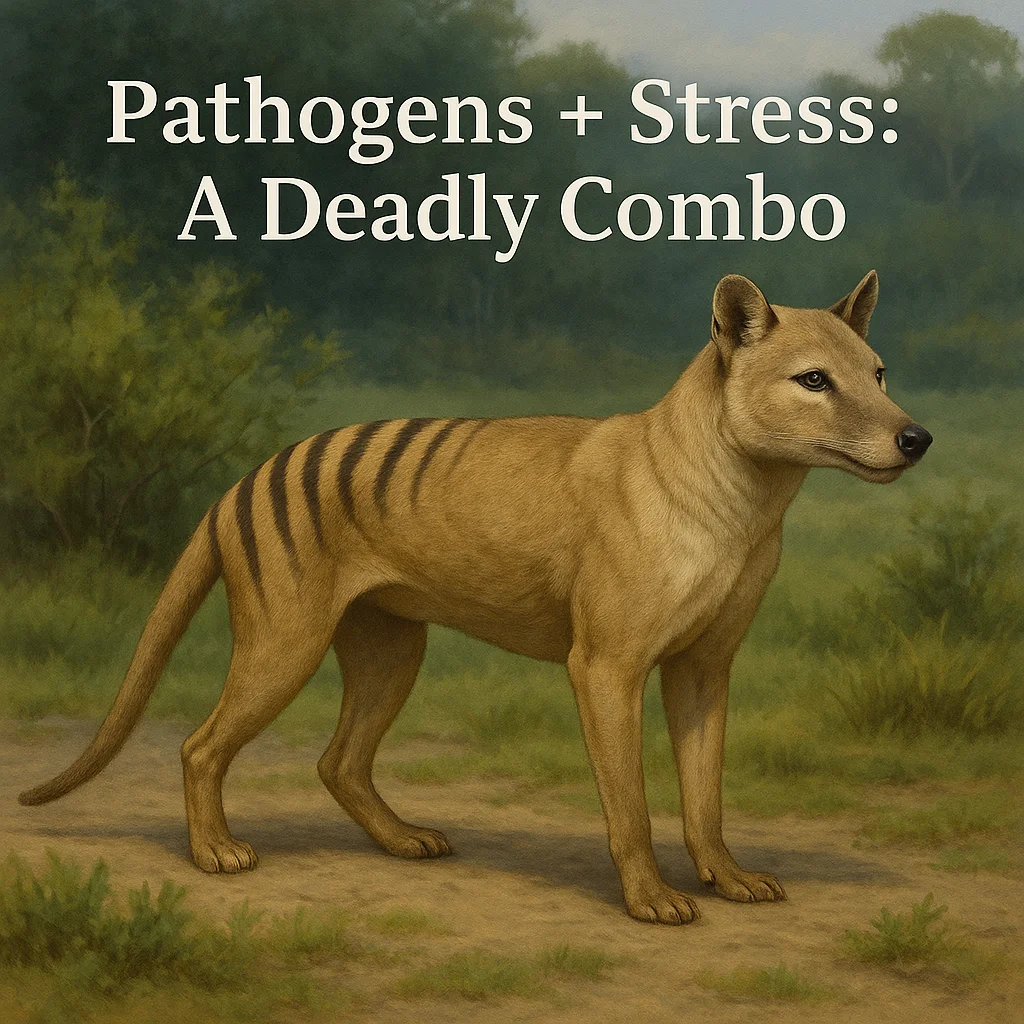
Despite its canine-like appearance, the Thylacine was more closely related to kangaroos and koalas, highlighting its unique position in the animal kingdom. It played a vital role in its ecosystem as a top predator, helping to maintain the balance of prey species within its habitat.
In this article, we will explore where the Thylacine lived, how it lived, when it disappeared, and the factors contributing to its extinction. By the end, you will have a basic understanding of how pathogens and stress combined to pose a deadly threat to this remarkable creature.
🧭 Where It Lived
The Thylacine was primarily found on the island of Tasmania, having gone extinct on the Australian mainland thousands of years ago. Its range within Tasmania covered a variety of landscapes, including forests, coastal heathlands, and grasslands.
Tasmania’s rugged and varied terrain provided the Thylacine with an abundance of prey to hunt, such as wallabies and small animals. The island’s isolation made the Thylacine vulnerable to extinction risks; without the ability to migrate or expand its territory, its population was contained within a limited area.
Living on an island brought distinct challenges for the Thylacine. The introduction of new species, habitat changes, and other stressors could have outsized impacts on its chances of survival, compared to animals with more widespread distributions.
🌿 Habitat and Daily Life
The climate of Tasmania is temperate, with mild to warm summers and cool, wet winters. This environment provided a diverse ecosystem for the Thylacine to inhabit, with ample food resources available throughout the year.
Primarily a solitary hunter, the Thylacine actively searched for prey during twilight and night, using its keen sense of smell and eyesight to track its targets. Despite its carnivorous diet, the Thylacine was not known for speed and relied on stamina to wear down its prey.
Breeding occurred once a year, with females giving birth to several small, undeveloped young that would continue to grow inside her pouch. This marsupial mode of reproduction ensured the young received constant care and protection during their early development stages.
Interactions with other species were mostly centered around its role as a predator. While it had few natural predators, competition with introduced species like dogs may have contributed to stress and resource scarcity.
🧬 What Made It Unique
The Thylacine possessed several distinctive physical traits, such as its striped coat, long snout, and large, powerful jaws equipped with pointy teeth designed for gripping prey. It was well-adapted to detect and hunt nocturnal animals.
Unlike placental predators, the Thylacine had a stiff tail and abdominal pouch, a trait shared with other marsupials. Its ecological role as a top-level predator was critical to controlling prey populations and preventing overgrazing.
In addition to its ecological significance, the Thylacine holds cultural importance. Indigenous Tasmanian peoples have long included this creature in their mythology and folklore, underscoring its integral presence throughout Tasmania’s history.
⏳ When It Disappeared
The Thylacine's last confirmed sighting in the wild is believed to have been in the 1930s, with the last known individual dying in captivity at the Hobart Zoo in 1936. While there have been sporadic, unverified reports and claimed sightings over the years, none have been substantiated.
Declaring a species extinct involves careful assessment and consensus within the scientific community. In the case of the Thylacine, extensive searches and data collection supported the conclusion of its extinction. Remote and dense forests in Tasmania made it particularly difficult to be entirely certain, leaving room for hope but little scientific evidence.
An important distinction in extinction terminology is "Extinct in the Wild" versus "Extinct." The Thylacine falls into the latter category, with no known individuals in captivity or natural habitats.
⚠️ Why It Went Extinct
Several factors contributed to the extinction of the Thylacine, all of which compounded the stress these animals faced. Habitat loss through deforestation and agriculture reduced their living space and prey availability.
Overhunting by humans severely impacted the Thylacine population. Farmers and bounty programs viewed them as threats to livestock, resulting in large-scale culling.
Introduced species like dogs and invasive pathogens brought from mainland Australia competed for resources and introduced diseases that the Thylacines had no immunity against.
Climate shifts may have also played a role, altering the availability of prey and shifting habitats, which further tested the Thylacine's adaptive capabilities.
While it's challenging to pinpoint a single cause, a combination of these factors created an unsustainable environment for the Thylacine, leading to its untimely extinction.
🧩 How We Know (Evidence and Records)
Evidence supporting the extinction of the Thylacine includes historical field notes, photographs, and museum specimens that have been meticulously studied over the years. Fossils and subfossils provide insights into their biological and ecological backgrounds.
Scientists authenticate sightings and historical records by using these physical specimens to confirm characteristic traits unique to Thylacines. Genetics is less of a tool in the case of recently extinct animals, though genetic studies on related marsupials offer supplemental information.
The elusive nature and dense habitats of Tasmania add complexity to confirming Thylacine extinction. Their nocturnal habits made detection difficult during the time they roamed freely.
🛡️ Could It Have Been Saved
Realistic conservation measures that might have helped the Thylacine include establishing protected areas to preserve their habitats, implementing hunting limits, and controlling introduced species.
Unfortunately, conservation awareness came too late. The damage from hunting and habitat disruption had already taken a severe toll. There were limited efforts to breed Thylacines in captivity, but these were unsuccessful before their population dwindled too far.
Though we can speculate about actions that might have changed their fate, understanding these missed opportunities highlights the importance of proactive conservation today.
🔁 Are There Any Survivors or Close Relatives Today
The Thylacine's closest living relatives are other marsupials, particularly members of the Dasyuridae family, which includes quolls and the Tasmanian devil. These creatures share some genetic traits and ecological niches.
In some cases, ecological replacements could help fill the void that extinct species like the Thylacine leave behind. For example, maintaining the population of existing predators such as the Tasmanian devil might partially compensate for the ecological gap.
Reintroduction through discovery or recreation remains speculative. While technological advancements might one day make "de-extinction" possible, practical and ethical considerations abound.
❓ Common Questions and Misconceptions
Was it hunted to extinction? Yes, hunting by humans was a major factor, but it combined with habitat loss and disease to drive it to extinction.
Why didn’t it adapt or move? Island endemics like the Thylacine had limited space and time to adapt to rapid changes.
Could it still be alive somewhere? While some believe they might exist in remote areas, there is no verified evidence to support these claims.
What does "declared extinct" actually mean? It means thorough searches and studies have failed to find evidence of living members.
What is the difference between endangered and extinct? "Endangered" means at high risk of extinction; "extinct" means the species no longer exists.
Why are island species so vulnerable? Geographic isolation, limited resources, and small population sizes make island species more susceptible to extinction threats.
Was it dangerous to humans? No, the Thylacine was shy and avoided human interactions.
Did any survive in zoos? The last known Thylacine died in captivity in 1936, and there has been no evidence of any others surviving since.
📌 Summary
- The Thylacine was a carnivorous marsupial once found in Tasmania.
- It lived primarily in forests, grasslands, and heathlands on the island.
- The climate was temperate, providing diverse habitats.
- The Thylacine's diet consisted mostly of small to medium-sized animals.
- It had unique adaptations like striped fur and marsupial reproduction.
- The last confirmed Thylacine died in 1936.
- Extinction drivers included habitat loss, hunting, and introduced species.
- Evidence includes historical records, specimens, and photographs.
- Closest living relatives include quolls and Tasmanian devils.
- Conservation lessons include the importance of proactive protective measures.
- A key takeaway is the combined impact of multiple threats leading to extinction.