🏞️ Disease-Driven Extinction(How It Happens)
🌍 What It Was
Diseases can play a significant role in driving species to extinction. Many fascinating animals once graced our planet, living in harmony with their environments until diseases disrupted their existence. For example, certain amphibian species have fallen victim to lethal fungal infections that compromised their populations and led to extinction.
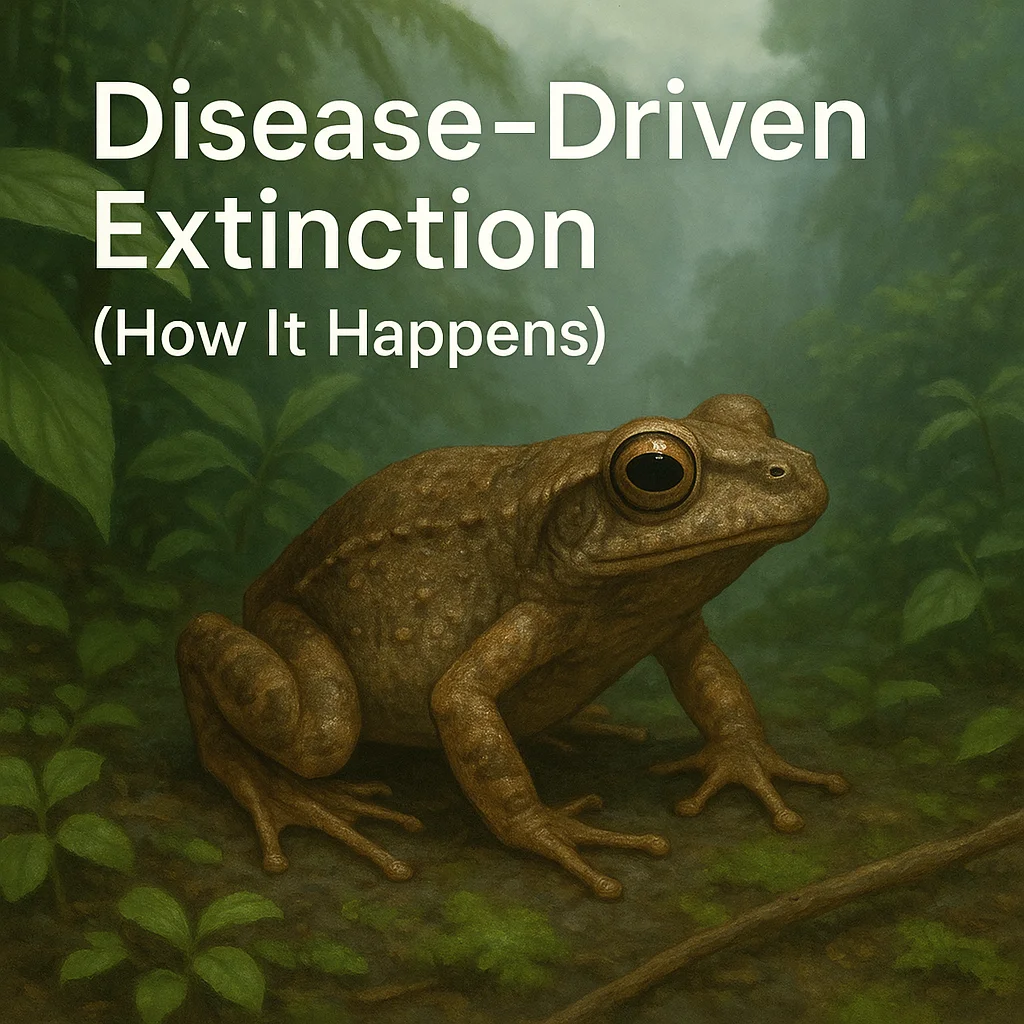
These animals were often part of rich ecosystems where they played critical roles, such as controlling insect populations or serving as prey for other animals. Amphibians, for instance, are indicators of environmental health. Their closest living relatives may include frogs and toads that exist in similar yet safer habitats.
Through this article, we will explore the habitats these animals lived in, their lifestyles, when they vanished, and the crucial role diseases played in their extinction.
🧭 Where It Lived
These species often inhabited lush rainforests, misty mountain ranges, and secluded wetlands where conditions were ideal. Small islands and isolated regions were common refuges due to their limited range. This isolation made them especially vulnerable to diseases introduced from outside.
For instance, many frogs lived in the dense canopies of tropical rainforests, where humidity was high, and the biodiversity was incredibly rich. These complex ecosystems supported various behaviors and life strategies optimized for survival in such environments.
However, the limited range and specialization to distinct environments increased their risk. Geographic isolation often meant no escape or alternative habitat to move to when diseases hit. In these regions, environmental factors such as consistent rainfall created microhabitats where they thrived.
🌿 Habitat and Daily Life
The natural habitats were characterized by their climate, which typically featured temperatures conducive to amphibian life, ample rainfall, and distinct seasons that guided life cycles. These conditions resulted in ecosystems teeming with life, fostering those adaptations specific to each environment.
Amphibians primarily fed on a range of small insects and other invertebrates, playing a role in regulating insect populations. Depending on their environment, some were nocturnal hunters, skilled in ambushing prey or utilizing camouflage.
Reproduction often involved elaborate courtship rituals during breeding seasons. Many species laid eggs in secluded water bodies, with certain species leaving offspring care to their environment or in some cases, parents providing care to ensure increased survival rates.
Their interaction with other species ranged from being prey for birds and snakes to engaging in competition with others for limited resources like food and breeding sites. Such dynamics were crucial for the ecological balance.
🧬 What Made It Unique
Amphibians are known for their distinct physical traits, which include permeable skin allowing respiration and moisture absorption. Their skin also played a role in communication and camouflage. Some species exhibited vivid colors for mating or warnings.
Besides these adaptations, many had unique vocalizations for attracting mates or warning off predators. They acted as ecological indicators due to their sensitivity to environmental changes like pollution and climate shifts, effectively serving as "canaries in a coal mine."
Culturally, amphibians have been significant throughout history, featuring in folklore and as symbols in different indigenous cultures, often representing life, fertility, or transformation.
⏳ When It Disappeared
The extinction timeline for these amphibians is not always clear-cut. Reliable sightings dwindled over the late 20th century as the prevalence of diseases like chytridiomycosis rose. Extinction is typically declared after extensive surveys fail to find surviving populations.
In many cases, small, isolated populations on remote islands or in inaccessible regions hindered immediate detection or study, contributing to uncertainty regarding the precise date of extinction.
For some species, a status of "Extinct in the Wild" means a few individuals may persist in captivity, although they no longer fulfill ecological roles in their native habitats. This status serves as a stark reminder of their precarious existence.
⚠️ Why It Went Extinct
A confluence of factors led to extinction, with disease being a significant driver. Habitat loss through deforestation and fragmentation meant reduced space for survival. Such disruptions altered ecological balances and increased disease exposure.
Overexploitation, although lesser for amphibians, played a role in other species' decline. Illegal collection and trade for pet industries put additional pressures on dwindling populations.
Introduced species often competed for resources or preyed upon native amphibians. Predators and competitors introduced by human activity disrupted existing ecological niches and put local species at a disadvantage.
Widespread disease, such as fungal infections, spread rapidly among population-dense communities, devastating vulnerable species. Chytridiomycosis notably attacked amphibian skin cells, crucial for their survival.
Climate shifts altered temperature and rainfall, aberrantly affecting breeding cycles and habitats. Combined with pollution, which reduced water quality, these changes created an inhospitable environment.
🧩 How We Know (Evidence and Records)
The extinction narrative is supported by extensive evidence. Fossils and subfossils provide insight into long-extinct species. Museum specimens allow comparative analysis with surviving relatives.
Field notes, photographs, and sometimes oral histories from local inhabitants complement scientific data, building a comprehensive picture of when and how extinctions occurred. Genetic studies provide clues about population declines and genetic diversity loss over time.
In many cases, nocturnal or cryptic lifestyles and remote habitats posed challenges in confirming disappearance, necessitating careful analysis and evidence to substantiate extinction claims.
🛡️ Could It Have Been Saved
Realistic conservation efforts could have slowed declines. Establishing protected areas and habitat restoration would have provided refuges. Limiting deforestation and pollution could have mitigated some threats.
Controlling invasive species through both preemptive and reactive measures would have helped reduce direct competition and predation pressures.
Captive breeding programs aimed at preserving genetic diversity could have re-established populations in the wild. Unfortunately, such actions were often too late or hampered by insufficient resources or knowledge.
🔁 Are There Any Survivors or Close Relatives Today
The closest living relatives, like other frogs and toads, provide a glimpse into what extinct amphibians might have been like. These relatives continue to fulfill similar ecological roles.
In some cases, ecological replacements occupy equivalent niches left vacant. Such replacements take time to establish, requiring the absence of close competitors.
Occasionally, reintroduction programs exist where captive breeding has been successful, aiming to restore populations to their native habitats. These initiatives are critical yet challenging.
❓ Common Questions and Misconceptions
Was it hunted to extinction? No, hunting was not the primary cause for amphibians, but it affected other groups.
Why didn’t it adapt or move? These species were highly specialized and geographically restricted, limiting adaptability and mobility.
Could it still be alive somewhere? While unlikely, undiscovered populations may remain; continuous surveys aim to confirm or refute presence.
What does 'declared extinct' actually mean? It means exhaustive searching has found no verifiable evidence of a surviving population.
What is the difference between endangered and extinct? Endangered species face high extinction risk, while extinct species are regarded as having no living individuals.
Why are island species so vulnerable? Limited range and specialized niches make island species particularly fragile to changes.
📌 Summary
- An example of disease-driven extinction concerns amphibians
- Lived in rainforests and isolated islands
- Thrived in humid, forested habitats
- Diet consisted mainly of insects
- Had permeable skin and unique communication methods
- Last known in late 20th century with declining records
- Extinct mainly due to diseases like chytridiomycosis
- Evidence includes fossils, museum specimens, genetic studies
- Closest living relatives are other amphibian species
- Conservation underscores the importance of early action
- Memorable takeaway: Isolation increases vulnerability