🏞️ Climate Change and Extinction Risk
🌍 What It Was
Extinction due to climate change is an increasingly concerning issue in conservation science. Animals that have become extinct due to climate shifts are varied, ranging from large mammals to small amphibians. Understanding these losses helps illuminate how climate change might continue to impact biodiversity.
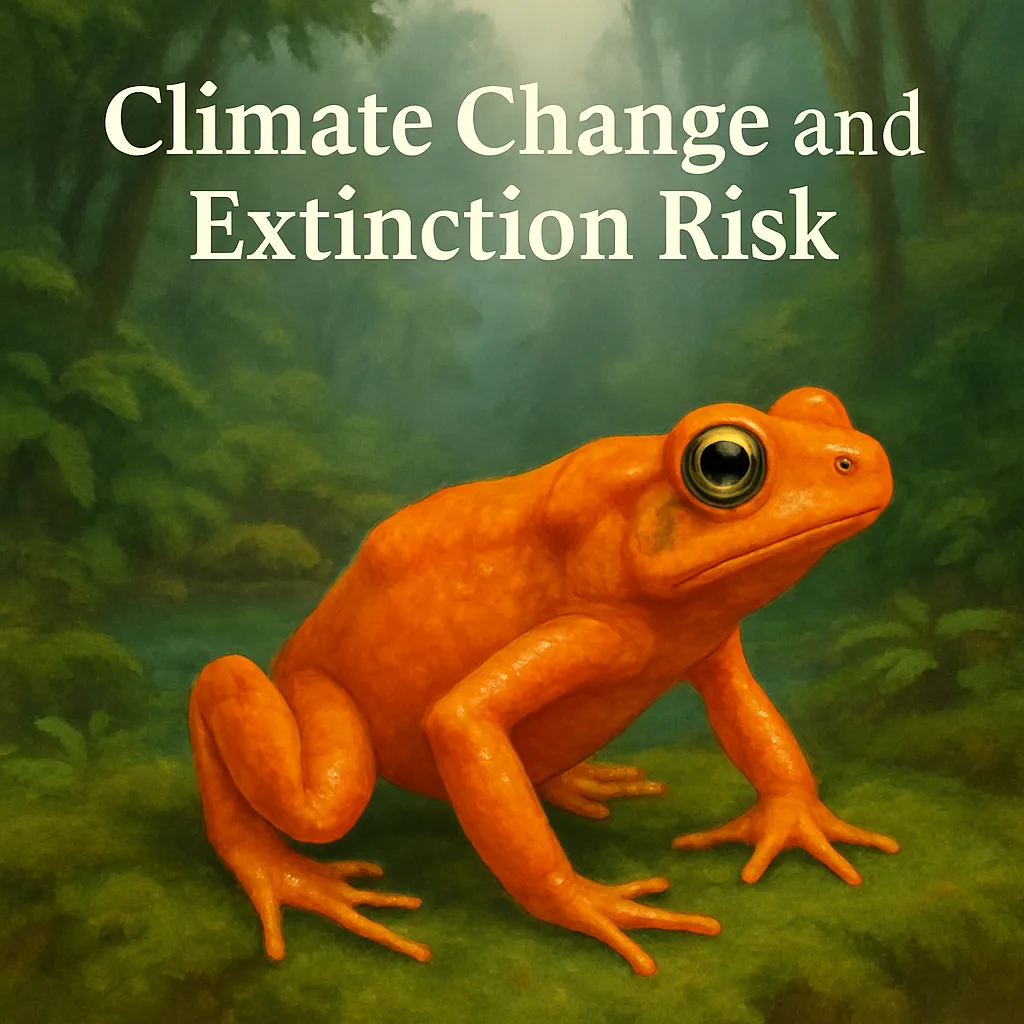
One such extinct species was the golden toad, an amphibian that was once found in the cloud forests of Costa Rica. Its closest living relatives are several species of small toads found in similar environments. These animals are known for their vibrant colors and reliance on moist habitats.
This article will explore the golden toad's ecology, habitat, and the factors contributing to its extinction, providing a comprehensive overview of a species that has become a symbol of climate change's impact on biodiversity.
🧭 Where It Lived
The golden toad inhabited the cloud forests of the Monteverde Reserve in Costa Rica. This area is part of the Tilarán Mountain range, which is characterized by its unique and diverse ecosystems. The cloud forests are enveloped in mist, creating a humid and cool environment crucial for the survival of many amphibian species.
This specific habitat type is rich in biodiversity due to its unique climatic conditions. The forests experience high levels of precipitation throughout the year, which supports lush vegetation and a variety of animal life. These conditions are essential for amphibians, which rely on moist environments to maintain their skin moisture and facilitate reproduction.
The limited geographic range of the golden toad, restricted to a high-altitude cloud forest, made it particularly vulnerable to environmental changes. Habitat specialization often increases extinction risk because localized species cannot easily adapt to changes outside their niche environment.
🌿 Habitat and Daily Life
The cloud forests experience frequent rainfall, stable temperatures, and high humidity. These climatic conditions allowed the golden toad to thrive. The toad's daily life revolved around the rainy season, which was the primary breeding period. They were often seen during the brief breeding season when pools formed by rain provided breeding grounds.
The diet of the golden toad consisted mainly of small insects and other invertebrates. As an adept forager, the toad relied on its keen eyesight to identify prey. Breeding occurred in temporary shallow pools, where males would gather and call to attract females, showcasing their bright coloring during this time.
Reproductive success heavily relied on the presence of adequate water bodies, as eggs were laid in water. Tadpoles then developed in these aquatic environments until metamorphosis. The toad's ecological interactions included being predator and prey within its ecosystem, maintaining a balance in insect populations and serving as food for larger animals.
🧬 What Made It Unique
The golden toad was remarkable for its stunning bright orange coloring, which was especially vibrant in males compared to females. This coloration served as a visual signal during the breeding season when males congregated at breeding sites.
The toad played a critical role in its ecosystem as an insect predator. By controlling insect populations, it contributed to the ecological balance of the cloud forest. The golden toad, along with its environment, was also crucial for scientific research and education, serving as a symbol of the need to conserve delicate habitats.
Culturally, the golden toad became a flagship species for conservation efforts, highlighting the impact of climate change on vulnerable species in biodiversity hotspots like Costa Rica's cloud forests.
⏳ When It Disappeared
The last confirmed sighting of the golden toad was in 1989. Despite extensive searches in subsequent years, no individuals were identified, leading scientists to declare it extinct. The end of sightings coincided with climate anomalies affecting the region.
The difficulty in confirming extinction lies in the species' limited range and the challenge of surveying cryptic amphibian species. The golden toad was declared "Extinct" as it no longer existed in the wild or captivity, with no confirmed sightings after 1989.
Extinctions can remain uncertain if habitats are remote or understudied, but ongoing efforts confirm through observations and searches whether a species is truly gone.
⚠️ Why It Went Extinct
The extinction of the golden toad was likely driven by multiple interacting factors. Habitat fragmentation and climate shifts are considered primary causes. The drying of cloud forests due to global climate changes reduced suitable breeding habitats.
Changes in temperature and moisture also facilitated the spread of diseases, such as chytridiomycosis, a fungal infection devastating to amphibian populations. Although direct evidence of the disease's impact on the golden toad is limited, it is a plausible factor.
The loss of habitat through deforestation and human encroachment compounded these challenges. Climate events such as the El Niño Southern Oscillation also contributed to irregular weather patterns, exacerbating conditions unfavorable for survival and reproduction.
🧩 How We Know (Evidence and Records)
The evidence of the golden toad's existence comes from field research, photographs, and scientific observations. Researchers documented breeding aggregations, observed behaviors, and collected specimens, providing a comprehensive record.
Descriptions and photographs help verify identity, while efforts to document and confirm sightings continued long after the last confirmed observation. Advances in genetics could offer further insights but were not available to verify the golden toad's status at the time of its disappearance.
Challenges in assessing extinction status include the toad's cryptic nature and its occurrence in a small, ecologically complex habitat, which may hinder comprehensive surveys.
🛡️ Could It Have Been Saved
Several conservation actions might have made a difference. Habitat preservation and improved environmental monitoring could have mitigated some climate impacts. Protective measures for breeding sites would address immediate habitat needs.
Initiatives to control diseases devastating amphibians globally, such as chytrid fungus, might have improved survival rates. However, such knowledge and technology were limited during the time of the toad's extinction.
The challenges of implementing timely conservation efforts often relate to the lack of resources and delayed responses in recognition of declining populations, highlighting ongoing issues in conservation strategy development.
🔁 Are There Any Survivors or Close Relatives Today
The golden toad's closest living relatives include other toads of the genus Incilius found in similar habitats in Central America. Although they share ecological roles and adaptations for amphibious life in cloud forests, these relatives face similar risks.
Ecological replacements, such as other forest-dwelling amphibians that share the insectivore niche, continue to maintain some balance in these ecosystems despite the toad's absence.
No reintroduction or captive breeding programs for the golden toad exist, as its extinction was confirmed without surviving individuals, making direct recovery efforts impossible.
❓ Common Questions and Misconceptions
Was it hunted to extinction? No, the golden toad wasn't hunted. Its extinction is linked more to climate shifts and disease.
Why didn’t it adapt or move? The toad's specialized habitat requirements and small range made adaptation difficult.
Could it still be alive somewhere? Given extensive surveys without sightings, it's considered extinct, although remote remnants are always a slim possibility.
What does 'declared extinct' actually mean? It means no individuals have been found despite thorough searches, often leading to official recognition by conservation bodies.
What is the difference between endangered and extinct? Endangered species are at high risk of extinction, while extinct ones have no surviving individuals.
Why are island species so vulnerable? Island species have limited ranges and specific adaptations, making them less resilient to changes and threats.
📌 Summary
- The golden toad was a brightly colored amphibian endemic to Costa Rica.
- It lived in the cloud forests of the Monteverde Reserve.
- Dependent on stable, humid environments with seasonal rainfall.
- Fed primarily on small insects and other invertebrates.
- Characterized by vibrant orange coloring important for mating.
- Last seen in 1989; extinction declared after extensive surveys.
- Main extinction drivers included climate change and disease.
- Evidence includes field notes, photos, and recorded sightings.
- Closest living relatives are other Central American toads.
- Conservation highlights the importance of habitat preservation.
- Lack of early intervention led to missed conservation chances.
- The species serves as a warning of climate risks to biodiversity.