🏞️ Passenger Pigeon
🌍 What It Was
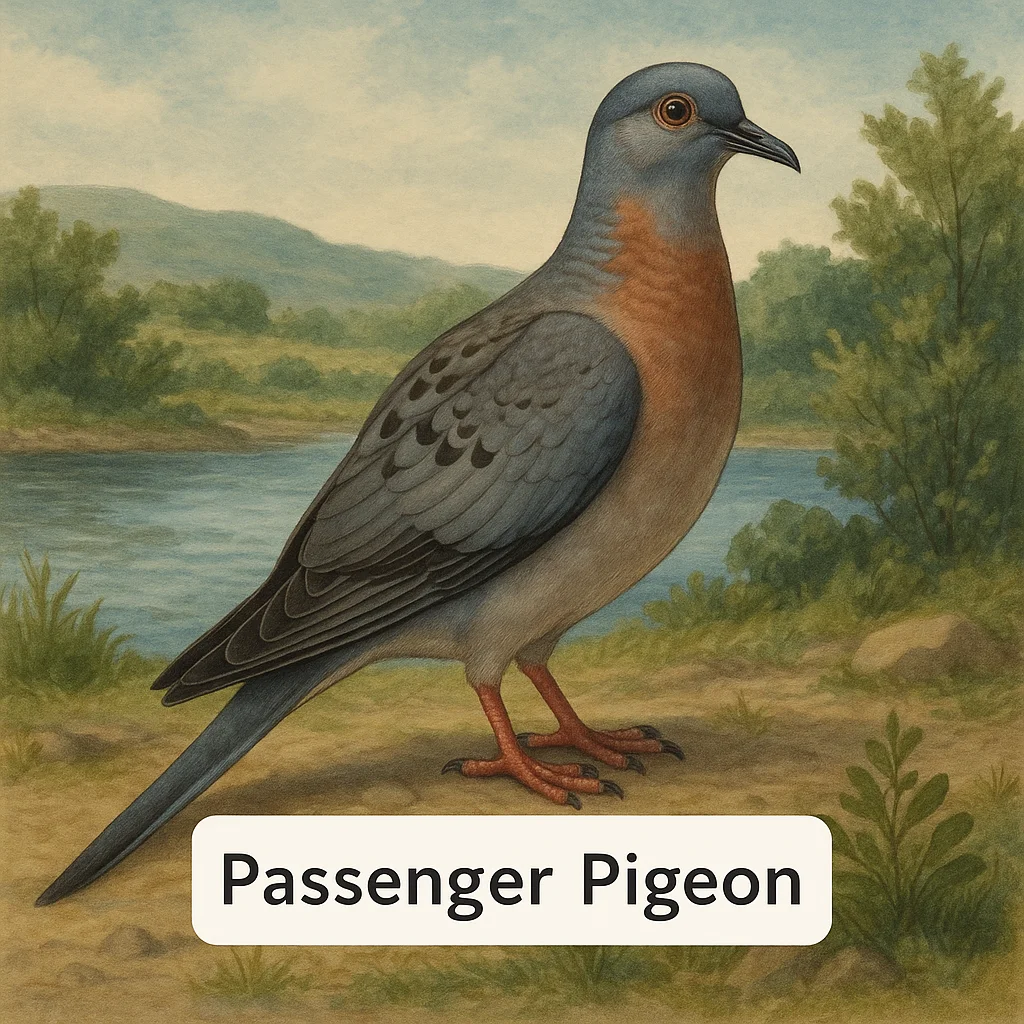
The passenger pigeon was a bird that once thrived in North America. It was known for its remarkable numbers and for forming some of the largest bird flocks recorded in history. These pigeons were medium-sized, with long tails and were part of the pigeon family, related to the modern rock pigeon commonly seen in urban areas today. Their vast flocks were a spectacle, often darkening the skies as they moved.
As we explore the passenger pigeon's world, we'll learn about its habitat, unique behaviors, and the unfortunate circumstances that led to its extinction. Key questions will be answered about its disappearance and what it teaches us about extinction science.
Understanding its relationships, both within its ecosystem and with humans, sheds light on wider environmental challenges and the ongoing struggle for biodiversity conservation. Through these insights, we appreciate not only its past life but also the enduring impact on ecological and conservation practices.
🧭 Where It Lived
The passenger pigeon was abundant across the deciduous forests of eastern North America. Its range extended from southern Canada down to the Gulf of Mexico, and from the Atlantic coast to the Midwest. These regions offered vast woodlands and mixed forests that were ideal for their communal living and foraging habits.
Passenger pigeons were specifically adapted to live in these forested areas because they provided the necessary resources for their survival, including abundant food sources and nesting sites. The rich, dense forests offered protection and an ample supply of seeds and nuts, particularly acorns and beechnuts, which were primary components of their diet.
While they primarily occupied vast forested areas, the passenger pigeon's range extended over such a large area because they were highly migratory. This migratory nature enabled them to move swiftly across regions in search of food and suitable nesting sites, showcasing their adaptability within a rather specific habitat requirement.
🌿 Habitat and Daily Life
The climate within the passenger pigeon's range varied from the warmer southern regions to the cooler northern areas, providing a diverse environment. Rainfall and seasonal changes influenced the availability of food sources, driving their migration patterns. These pigeons lived in enormous flocks, which made their daily life quite distinctive, often involving cooperative foraging and protection strategies.
Passenger pigeons primarily fed on seeds, fruits, and nuts. They were known to descend in swarms upon a forest to feed on acorns, chestnuts, and various seeds. Their communal feeding habits facilitated the cleaning of large areas in search of food, which aided in seed dispersal across the regions they inhabited.
Breeding took place in spring and early summer. The nesting process was a collective effort, with many pairs settling close together in the trees, forming massive breeding colonies. Each pair typically produced one egg per year, which led to a slow reproductive rate that might have affected their resilience to external threats.
🧬 What Made It Unique
The passenger pigeon was characterized by its striking physical features, including its graceful flight and distinctive coloration. It had a slate-blue head and rump, a reddish-bronze breast, and a long tail. These adaptations were well-suited for aerodynamics, aiding in their long migratory flights.
The pigeon's remarkable ability to thrive in large social groups distinguished it from many other bird species. These enormous flocks provided safety in numbers, minimizing individual risk from predators. Furthermore, by migrating together, the birds were often able to find and utilize food sources that might not sustain smaller groups.
Culturally, passenger pigeons held a place in Native American folklore and were commonly referenced in 19th-century American writings. Their presence had both ecological and symbolic significance, reflecting the interconnectedness of natural systems and cultural identity before their population crash.
⏳ When It Disappeared
The decline of the passenger pigeon began in the late 1800s. By 1914, the last confirmed individual, named Martha, died in captivity at the Cincinnati Zoo. This marked the extinction of a species once numbering in the billions. The exact timeline of their extinction is subject to some debate, as wild populations dwindled to the point of becoming functionally extinct before complete disappearance.
Despite extensive range and numbers, documented declines were rapid. Misidentifications and gaps in records have added to uncertainty about their exact extinction timeline. Remoteness and speed of ecological change compounded difficulties in documenting the final wild instances of the passenger pigeon.
Today, the passenger pigeon is officially classified as "Extinct." This highlights the consequences of unchecked environmental impacts, offering crucial insights into preventive conservation actions for other vulnerable species.
⚠️ Why It Went Extinct
Passenger pigeons disappeared primarily due to overexploitation and habitat loss. During the 19th century, they were extensively hunted for food. This overhunting devastated the population, unable to recover due to their slow reproductive rate.
Habitat fragmentation added to their plight. As agriculture expanded, the vast forests they depended on were cleared, reducing their nesting and feeding grounds. This loss made it difficult for the pigeons to sustain their large flock dynamics, crucial for their survival.
The introduction of invasive species and diseases, along with changes in climate, further pressured their declining population. These external threats combined to create insurmountable challenges, leading to their extinction despite their once-massive numbers.
🧩 How We Know (Evidence and Records)
The extinction of the passenger pigeon is well-documented through various lines of evidence. These include taxidermy specimens preserved in museums, contemporary accounts from hunters and naturalists, and photographs from the late 19th century.
Scientists have also used genetic studies to better understand the species' genetic diversity and population structure, utilizing preserved DNA from museum specimens. Oral histories and indigenous narratives provide additional insights into the historical presence and ecological role of passenger pigeons.
Identifying avian remains in archaeological sites has helped reconstruct migratory patterns and behavioral ecology, contributing to a comprehensive understanding of their population dynamics before and after rapid decline.
🛡️ Could It Have Been Saved
Had conservation efforts been implemented earlier, the extinction of the passenger pigeon might have been averted. Instituting hunting restrictions and protecting large tracts of forest habitat could have supported population recovery.
Due to the era's lack of ecological understanding, actions such as regulated hunting and habitat conservation were not prioritized. Awareness of the pigeon’s decline surfaced too late, leaving little time for effective interventions.
Additionally, captive breeding programs could have served as a last-ditch conservation measure, but they were underdeveloped in the early 20th century. By the time conservation became a consideration, the population was already insufficient for recovery efforts.
🔁 Are There Any Survivors or Close Relatives Today
Today, the closest living relatives to the passenger pigeon are other pigeon species, such as the band-tailed pigeon and the mourning dove. These relatives share some ecological and physical traits, though their behaviors differ significantly from the passenger pigeon.
Ecological replacements have emerged in some areas where passenger pigeons once thrived. While these species can partially fill ecological roles, none match the vast flock numbers or migratory habits of the passenger pigeon.
There are no known reintroduction or captive breeding programs for the resurrected passenger pigeon, as the species is fully extinct with no surviving individuals. The focus has shifted to preventing extinction of other species facing similar threats.
❓ Common Questions and Misconceptions
Was it hunted to extinction? Yes, hunting was a major factor, but not the only one. Habitat loss and other pressures also contributed.
Why didn't it adapt or move? The passenger pigeon's specialized social structure and habitat needs made adaptation challenging amid rapid change.
Could it still be alive somewhere? No verified sightings exist beyond the early 20th century. It is considered extinct.
What does "declared extinct" actually mean? A species is declared extinct when no living individuals are found after exhaustive surveys in its known habitats.
What is the difference between endangered and extinct? Endangered species face a high risk of extinction in the wild; extinct species have no surviving individuals.
Why are island species so vulnerable? Island ecosystems are fragile with limited resources and space, more easily disrupted by threats.
Why were the flocks so large? Social structure and food availability supported large numbers, which provided safety and efficiency in feeding.
Did people know they were overhunted? Contemporary reports exist, but a widespread acknowledgment of the extinction threat came too late.
📌 Summary
- A bird native to North America, part of the pigeon family
- Inhabited eastern North American forests
- Preferred deciduous and mixed forests for feeding and nesting
- Diet of seeds and nuts, especially acorns and beechnuts
- Adaptations for large flocks and long migrations
- Last known period alive in the early 20th century
- Main extinction drivers were hunting and habitat loss
- Evident through museum specimens and historical records
- Closely related to the band-tailed pigeon and mourning dove
- Teaches us the importance of timely conservation actions
- Remembered for its massive flocks and sudden extinction