🏞️ Laughing Owl
🌍 What It Was
The Laughing Owl was a fascinating bird species native to New Zealand, known for its haunting calls that resembled human laughter. This nocturnal bird was part of the Strigidae family, closely related to other owls but distinctive in its behavior and habitat.
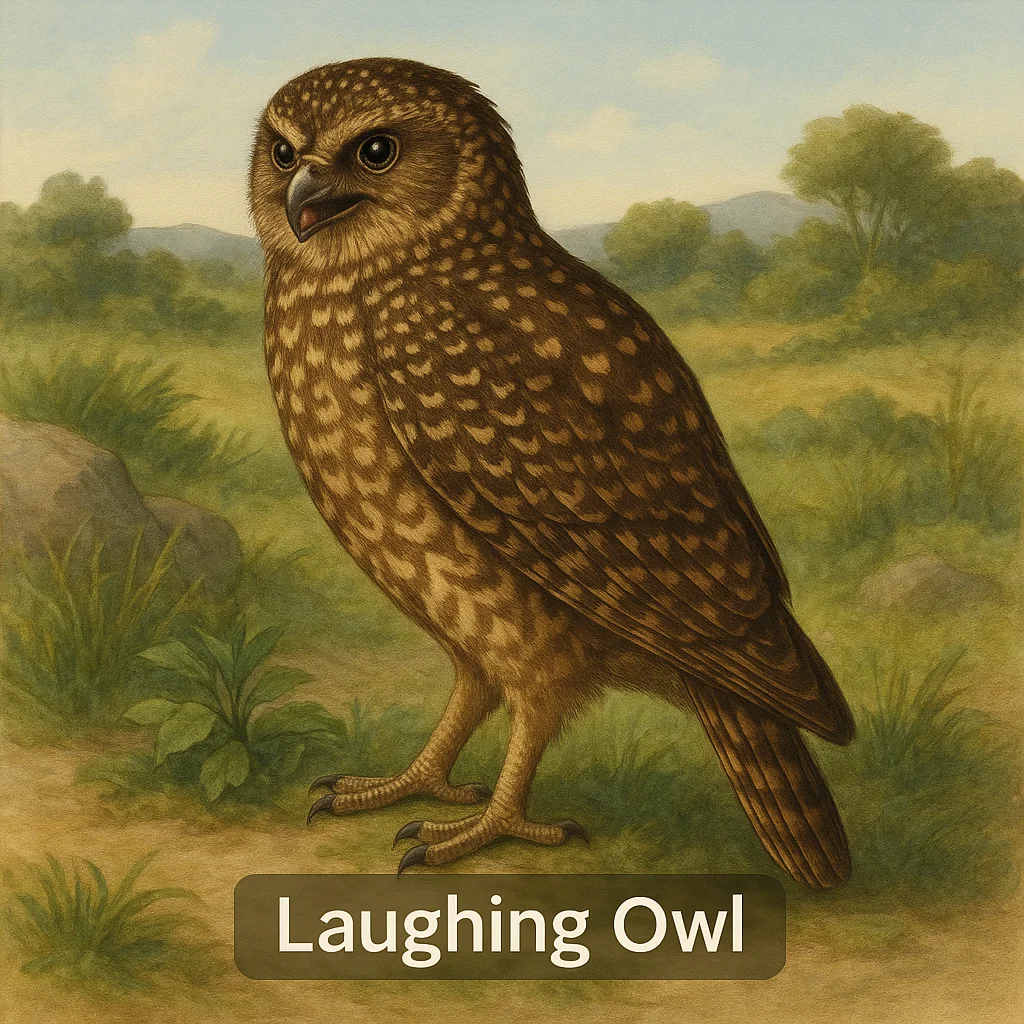
Its closest living relatives are various species of owls worldwide, sharing many features typical of owls such as excellent night vision and a diet primarily consisting of smaller animals. The Laughing Owl played a significant role in its ecosystem, helping control populations of rodents and insects.
In this article, readers will discover where this unique creature lived, how it survived in its environment, and explore the factors that ultimately led to its disappearance from the wild.
🧭 Where It Lived
The Laughing Owl was endemic to New Zealand, meaning it was found nowhere else in the world. Specifically, it inhabited both the North and South Islands, including smaller offshore islands.
This bird preferred rocky landscapes, open grasslands, and forested regions, demonstrating adaptability to various environments. However, its presence was notably absent from dense forests, favoring areas with ample hunting opportunities.
Being restricted to an island nation increased its risk of extinction, as habitat changes and introduced species posed more significant threats. Geographic isolation often limits a species' ability to adapt quickly to modifications in their environment.
🌿 Habitat and Daily Life
New Zealand's climate is mild and temperate, providing a suitable environment for the Laughing Owl. The bird thrived in areas with moderate rainfall and varied landscapes, which offered different prey types and nesting opportunities.
The Laughing Owl's diet was diverse, consisting mainly of rodents, small birds, insects, and lizards. It hunted primarily at night, using its keen eyesight and sharp talons to capture prey.
Nesting occurred in cliff crevices or among rocks, where it laid eggs and raised its young. Little is known about its social structure, but like many owls, it was likely territorial and solitary outside the breeding season.
🧬 What Made It Unique
The Laughing Owl was notable for its mottled brown and white plumage, aiding in camouflage against the New Zealand landscape. It was medium-sized for an owl, with strong wings adapted for silent flight.
Its distinctive call, resembling laughter, made it easily distinguishable from other birds. This unique vocalization served as both a mating call and a territorial warning.
In Maori culture, the Laughing Owl, known as "whēkau," was sometimes considered an ominous creature. Its presence in folklore highlights its integration into human history and interaction with indigenous people.
⏳ When It Disappeared
The last confirmed sighting of the Laughing Owl was in the early 1900s, with anecdotal reports extending into the 1920s. Declaring a species extinct involves thorough searches and considerable evidence that no individuals remain in the wild.
Uncertainty exists due to remote habitats and the secretive nature of owls, potentially leading to misidentifications. Nonetheless, the confirmed absence of sightings eventually led to its classification as extinct.
The declaration of extinction marks the end of the Laughing Owl's known existence in its natural habitat, illustrating the challenges of conserving lesser-known species.
⚠️ Why It Went Extinct
The primary driver of the Laughing Owl’s extinction was habitat loss and fragmentation. As forests were cleared for agriculture and urban development, the owl’s nesting and hunting grounds diminished significantly.
Overhunting and collection by settlers, fascinated by its unusual call and appearance, further contributed to its decline. Eggs and specimens were collected for museums, reducing surviving populations.
Invasive species such as cats, stoats, and rats were especially detrimental. These predators fed on owl eggs and competed for the same prey, disrupting the ecological balance. Climate shifts might have forced some prey populations to relocate or dwindle, indirectly impacting the owls.
🧩 How We Know (Evidence and Records)
Evidence of the Laughing Owl comes from museum specimens, written accounts, and field notes by early European settlers and naturalists. These sources provide valuable insights into its existence and habits.
Subfossils and oral histories from indigenous Maori further support these findings, with scientists cross-referencing these records to verify accuracy. Identification involves comparing physical traits and behaviors with existing data.
The nocturnal and elusive nature of many owls makes it challenging to verify their presence or absence definitively, a common issue faced in extinction studies.
🛡️ Could It Have Been Saved
Potential conservation actions for preserving the Laughing Owl could have included habitat protection and creating wildlife reserves to safeguard critical nesting areas. Implementing hunting restrictions might have reduced pressure from human activities.
Controlling invasive species would have been crucial, especially as predators and competitors increasingly dominated the ecosystem. However, conservation awareness and measures were limited or nonexistent during the owl's decline period.
By the time efforts were made to understand its situation, it was already too late for effective intervention, highlighting the importance of proactive conservation.
🔁 Are There Any Survivors or Close Relatives Today
The closest living relatives of the Laughing Owl are other owl species, including those in the Strigidae family. These relatives share many characteristics typical of owls, such as nocturnal habits and predatory skills.
Although no direct ecological replacement exists, other owl species in New Zealand and globally continue to fulfill similar roles within their ecosystems, maintaining balance and controlling prey populations.
No known reintroduction or captive breeding programs for the Laughing Owl exist, as its extinction predates modern conservation efforts of this nature.
❓ Common Questions and Misconceptions
Was it hunted to extinction? Overhunting contributed, but habitat loss and invasive species had a larger impact.
Why didn’t it adapt or move? Its insular habitat and rapid environmental changes limited adaptation opportunities.
Could it still be alive somewhere? While remote areas might hold hope, extensive searches have found no evidence of survivors.
What does 'declared extinct' actually mean? It means no known individuals have been observed despite exhaustive surveys.
What is the difference between endangered and extinct? Endangered species are at risk of extinction, while extinct means no known individuals remain.
Why are island species so vulnerable? Isolation and limited genetic diversity make adaptation slower, with fewer resources to withstand changes.
📌 Summary
- The Laughing Owl was an owl species native to New Zealand.
- It lived on both the North and South Islands with rocky and open habitats.
- Its preferred environments included grasslands and rocky outcrops.
- Diet consisted of small mammals, insects, and birds; it was a nocturnal hunter.
- Unique for its laughing call and brown, mottled plumage that provided camouflage.
- Last confirmed sightings occurred in the early 1900s before being declared extinct.
- Main factors included habitat loss, invasive species, and overhunting.
- Museum specimens and historical accounts serve as key evidence.
- Closest relatives are other members of the owl family.
- Conservation teaches the importance of protecting habitats and regulating invasive species.
- Remembered for its unique voice, the Laughing Owl exemplifies the fragility of island ecosystems.