🏞️ Great Auk
🌍 What It Was
The Great Auk was a flightless bird that roamed the rocky shores and cold waters of the North Atlantic Ocean. Unlike many birds of its time, the Great Auk was distinct for its inability to fly, though it was an adept swimmer, much like modern penguins. Standing about 75–85 cm tall, it had a robust build with black and white plumage and a large, hooked beak.
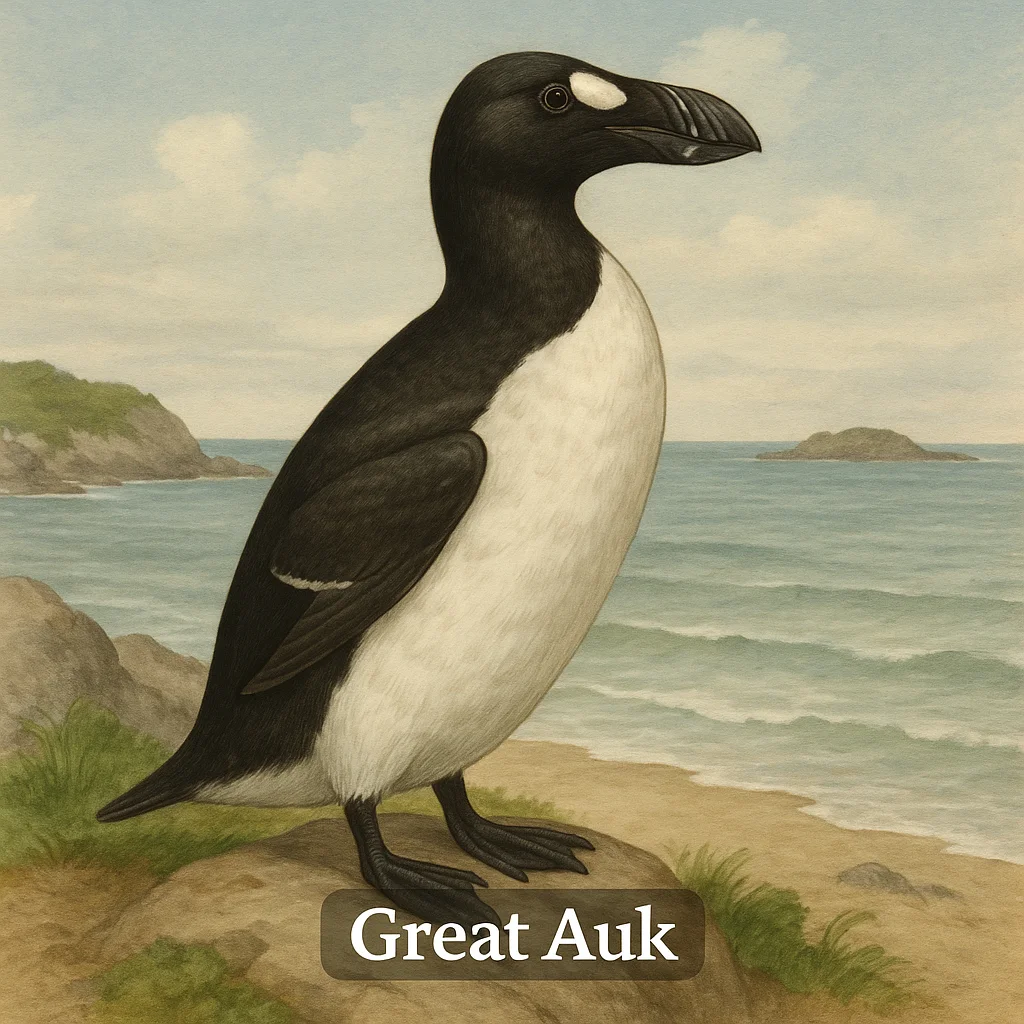
This species held similarities to the modern Razorbill, its closest living relative, yet the Great Auk was significantly larger. As part of the auk family, the Great Auk played a crucial role in its ecosystem, primarily as a consumer of marine resources. Readers will discover where the Great Auk lived, its lifestyle, the timeline of its extinction, and the factors that led to its disappearance.
Throughout this article, you'll explore the fascinating aspects of this once-thriving species that sadly vanished from our planet. With a focus on its living conditions, interactions with humans, and eventual extinction, the Great Auk story offers valuable lessons in extinction science and conservation today.
🧭 Where It Lived
The Great Auk's geographic range was concentrated around the North Atlantic Ocean, extending from the northeastern coasts of North America to the shores of Northern Europe. Some of the islands where they were frequently found included Iceland, Greenland, Newfoundland, and the Faroe Islands. These regions provided ideal environments for the birds to thrive owing to their rocky coastlines and abundant marine life.
These birds were primarily seabirds, relying on marine ecosystems for sustenance. Preferred habitats included rocky islets and coastal cliff areas where they could nest, rest, and feed efficiently. The Great Auk's excellent swimming abilities made it well-suited for these locations, as it depended heavily on the ocean for food.
Being island-limited, the Great Auk faced increased risks to its survival. Isolation on these islands made them vulnerable to external pressures such as overhunting and habitat disruption. Their reliance on specific breeding grounds meant that any environmental or human-induced change could dramatically impact their population.
🌿 Habitat and Daily Life
The climate in the Great Auk's habitats was typically cold and challenging, with long, harsh winters and shorter cool summers. The presence of abundant fish, such as herring and capelin, provided a constant food source. Winters in the North Atlantic known for their severity further tested the Great Auks' adaptability to such conditions.
The Great Auk diet primarily consisted of fish and crustaceans, which it hunted by diving into the ocean. Their strong limbs allowed them to dive to considerable depths, and they could swim significant distances to locate food. On land, they formed dense colonies during the breeding season, displaying social behavior like cooperative nesting.
Reproduction involved laying a single egg on bare rock or in shallow depressions. Both parents shared incubation responsibilities and cared for the chick, highlighting a shared investment in offspring survival. The absence of natural predators on breeding islands allowed fledglings to grow with a reduced risk of predation.
🧬 What Made It Unique
The Great Auk's physical characteristics included a striking black and white plumage, with a notable white patch on the wings and a prominent black beak. Its robust body was adapted for strong swimming abilities, facilitating an efficient pursuit of underwater prey.
This bird had short wings not suited for flight but perfectly adapted for underwater propulsion. The Great Auk played a vital role in maintaining its ecosystem balance by controlling fish populations. In particular, its feeding habits may have influenced the distribution and health of various fish species.
Historically, the Great Auk held cultural significance for Indigenous peoples in North America, as well as European explorers. Its feathers and meat were valuable resources, leading to its prominence in local economies. Such interactions with humans eventually contributed to its extinction.
⏳ When It Disappeared
The timeline of the Great Auk's disappearance is marked by a steady decline throughout the 17th and 18th centuries, culminating in its extinction in the mid-1800s. The last confirmed sighting took place in 1844 on Eldey Island, Iceland, where the final known pair were killed for museum specimens.
There is uncertainty surrounding exact dates due to the scattered nature of historical records. Instances of mistaken identity with similar birds have also led to challenges in pinpointing the last instances of true sightings. The extinction of the Great Auk was eventually confirmed through a lack of verifiable sightings over subsequent decades.
Extinction is formally declared when exhaustive surveys and studies fail to locate any remaining individuals. For the Great Auk, a lack of further evidence and the high degree of exploitation witnessed during its decline expedited its classification as extinct.
⚠️ Why It Went Extinct
The extinction of the Great Auk was driven by several factors, with overhunting being a major contributor. Humans extensively collected Great Auks for their meat, feathers, and eggs. This excessive hunting pressure drastically reduced their populations and reproductive potential.
Habitat loss and fragmentation also played a crucial role. Coastal development and disturbances in their breeding areas led to increased vulnerability. Human exploitation disrupted the safe environments Great Auks depended on for reproducing, feeding, and resting.
Although invasive species did not significantly directly impact the Great Auk, their breeding sites were occasionally affected by invasive mammals that preyed upon eggs and chicks. Furthermore, climatic shifts and extreme weather events may have adversely affected their habitat and food availability.
🧩 How We Know (Evidence and Records)
Our knowledge of the Great Auk is enriched by various evidence types, including subfossils such as bones and eggshells, which provide insights into their physical characteristics and distribution. Museums globally house specimens originating from different colonies.
Historical field notes and illustrations offer a glimpse into the past, largely drawn from sailors, explorer documentation, and oral histories from Indigenous communities. These records have been crucial in confirming extinct status.
Modern genetic studies aim to explore the Great Auk's relationships within its family group, using remnants like feathers and bones. Comprehensive surveys and thorough verification processes address misidentifications and confirm species status and disappearance.
🛡️ Could It Have Been Saved
Had timely conservation measures been implemented, the Great Auk might have had a chance at survival. Protecting key habitats and restricting hunting activities could have alleviated some of the pressures that led to its extinction.
Invasive species control and regulated resource use along breeding grounds would have helped preserve essential breeding sites. However, conservation action for the Great Auk only came as awareness of its decline increased, but these efforts were too late to prevent extinction.
No known late conservation attempts were successfully executed, though modern principles suggest captive breeding programs and marine protected areas might have provided alternatives for rehabilitation. Historical context highlights missed opportunities for impactful conservation.
🔁 Are There Any Survivors or Close Relatives Today
The Razorbill, Alca torda, stands as the closest living relative to the Great Auk, sharing similar habitats and feeding strategies. Razorbills are smaller but resemble the Great Auk physically and behaviorally. They continue to occupy similar ecological niches.
Modern-day ecological replacements do not exist directly for the Great Auk, as its role was somewhat unique. Other seabirds present today continue to fulfill specific ecosystem functions, though none match the Great Auk's substantial impact.
Currently, there are no known reintroduction or captive conservation programs explicitly aimed at the Great Auk. Discussions exist around potential de-extinction techniques, though they remain speculative and face significant ethical and practical challenges.
❓ Common Questions and Misconceptions
Was it hunted to extinction? Yes, overhunting was a primary cause of the Great Auk's extinction as humans aggressively harvested them for resources.
Why didn’t it adapt or move? The Great Auk's specialized habitat and limited mobility due to its flightlessness made it difficult to adapt or relocate.
Could it still be alive somewhere? Extensive surveys and lack of recent evidence support that the Great Auk is indeed extinct, though there's interest in de-extinction.
What does "declared extinct" actually mean? It indicates that thorough searches have failed to find any individuals and the species is presumed no longer surviving in the wild.
What is the difference between endangered and extinct? "Endangered" species face a high risk of extinction, while "extinct" means no living members exist.
Why are island species so vulnerable? Island species like the Great Auk often face special threats due to isolation, limited ranges, and unique adaptations that struggle with rapid changes.
📌 Summary
- The Great Auk was a flightless seabird similar to modern penguins in swimming capability.
- It lived along the North Atlantic coastal regions, including Iceland and Newfoundland.
- Habitats included rocky islets and coastal cliffs.
- Diet consisted mainly of fish and crustaceans, hunted by diving.
- Physical features included black and white plumage and a large beak.
- The species was last confirmed in the mid-1800s on Eldey Island, Iceland.
- Main extinction drivers involved overhunting and habitat disruption from humans.
- Evidence from fossils, museum specimens, and historical accounts confirmed extinction.
- The Razorbill is its closest living relative, sharing some ecological traits.
- Key conservation lesson: Timely intervention is crucial to prevent extinction.
- Memorable takeaway: The Great Auk serves as a stark reminder of humanity's impact on biodiversity.