🏞️ Elephant Birds (Madagascar)
🌍 What It Was
Elephant birds were enormous, flightless birds that were native to Madagascar. These colossal creatures belong to the family Aepyornithidae and were one of the heaviest birds to ever exist. They are notable for their size and inability to fly, which distinguished them from many other bird species.
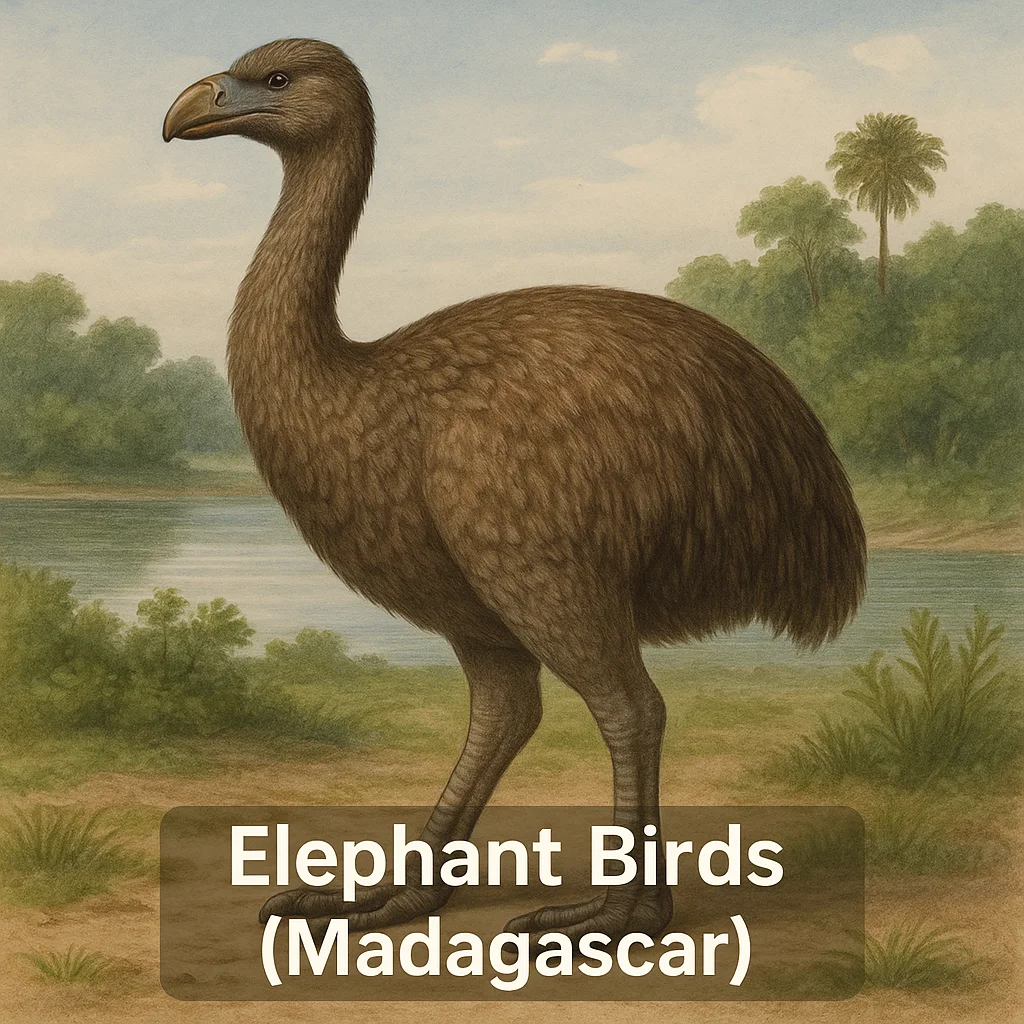
Closely related to the kiwis of New Zealand, elephant birds coexisted in the ecosystem of Madagascar, contributing to its biodiversity. As herbivores, they played a significant role in their environment, particularly in terms of seed dispersal.
In this article, you will learn about the natural habitat of elephant birds, their lifestyle, the reasons for their extinction, and the scientific evidence that we use to study them today. We'll also explore their uniqueness and their timeline of disappearance.
🧭 Where It Lived
The elephant bird was endemic to the island of Madagascar, meaning it was found nowhere else in the world. Madagascar is located off the southeastern coast of Africa and is the fourth largest island in the world.
Their habitat was primarily comprised of the island’s forests and grasslands. These regions provided ample food sources and breeding areas suitable for their large size and ground-dwelling nature.
Being isolated on an island, the elephant bird faced an increased risk of extinction. Island species are often susceptible to ecological changes and human impact, as their geographical range is limited and they often lack the adaptability seen in mainland species.
🌿 Habitat and Daily Life
Madagascar's climate includes a range of ecosystems from tropical rainforests to dry deciduous forests. The elephant birds thrived in these environments, with the warm temperatures and seasonal rains supporting the growth of plants which constituted their primary diet.
These giant birds fed on a variety of foliage, fruits, and seeds, and their foraging habits were crucial for the dispersal of several plant species. Unlike many birds, they did not migrate and were dependent on the resources available within their territory.
Little is known about their social structure, but it is believed that they were solitary or lived in small groups. Breeding season likely coincided with the rainy season, providing ample resources for raising their young. Elephant birds laid large eggs, much larger than those of any living bird today, which were incubated until hatching.
🧬 What Made It Unique
One of the most striking characteristics of elephant birds was their enormous size. Some species could reach over 3 meters (around 10 feet) in height and weigh as much as 500 kilograms (approximately 1,100 pounds). Their hefty frames were supported by strong legs adapted for walking rather than flight.
Their massive eggs are a subject of fascination even today. Recorded as the largest eggs of any known vertebrate, they were over 30 centimeters long and had the capacity to hold a volume greater than the average ostrich egg.
Culturally, elephant birds have been linked to legends and myths, possibly inspiring tales of giant birds seen by travelers who visited Madagascar. Despite their extinction, they remain a symbol of the island's unique heritage.
⏳ When It Disappeared
The extinction timeline of elephant birds is an area of ongoing research. The last confirmed remains date to around the 17th century, though some reports suggest they may have survived into the 1800s. Precise dates are challenging to confirm due to the paucity of written records from that period.
In declaring a species extinct, scientists rely on consistent evidence over significant periods indicating the absence of individuals. For elephant birds, this conclusion comes from the lack of recent findings or credible sightings after the specified time range.
While unclear records can create uncertainties, there is confidence in existing data that conclusively places them as extinct, with no remaining populations documented in the wild or captivity.
⚠️ Why It Went Extinct
The extinction of elephant birds was likely caused by a combination of factors. Habitat loss due to human settlement and agricultural expansion led to significant habitat fragmentation, which limited their living spaces and resources.
Overhunting by humans is thought to have been a major contributor to their decline. The demand for their large eggs and meat put pressure on their populations and decreased their ability to rebound.
Invasive species introduced by human settlers further complicated their survival. These animals competed with or preyed on elephant birds, introducing new challenges to which these large birds could not adapt quickly.
🧩 How We Know (Evidence and Records)
Evidence of elephant birds primarily comes from fossil records, including bones and eggshells found throughout Madagascar. These subfossils give researchers insight into the species’ size, diet, and biology.
Museum specimens and field notes from early explorers provide additional data. Historians also rely on oral histories and storytelling to piece together historical interactions between humans and elephant birds.
Scientists verify the identity and timeline of these creatures using advanced techniques like radiocarbon dating, which helps to clarify the ages of fossils and the chronological history of these birds.
🛡️ Could It Have Been Saved
If conservation actions had been implemented earlier, it is possible that elephant birds could have been saved. Protecting their habitats and regulating hunting might have stabilized or increased their populations.
Controlling invasive species could have minimized external threats, giving the elephant birds a better chance at survival. Captive breeding programs might also have contributed to their preservation, though these efforts often faced logistical challenges.
Unfortunately, many of these measures were not available or prioritized during the time of their decline, and understanding of ecological conservation was limited, allowing extinction to proceed unchecked.
🔁 Are There Any Survivors or Close Relatives Today
The closest living relatives of the elephant birds are the kiwis of New Zealand, which share several anatomical features despite being much smaller. These birds fill a similar ecological niche in their native environments.
Though there are no direct "ecological replacements" for elephant birds due to their unique size and role, other species like the cassowary and emu have similar grazing patterns and bodily structures.
There are no reintroduction or captive programs for elephant birds, as no surviving individuals remain and the conditions that led to their extinction persist in altered forms today.
❓ Common Questions and Misconceptions
Was it hunted to extinction? Hunting contributed significantly, but habitat loss and invasive species were also key factors.
Why didn’t it adapt or move? Being large and flightless, adaptive options were limited, and island confinements hindered migration possibilities.
Could it still be alive somewhere? Current evidence strongly supports their extinction, with no credible sightings in recent history.
What does 'declared extinct' actually mean? It means thorough surveys have found no living individuals over a significant period.
What is the difference between endangered and extinct? Endangered species are at risk but still have surviving populations; extinct species have none.
Why are island species so vulnerable? Limited ranges and resources make adapting or competing with new threats harder for island species.
📌 Summary
- Elephant birds were massive, flightless birds native to Madagascar.
- They were endemic to Madagascar, making them uniquely vulnerable.
- Inhabited forests and grasslands rich in resources.
- Herbivorous diet aiding in seed dispersal.
- Extraordinarily large, adapted to ground dwelling.
- Last known presence spanned from the 17th to possibly 19th century.
- Extinction resulted from habitat loss, overhunting, and invasive species.
- Evidenced by extensive fossil records and historical accounts.
- Closest living relatives are the kiwis of New Zealand.
- Their extinction highlights the importance of early conservation action.
- They remain a testament to Madagascar's unique ecological history.