🏞️ Carolina Parakeet
🌍 What It Was
The Carolina Parakeet was a colorful member of the parrot family that once inhabited North America. With its bright green body, yellow head, and striking orange face, it was an exceptionally vibrant bird.
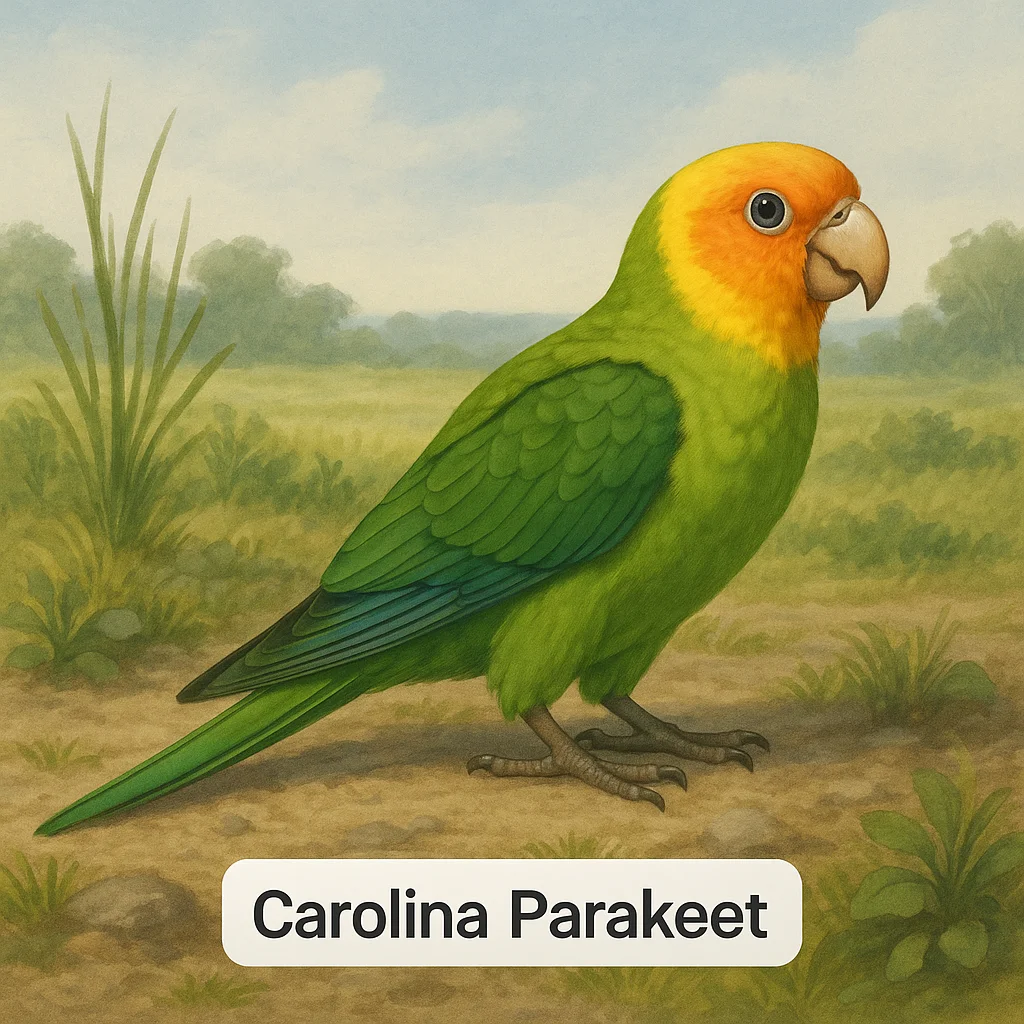
Its closest living relatives include the Amazon parrots native to Central and South America. The Carolina Parakeet played a significant role in its ecosystem as both a seed disperser and as prey for larger animals.
In this article, you will learn about where the Carolina Parakeet lived, how it contributed to its environment, when it disappeared, and the factors that led to its extinction.
🧭 Where It Lived
The Carolina Parakeet thrived in the eastern United States, ranging from the Midwest to the Atlantic and as far south as the Gulf Coast. Its range included present-day states like Ohio and Illinois all the way to Florida and Louisiana.
This parakeet primarily depended on forested habitats, especially those near water bodies such as rivers and swamps. These environments provided abundant food sources and nesting opportunities.
As forests were fragmented for agriculture and urban development, the available habitat for these birds decreased significantly, increasing their risk of extinction. When species are limited to specific habitats like the Carolina Parakeet was, they are inherently more vulnerable to changes in their environment.
🌿 Habitat and Daily Life
The climate in the Carolina Parakeet's range varied from temperate to subtropical, with warm summers and mild winters. Rainfall was typically adequate for maintaining its preferred lush, forested habitats.
This parakeet fed on seeds, fruits, and the flowers of various plants. In consuming these, the birds helped in dispersing seeds, thus playing a crucial role in their ecosystem.
Carolina Parakeets were highly social birds, often seen in flocks. They had a unique nesting system where they laid eggs in tree cavities. Their social structure included shared parental responsibilities for the young.
Their predators included snakes, mammals, and birds of prey, while they competed with other bird species for food and nesting sites.
🧬 What Made It Unique
The Carolina Parakeet's bright plumage made it easy to spot against the green backdrop of their forest homes. Its beak was adapted to crack various seed types, and its colorful feathers helped in attracting mates.
Aside from its visual appeal, the bird's ecological role as a seed disperser was invaluable. They aided in the maintenance and propagation of forest plant diversity.
Historically, the bird held significant cultural value to indigenous peoples and early settlers, often seen as a symbol of vibrancy and resilience, although without the layers of romanticized myth that sometimes accompany extinct species.
⏳ When It Disappeared
The Carolina Parakeet's numbers began declining rapidly in the late 19th century. The last confirmed wild sighting was in the early 1900s. By the mid-20th century, it was declared extinct following extensive surveys that failed to locate any surviving individuals.
It's important to note that extinction declarations take into account thorough evidence collection and the lack of any recent sightings over a prolonged period.
⚠️ Why It Went Extinct
The extinction of the Carolina Parakeet was driven by multiple factors. Habitat loss due to deforestation and agriculture broke apart the ecosystems they depended upon.
Overhunting also played a substantial role, as the birds were hunted for their feathers and as pests by farmers. Introduced species, including pets and pest control agents, possibly spread diseases to which the parakeets had no immunity.
Each of these factors individually stressed the parakeet's population, but together, they created insurmountable challenges for survival and reproduction.
🧩 How We Know (Evidence and Records)
Evidence for the Carolina Parakeet includes museum specimens, historical field notes, and records of its behavior. These allow scientists to identify traits and define its ecological role.
Fossils and subfossils provide a timeline of their existence, while genetics could offer insights, although data may be limited due to their extinction prior to modern techniques.
🛡️ Could It Have Been Saved
Protection of its habitat and the regulation of hunting might have contributed to preserving some populations. However, active conservation efforts to save the species were minimal or came too late, exhibiting a common pattern for extinct species.
Captive breeding programs, if established before their extinction, could have helped maintain viable populations, especially if paired with controlled rewilding efforts.
🔁 Are There Any Survivors or Close Relatives Today
Today, the closest living relatives of the Carolina Parakeet are Amazon parrots. These share similarities in physical appearance and ecological roles.
Although the Carolina Parakeet is extinct, its ecological role can be performed by other seed dispersing bird species, maintaining some level of ecological balance.
❓ Common Questions and Misconceptions
Was it hunted to extinction? Hunting was a significant factor, but habitat loss and disease also contributed.
Why didn’t it adapt or move? The rapid changes and combined threats were too overwhelming for the species to adapt quickly enough.
Could it still be alive somewhere? It is highly unlikely given the extensive searches and lack of evidence since the early 20th century.
What does 'declared extinct' actually mean? It means there have been no confirmed sightings despite thorough efforts to locate the species.
What is the difference between endangered and extinct? Endangered means at risk of extinction, whereas extinct means no individuals have been observed or verified to exist.
Why are island species so vulnerable? They are especially at risk due to limited ranges, specific habitat needs, and lack of resistance to new predators or diseases.
📌 Summary
- The Carolina Parakeet was a colorful parrot native to North America.
- It lived across the eastern United States, from the Midwest to the Gulf Coast.
- Forested habitats with proximity to water were vital for their survival.
- They had a varied diet of seeds and fruits, contributing to seed dispersal.
- Their bright plumage and seed-cracking beaks were key adaptations.
- The species was last confirmed in the wild in the early 1900s.
- Habitat loss and overhunting were main extinction drivers.
- Specimens and records provide evidence of their existence.
- Amazon parrots are their closest living relatives.
- Conservation teaches the importance of timely intervention.
- Their extinction highlights the delicate balance of ecosystems.