🏞️ Southern Gastric-brooding Frog
🌍 What It Was
The Southern Gastric-brooding Frog was a unique amphibian species known for its remarkable reproductive process. Unlike other frogs, this species had the extraordinary ability to brood its young in the stomach, giving it its distinctive name. This fascinating animal belonged to the amphibian family and was closely related to some of the more commonly known tree frogs.
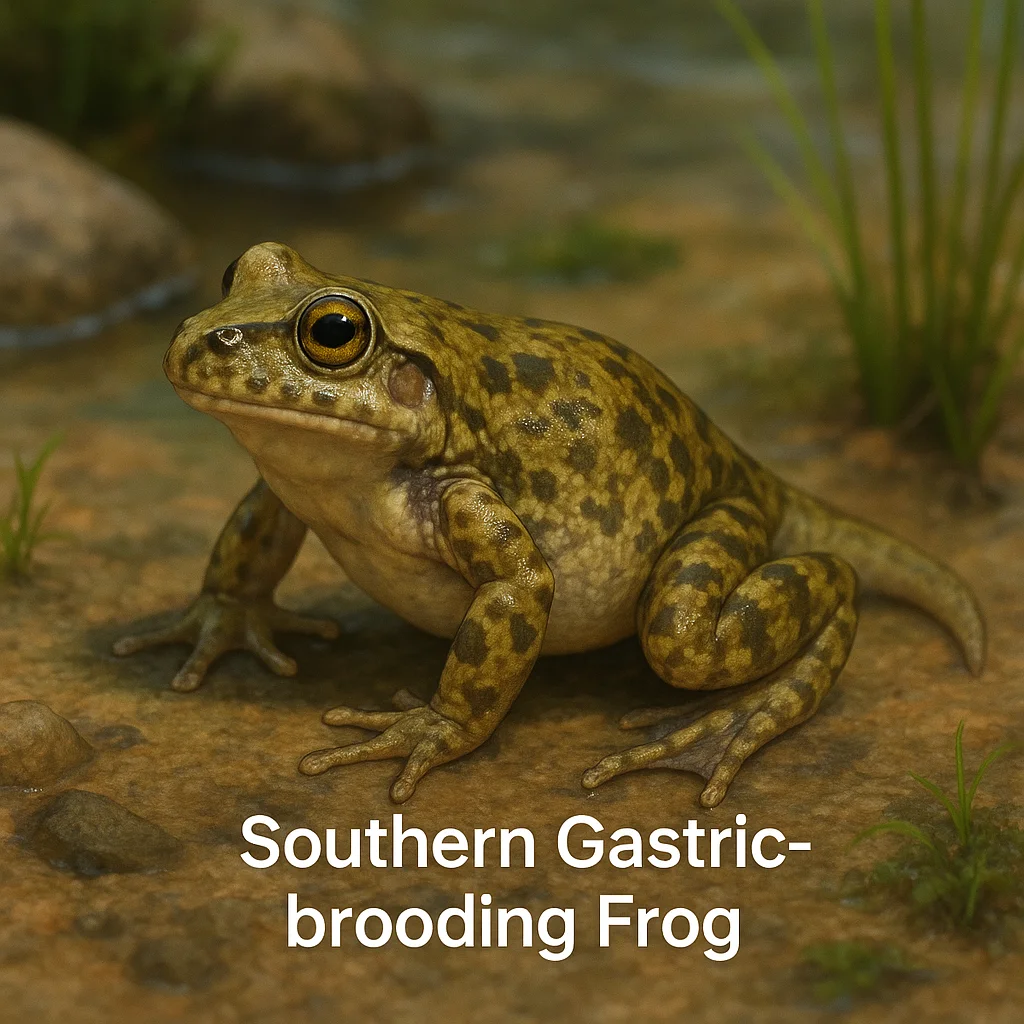
As part of its ecosystem, it played a role like many other frogs, helping to control insect populations and serving as prey for larger animals. Readers can expect to learn about its habitat, lifestyle, extinction timeline, and the factors that contributed to its disappearance.
This article will explore where the Southern Gastric-brooding Frog lived, how it sustained itself, when it vanished, and what threats it faced. By understanding these aspects, we can gain insights into its life and the delicate balance of its environment.
🧭 Where It Lived
The Southern Gastric-brooding Frog was endemic to Australia, specifically inhabiting areas of sub-tropical rainforest in the southeastern part of the country. Endemic means it was found only in this particular geographic location. Its range was limited, meaning it lived in a specific and constrained area, which heightened its vulnerability to environmental changes.
The frog's environment consisted mainly of mountainous rainforest regions where moisture levels and temperatures were suitable for its lifestyle. These areas provided the damp and cool conditions that the species needed to thrive.
Due to its restricted habitat and geographic range, any disturbances or alterations in its environment could have severe impacts on its survival. Consequently, the frog was sensitive to changes in land use and climate, which posed significant threats to its continued existence.
🌿 Habitat and Daily Life
The Southern Gastric-brooding Frog lived in a climate characterized by high humidity and moderate temperatures. The region received significant rainfall which supported the dense rainforests in which the frog thrived. These environmental conditions were crucial for the species' survival, as they depended on moisture for their skin respiration and breeding activities.
As for diet, the Southern Gastric-brooding Frog primarily fed on small invertebrates, including insects and spiders. It was an active forager, hunting in the leaf litter and understory of the rainforest. Its predatory role helped maintain a healthy balance of insect populations within its ecosystem.
The frog's reproduction was particularly notable. Females would engulf fertilized eggs and brood them in their stomachs. Over time, the eggs developed into tadpoles and eventually young frogs, which were then regurgitated and released into the environment. This unique reproductive process reduced the risk of predation and increased survival rates for the offspring.
🧬 What Made It Unique
The Southern Gastric-brooding Frog was small in size, typically showcasing a muted coloration that ranged from brown to green, helping it blend into the rainforest floor. Its most significant adaptation, however, was its remarkable reproductive strategy—gastric brooding, where it nurtured its young inside its stomach until they underwent metamorphosis.
This extraordinary adaptation may have also contributed to its role in cultural or historical contexts. The frog's unique reproductive method made it a subject of scientific curiosity and study, providing insights into the flexibility and variety of life strategies among amphibians.
⏳ When It Disappeared
The last confirmed sightings of the Southern Gastric-brooding Frog were in the early 1980s. Despite concerted efforts to locate remaining populations, no definitive evidence of their existence has been confirmed since. This led to the species being declared extinct.
Declaring a species extinct involves thorough surveys and consideration of potential habitats. In some cases, remote or inaccessible locations can harbor undiscovered populations, but the repeated absence of sightings often leads to the formal extinction declaration.
The uncertainty in exact last sightings highlights the challenges in identifying extinctions, especially for species dwelling in isolated and complex habitats like rainforests.
⚠️ Why It Went Extinct
The extinction of the Southern Gastric-brooding Frog is attributed to multiple causes. Habitat loss and fragmentation played a significant role, as deforestation and land use changes reduced the suitable living areas for the frog. This made it harder for populations to sustain themselves and find the necessary resources.
Introduced species and diseases, such as the chytrid fungus, also contributed to the decline. The chytrid fungus is a pathogen that affects amphibian skin, leading to critical health problems and death. As this fungus spread through frog populations globally, it posed a severe threat to species like the Southern Gastric-brooding Frog, which may have had limited disease resistance.
Climate change and extreme weather events potentially exacerbated these challenges, altering the frog's habitat conditions and further impacting its survival prospects. These factors, together with others, demonstrate how extinctions can result from a combination of human activities and natural processes.
🧩 How We Know (Evidence and Records)
The existence and extinction of the Southern Gastric-brooding Frog are documented through various forms of evidence. Museum specimens and field notes from researchers who studied the species before its extinction provide valuable insights into its biology and disappearance.
Photographs and firsthand accounts from experts who observed the frog in its natural habitat contribute to our understanding of its physical characteristics and behaviors. Additionally, genetic studies from preserved specimens help verify its identity and confirm its extinction.
The reliability of these records and the repeatability of surveys confirm that no populations remain, solidifying the understanding of the frog's demise.
🛡️ Could It Have Been Saved
Conservation efforts, if implemented in time, might have slowed or prevented the extinction of the Southern Gastric-brooding Frog. Protecting and preserving its remaining habitat could have provided a refuge against habitat loss, while monitoring and controlling the spread of the chytrid fungus could have improved survival rates.
In hindsight, captive breeding programs that preserve genetic material might have offered opportunities for reintroduction, assuming habitats could be restored. Unfortunately, these measures came too late or were inadequately pursued, leading to the frog's extinction.
Despite the many challenges, the case of the Southern Gastric-brooding Frog serves as a lesson in the importance of early intervention and comprehensive conservation strategies.
🔁 Are There Any Survivors or Close Relatives Today
While the Southern Gastric-brooding Frog itself is extinct, it has close relatives among other amphibians, particularly within the tree frog family. These relatives share some ecological roles and physical characteristics, although none exhibit the unique gastric brooding reproduction strategy.
No direct ecological replacements fulfill the gastric brooding role, highlighting the irreplaceable value of unique species within ecosystems. The loss reflects a gap in diversity that cannot easily be filled by existing species.
These relatives continue to inhabit similar ecosystems, serving as a reminder of biodiversity's fragility and the need for effective conservation to prevent further losses.
❓ Common Questions and Misconceptions
Was it hunted to extinction?
No evidence suggests that hunting was a significant factor in its extinction.
Why didn’t it adapt or move?
Rapid environmental changes and disease outpaced its ability to adapt or relocate.
Could it still be alive somewhere?
While unlikely, it's not impossible for undiscovered individuals to exist, though none have been found despite extensive searches.
What does 'declared extinct' actually mean?
It means no live individuals have been observed for a significant period, despite comprehensive surveys.
What is the difference between endangered and extinct?
Endangered species are at high risk of extinction, while extinct species have no surviving individuals.
Why are island species so vulnerable?
Isolated evolution and limited ranges make island species more susceptible to environmental changes and invasive species.
📌 Summary
- The Southern Gastric-brooding Frog was an extinct amphibian unique for raising its young in its stomach.
- It lived in the subtropical rainforests of southeastern Australia.
- The frog depended on moist, cool rainforests as its habitat.
- Its diet consisted of small invertebrates, aiding in insect population control.
- Unique adaptations included gastric brooding, unparalleled amongst frog species.
- Last seen in the early 1980s, leading to an extinction declaration.
- Main extinction drivers included habitat fragmentation, disease, and climate change.
- Museum specimens and field notes validate its existence and decline.
- Closely related to other tree frogs but with no direct ecological replacement.
- The Southern Gastric-brooding Frog's story teaches the need for early and comprehensive conservation strategies.
- Memorable takeaway: Its unique reproductive method underscores biodiversity's imaginative potential and fragility.