🏞️ Commercial Hunting Peaks
🌍 What It Was
The concept of "Commercial Hunting Peaks" pertains to historical periods where specific animal species were intensely hunted for economic reasons. This practice often targeted animals with high-value parts such as furs, skins, tusks, or meat. Many of these animals played significant roles in their ecosystems.
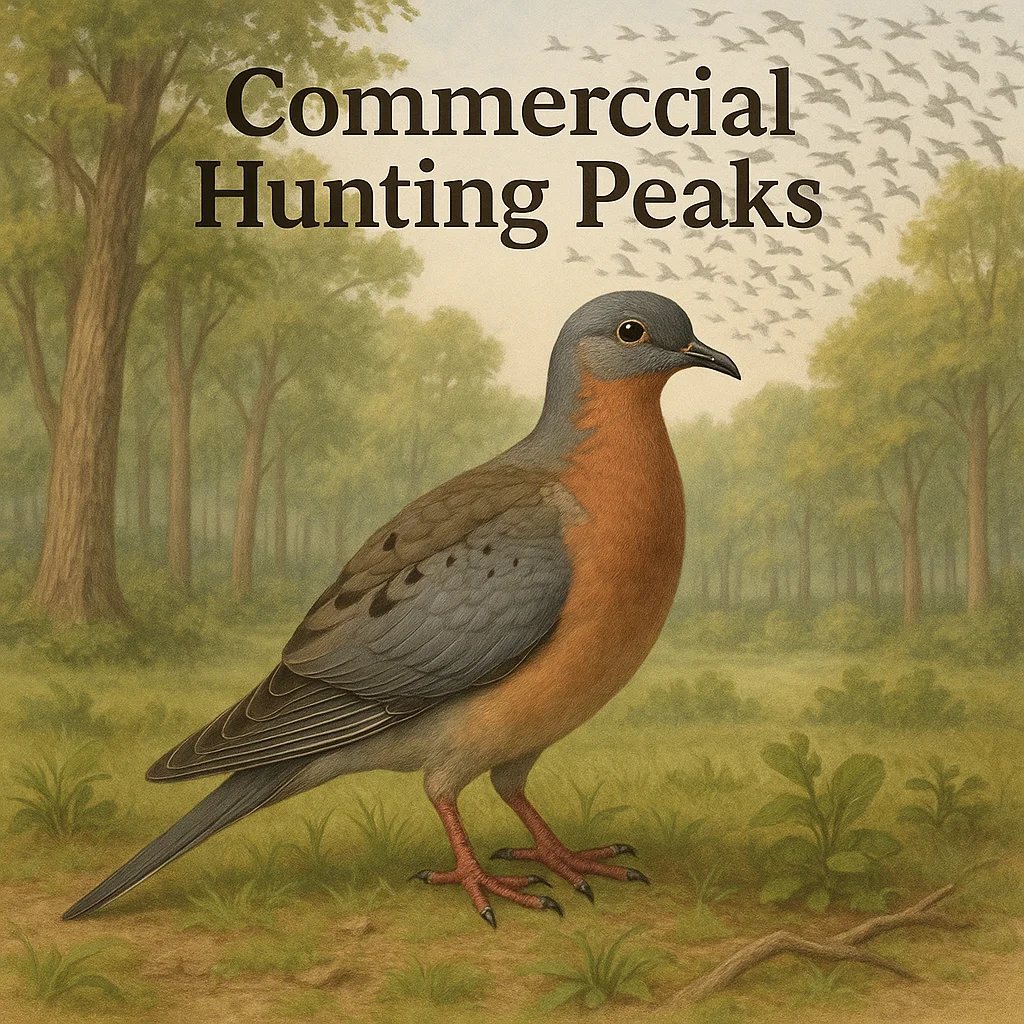
An iconic example of a species driven to extinction due to commercial hunting peaks is the Passenger Pigeon, a bird once abundant in North America. Distinctive for its vast flocks, the Passenger Pigeon was an essential player in spreading seeds across its habitat.
In this article, we will explore the general characteristics of animals affected by commercial hunting peaks, where they lived, their daily life, and what ultimately led to their extinction. We will use the Passenger Pigeon as a guiding example while referring to similar cases.
🧭 Where It Lived
The Passenger Pigeon, like several commercially hunted species, once roamed a broad geographic range. It primarily inhabited deciduous forests in North America, spanning from the eastern United States to Canadian territories.
Forests and woodlands served as their optimal habitat, offering ample resources such as food and nesting areas. These environments, rich in acorns, nuts, and seeds, supported the dense populations through seasonal shifts.
The availability of vast forested areas allowed massive flocks to thrive, a trait that increased their vulnerability when these forests were fragmented or cleared. Island-limited species faced even higher risks since they could not easily relocate as their habitats deteriorated.
🌿 Habitat and Daily Life
The temperate climate in the eastern parts of North America provided a suitable environment for Passenger Pigeons. They benefited from seasonal variations, which affected food availability and breeding patterns.
Passenger Pigeons primarily fed on seeds, fruits, and insects. They had a unique foraging behavior, traveling in enormous flocks that could darken skies, searching for food over large areas.
Breeding took place in large colonies, with each pair caring for a single offspring. Flocks nested in concentrated areas, making them susceptible to mass captures by hunters. They had few natural predators, but humans proved significantly more impactful.
🧬 What Made It Unique
The sheer size of the Passenger Pigeon flocks was unparalleled, with numbers so vast they would block sunlight. Their size and social behavior were key to their evolutionary success until commercial hunting dramatically reduced their populations.
Passenger Pigeons played a vital role in their ecosystems by aiding the dispersal of seeds across forests. Cultural significance was observed as they often appeared in Aboriginal myths and were an integral resource for early settlers.
⏳ When It Disappeared
The last confirmed record of a wild Passenger Pigeon was in the early 1900s. The species is officially considered extinct following the death of the last known individual, named Martha, in a Cincinnati zoo in 1914.
The timeline of extinction indicates a rapid decline from billions to none within a few decades. Uncertainty exists in precise records due to the vast territory they covered and the difficulty in tracking such large flocks.
Extinction is declared when rigorous searches fail to find individuals over a specific period. In the wild, Passenger Pigeons were no longer observed, indicating their demise in nature before Martha's death.
⚠️ Why It Went Extinct
The extinction of the Passenger Pigeon and other commercially hunted species was multi-causal. The primary driver was overhunting for commercial purposes, capturing the birds by the hundreds for meat markets.
Habitat loss due to forest clearing for agriculture compounded the threat of overhunting. As forests disappeared, so did the critical food sources and nesting areas for the birds.
Other contributing factors include the lack of legal protection and slow reproductive rates, unable to compensate for the drastic population declines caused by human activities.
🧩 How We Know (Evidence and Records)
Evidence of the Passenger Pigeon's decline is supported by museum specimens, historical records, field notes, and photographs. These records help verify the species' existence, habits, and eventual disappearance.
Oral histories also provide secondary accounts of interactions and sightings. Genetic studies of preserved specimens offer insight into their population dynamics and genetic diversity before extinction.
Species that lived in remote or densely forested areas often remain difficult to track, leading to debates about their status until comprehensive surveys confirm extinctions.
🛡️ Could It Have Been Saved
Realistic conservation actions could have included strict hunting limits and protected reserves to prevent habitat loss. Laws enacted in time may have slowed or halted declines.
Trade-offs included economic dependence on hunting industries at the time, delaying protective measures. Late interventions reflect society's initial undervaluing of biodiversity and ecological balance.
Some late conservation attempts, such as captive breeding, were considered but too delayed to counteract the rapid decline in wild populations.
🔁 Are There Any Survivors or Close Relatives Today
Closest living relatives to the Passenger Pigeon are species like the Mourning Dove, sharing similar habitats and ecological roles. However, no direct ecological replacement exists for their seed dispersal behavior.
Reintroduction attempts that focus on de-extinction are largely theoretical and controversial, given the unknowns in creating viable, self-sustaining populations.
❓ Common Questions and Misconceptions
Was it hunted to extinction? Yes, overhunting was a primary driver, but habitat loss also played a significant role.
Why didn’t it adapt or move? These birds relied on specific habitats that were disappearing too quickly for them to adapt.
Could it still be alive somewhere? Given the lack of confirmed sightings and habitat loss, experts agree it is extinct.
What does 'declared extinct' actually mean? Declared extinct means no individuals have been reliably observed over a significant period in their natural environment.
What is the difference between endangered and extinct? Endangered species are at risk of extinction, while extinct species no longer exist.
Why are island species so vulnerable? Island species often have smaller populations and limited habitats, making adaptation or dispersion difficult during environmental changes.
📌 Summary
- Commercial hunting targets animals for economic value.
- Species like the Passenger Pigeon lived in North America.
- Habitat included deciduous forests rich in nuts and seeds.
- Social behavior and flock size were distinctive traits.
- Overhunting and habitat loss led to extinction.
- Evidence includes museum specimens and historical records.
- Closest relatives include the Mourning Dove.
- Protection could have helped, indicating conservation value.
- Extinctions are often complex and multifaceted.
- Conservation efforts must prioritize timely interventions.
- Passenger Pigeons played a crucial role in seed dispersal.