🏞️ Natural History Collections: Help or Harm?
🌍 What It Was
Natural history collections serve as a tangible record of life on Earth, harboring specimens of plants, animals, and other organisms. These collections are crucial for understanding biodiversity, ecological relationships, and evolutionary processes. In this article, we explore the dual role of natural history collections: are they helpful tools for science, or do they harm nature by removing living organisms from the wild?
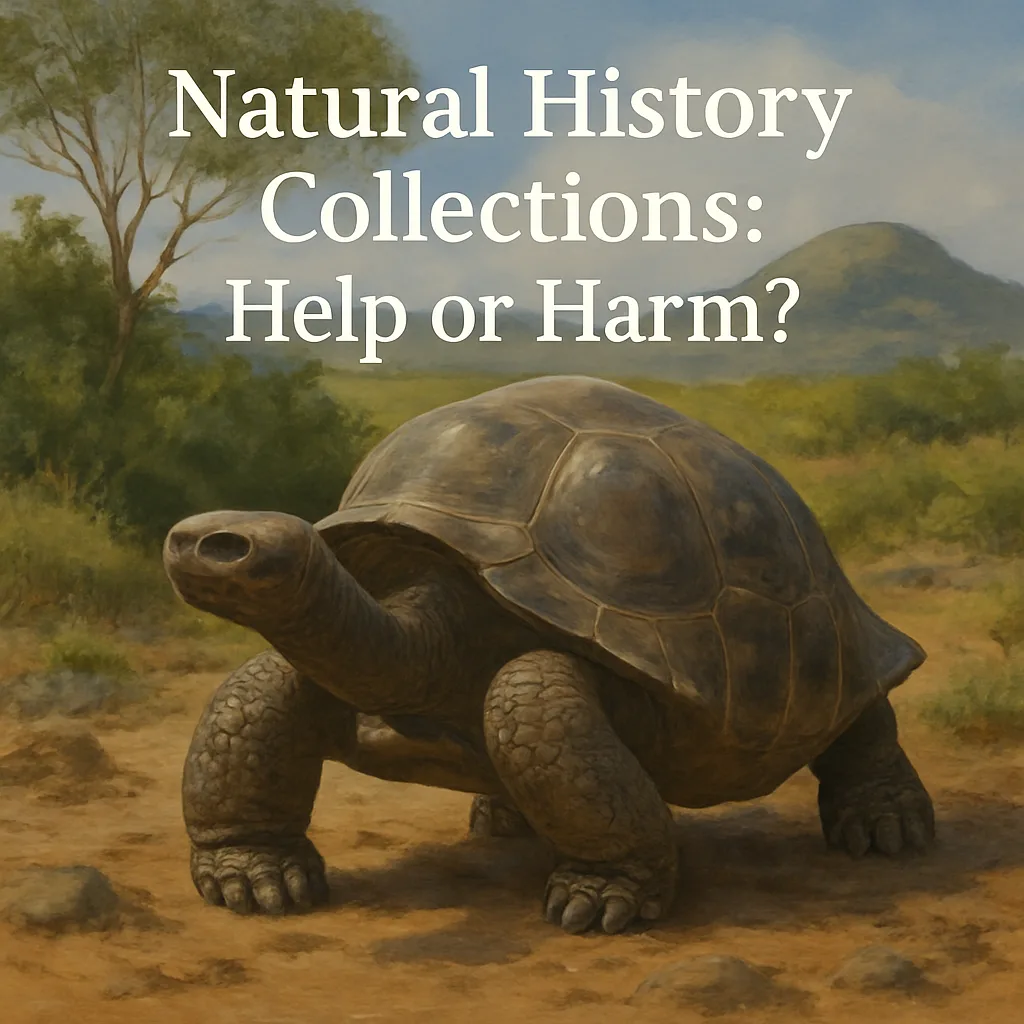
The giant tortoises of the Galápagos Islands, for example, were once collected extensively. As unique reptiles, they possessed large shells and played a vital role in their ecosystems. These tortoises are closely related to the smaller tortoises found on mainland South America.
By studying collections of these tortoises, researchers aim to learn more about where and how these animals lived, when they disappeared from particular islands, and the reasons behind their decline. This article will delve into these aspects, highlighting the balance necessary in maintaining natural history collections.
🧭 Where It Lived
The giant tortoises were endemic to the Galápagos Islands, an archipelago located about 1,000 kilometers (620 miles) off the coast of Ecuador. Each island hosted its own population of tortoises, some of which varied significantly in shape and size.
The islands' diverse habitats range from arid lowlands dominated by cacti to lush highland forests. Tortoises adapted to these environments, inhabiting territories best suited to their physical adaptations. Some tortoises, for instance, evolved saddleback shells which enabled them to reach up high for food, while others developed dome-shaped shells suitable for environments with abundant ground vegetation.
This specialization in habitat made the tortoises highly susceptible to environmental changes. Their limited geographic distribution meant that any alteration in their environment—such as human activities or the introduction of invasive species—could have devastating effects.
🌿 Habitat and Daily Life
The climates of the Galápagos Islands vary significantly. However, they generally experience a warm season with frequent rainfall and a cooler, dryer season influenced by ocean currents. These factors heavily influenced the daily lives of the tortoises.
Their diet mainly consisted of grasses, cacti, and berries. The tortoises were mostly solitary creatures, but during the breeding season, they would congregate in larger groups. Females laid their eggs in sandy nests, and juvenile tortoises were left to fend for themselves after hatching.
Interactions with other species included grazing patterns that impacted the spread of certain plant species and possibly even competition for food resources with introduced animals like goats and pigs.
🧬 What Made It Unique
Giant tortoises are renowned for their size, reaching over 1 meter (3 feet) in length and weighing up to 300 kilograms (660 pounds). Their distinctive shells not only served as protection but also played a role in thermoregulation.
These reptiles were vital seed dispersers, contributing to the maintenance and regeneration of plant communities on the islands. The cultural significance of these tortoises cannot be understated, as they became symbolic of the unique biodiversity of the Galápagos Islands.
Their remarkable endurance and adaptability allowed them to survive on scant resources, and their uniquely adapted shells were perfect for the specific islands they inhabited.
⏳ When It Disappeared
The decline of giant tortoises began in the 19th century. Sailors and settlers hunted them for food, and they were easy targets because of their slow movements and lack of natural predators. By the late 20th century, several populations were declared extinct.
Establishing the exact extinction date for many tortoise populations is challenging due to incomplete records and the remoteness of the islands. Often, the declaration of extinction comes years or even decades after the last confirmed sighting when exhaustive surveys find no trace of the creatures.
For some subspecies, like the Pinta Island tortoise, the status "Extinct in the Wild" reflected conservation programs' efforts to preserve genetic material and potentially resurrect species through captive breeding.
⚠️ Why It Went Extinct
The extinction of many giant tortoise populations was driven by a combination of factors. Habitat loss and fragmentation occurred as humans altered landscapes for agriculture or settlement.
Overexploitation played a significant role; the tortoises were hunted for their meat and oil. Introduced species like rats and goats competed with them for resources and destroyed eggs and vegetation.
Natural events such as volcanic eruptions and climate fluctuations may have also contributed. These multiple pressures compounded to weaken tortoise populations and hinder their ability to recover.
🧩 How We Know (Evidence and Records)
Evidence of the historical presence of giant tortoises comes from various sources, including subfossil remains, museum specimens, early explorer accounts, and more recently, genetic analyses. These methods help scientists piece together the history and extent of tortoise populations.
Museum specimens play a crucial role in verifying species identities and documenting physical characteristics. Field notes and photographs from early visitors to the Galápagos also provide valuable insights into the tortoises' distribution and abundance.
Sometimes, confirming the presence of these reptiles in specific areas is difficult due to their remote habitats and elusive nature. Genetic studies have helped clarify lineage and evolutionary relations among different tortoise populations.
🛡️ Could It Have Been Saved
Conservation efforts, including habitat protection, invasive species control, and captive breeding, have been implemented too late for some tortoise populations but have shown success for others.
Trade-offs in conservation efforts often reflect the balance between preserving genetic diversity and immediate action to prevent further declines. Comprehensive surveys and early intervention are critical to ensuring better outcomes.
Several subspecies have been successfully reintroduced to their native habitats, thanks to concerted breeding programs that highlight the resilience of some populations when given adequate protection.
🔁 Are There Any Survivors or Close Relatives Today
Several giant tortoise populations still survive across different islands of the Galápagos. These survivors share common ancestry but have diverged significantly over time, each adapting uniquely to their island's environment.
The giant tortoises' closest living relatives are likely found on mainland South America. Conservation efforts today focus on protecting these animals and expanding captive breeding programs to help bolster population numbers.
While reintroduction efforts have seen success, it is essential to maintain the ecological balance of the islands, ensuring these storied reptiles continue to play their role in the archipelago's ecosystem.
❓ Common Questions and Misconceptions
Was it hunted to extinction? In part, yes. Overhunting was a significant factor, though other issues also contributed.
Why didn’t it adapt or move? Tortoises had highly specialized adaptations to their unique environments and geographic isolation limited their ability to migrate.
Could it still be alive somewhere? Some populations considered extinct might still exist, as undiscovered populations can occur, but most are thoroughly investigated.
What does 'declared extinct' actually mean? It refers to when there is no reasonable doubt that the last individual of a species has died, based after rigorous surveys in known or expected habitats yield no results.
What is the difference between endangered and extinct? 'Endangered' means at significant risk of extinction, while 'extinct' means no known living individuals remain.
Why are island species so vulnerable? Island species often have small populations and limited ranges, making them more susceptible to changes in their environments.
📌 Summary
- Giant tortoises serve as an example of natural history collections' complexities.
- They were native to the Galápagos Islands.
- They occupied diverse habitats, from desert lowlands to lush highlands.
- Their diet included grasses and cacti, influencing plant distributions.
- Distinctive large shells were key adaptations.
- Population declines began in the 19th century due to overhunting and habitat changes.
- Extinction drivers were multi-causal: hunting, habitat loss, invasive species.
- Research relies on fossils, museum specimens, and genetic analyses.
- Closest living relatives may be on mainland South America.
- Effective conservation requires prompt action and habitat protection.
- Giant tortoises underscore the importance of biodiversity preservation.
- These animals play a crucial ecological role in the Galápagos ecosystem.