🏞️ Major Extinction Lessons from the 1700s
🌍 What It Was
During the 1700s, several animal species faced extinction, leaving behind important lessons for future generations. Among these was the Great Auk, a flightless bird that became one of the era's most poignant symbols of extinction. The Great Auk was similar to today's penguins, though it was more closely related to other auks. This bird played a significant role in its marine ecosystem, contributing to the nutrient cycle through its feeding and nesting behaviors.
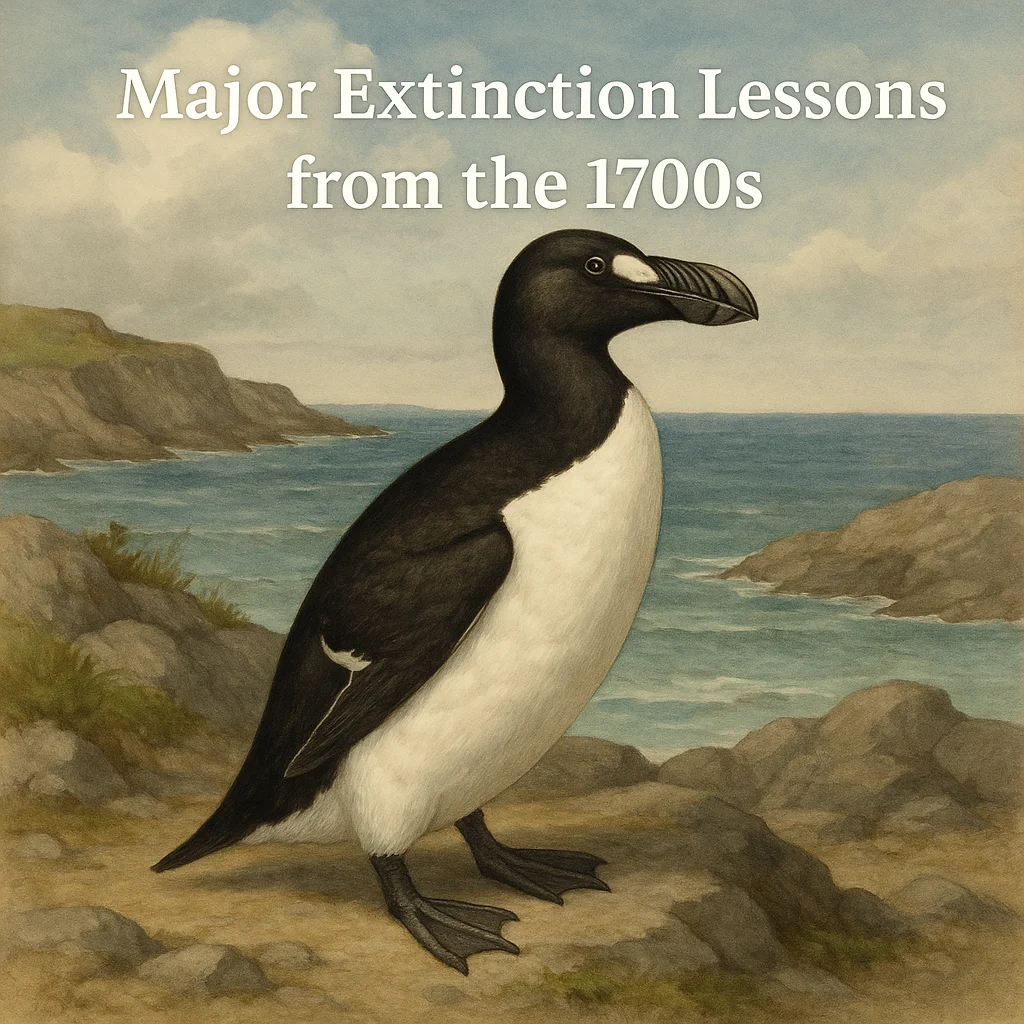
Readers will explore the habitats where the Great Auk lived, how it thrived in its environment, when it vanished, and the reasons for its disappearance. The Great Auk's story provides a window into the ecological dynamics of the time and the early factors contributing to species extinction.
This article will cover the geographic range of the Great Auk, its daily life and habits, unique physical traits, the timeline of its extinction, and the complex causes behind its disappearance. Additionally, it will address common misconceptions about extinction and highlight lessons for modern conservation efforts.
🧭 Where It Lived
The Great Auk inhabited the North Atlantic, with a range stretching across coastal areas from the northeastern United States to northern Europe. It was particularly abundant on rocky islands and coastlines where it could nest and find refuge from predators.
This bird was adapted to a specific environment, depending on cold, nutrient-rich waters filled with fish, its primary food source. These regions offered the necessary resources for feeding and breeding, making them crucial to the Great Auk’s survival.
Island habitats often pose additional risks to species like the Great Auk. Isolation can limit genetic diversity and make populations more susceptible to changes in their environment. This reliance on limited and specific locales made the Great Auk more vulnerable to external threats, such as human disturbance and environmental changes.
🌿 Habitat and Daily Life
The climate in the Great Auk's habitat regions typically featured cold temperatures and rough seas, which provided ideal conditions for its existence. Abundant fish populations supported its diet, as it primarily consumed fish caught during deep dives.
Like many seabirds, the Great Auk was a skilled swimmer, using its wings to propel through water while hunting. It spent much of its life at sea, coming ashore only to breed on rocky, isolated coastal islands. Breeding seasons were marked by the creation of large colonies, where pairs would lay a single egg and share parenting duties.
The Great Auk interacted with other marine species, competing for food with similar fish-eating birds and perhaps benefiting from shoaling fish stirred up by marine mammals. Such ecological interconnections highlight the Auk's role within its ecosystem.
🧬 What Made It Unique
The Great Auk stood nearly a meter tall, with dense, waterproof feathers that provided insulation against cold waters. Its black and white plumage resembled that of modern penguins, offering camouflage in the oceanic environment.
Beyond its physical traits, the Great Auk was a skilled diver, capable of reaching significant depths in pursuit of prey. This adaptation was crucial for its survival in marine ecosystems where fish formed a large part of its diet.
Historically, the Great Auk held cultural significance to the indigenous peoples of the North Atlantic. Its presence in folklore and as a resource for food and materials underscored its role in human life, a factor contributing to its eventual decline.
⏳ When It Disappeared
The Great Auk's decline was noted throughout the 1700s, with the last confirmed sightings recorded in the mid-1800s. Specific dates and locations vary across records, but the last known breeding pair was killed in 1844 on an Icelandic island, marking a sad milestone.
Extinction declarations are based on thorough searches and the absence of sightings within a historically occupied range. With missing records and potential misidentifications complicating timelines, declaring a species extinct requires both scientific rigor and acceptance of uncertainty.
For the Great Auk, this process concluded with its extinction being recognized after repeated failed searches and no reliable evidence of surviving individuals.
⚠️ Why It Went Extinct
The extinction of the Great Auk was driven by several factors, each contributing to its decline. Habitat loss played a significant role as human settlements expanded, and land use changes encroached upon breeding sites. The fragmentation of nesting grounds limited safe spaces for reproduction.
Overhunting was another primary cause. The Great Auk was hunted extensively for its meat, eggs, and feathers. Such overexploitation outpaced its slow reproductive rate, which could not sustain population levels.
Introduced species, like rats and cats, threatened eggs and chicks on colonies, while climate shifts in the North Atlantic may have further stressed the population by altering fish availability. Though no single cause was insurmountable, together they created an overwhelming challenge for the Great Auk.
🧩 How We Know (Evidence and Records)
Our understanding of the Great Auk’s extinction comes from various sources, including subfossils, museum specimens, and field notes from early naturalists. These records document the bird's physical characteristics and life history.
Oral histories from indigenous communities and mariners also contribute valuable insights, while genetics offer clues about population bottlenecks preceding extinction. Together, these sources provide a comprehensive view, allowing scientists to verify the timeline and causes of the auk’s decline.
Due to its oceanic nature, some uncertainty persists regarding the exact timing of extinction, but modern methods continually refine our understanding.
🛡️ Could It Have Been Saved
Conservation measures like habitat protection and regulated hunting might have extended the Great Auk's survival. Protecting breeding colonies and addressing invasive species could have mitigated some extinction drivers.
However, conservation awareness was limited during the 1700s, and understanding of ecosystem dynamics was nascent. Though retrospective conservation appears straightforward, real-time interventions are complex, often hindered by resource limitations and competing human interests.
Late attempts to conserve the Great Auk were insufficient, as overhunting and habitat disruption had already decimated critical populations before effective action could take place.
🔁 Are There Any Survivors or Close Relatives Today
The Great Auk’s closest living relatives are other auks, such as the Razorbill. These birds share similar ecological roles, including feeding patterns and nesting behaviors. While not direct replacements, they offer insights into what the Great Auk's role might have been in today's ecosystems.
No direct survivor populations or reintroduction programs exist for the Great Auk, given its confirmed extinction status. However, understanding related species enhances our ecological knowledge and informs current conservation strategies.
Efforts to protect extant auks benefit from lessons learned from the Great Auk, emphasizing proactive conservation before populations reach critical decline.
❓ Common Questions and Misconceptions
Was it hunted to extinction? Yes, overhunting was a major factor, alongside habitat loss and other pressures.
Why didn’t it adapt or move? The Great Auk had specific habitat needs and faced rapid environmental changes, limiting its adaptability.
Could it still be alive somewhere? Given extensive searches and lack of sightings, the consensus is that it is extinct.
What does 'declared extinct' actually mean? It means no individuals have been reliably documented despite thorough searches.
What is the difference between endangered and extinct? Endangered species are at high risk of extinction, while extinct species have no remaining individuals.
Why are island species so vulnerable? Island species often have limited ranges and unique adaptations, making them susceptible to introduced threats and habitat change.
Did it have any natural predators? Its primary threat was human hunting, though eggs and chicks were vulnerable to other animals.
How did people know it was gone? Systematic searches and lack of sightings confirmed its extinction.
📌 Summary
- The Great Auk was a flightless marine bird.
- It lived across the North Atlantic.
- Dependent on cold, fish-rich waters.
- It dived for fish and formed breeding colonies on islands.
- Adaptations included swimming proficiency and thick feathers.
- Last seen in mid-1800s, declared extinct following extensive searches.
- Main extinction drivers: overhunting, habitat loss, introduced predators.
- Evidence includes subfossils, specimens, and historical accounts.
- Closest relatives are living auk species like the Razorbill.
- Lesson: Address extinction drivers promptly before populations decline.
- Memorable takeaway: Island species require careful conservation to prevent similar fates.