🏞️ Island Encounters and Rapid Loss
🌍 What It Was
The story of extinction is often a tale of uniqueness lost, and the Pinta Island tortoise is a poignant example. It was a giant tortoise native to the Galápagos Islands, part of a species complex that differed significantly from island to island. Known for its distinct saddle-backed shell, this tortoise was a marvel of evolutionary adaptation.
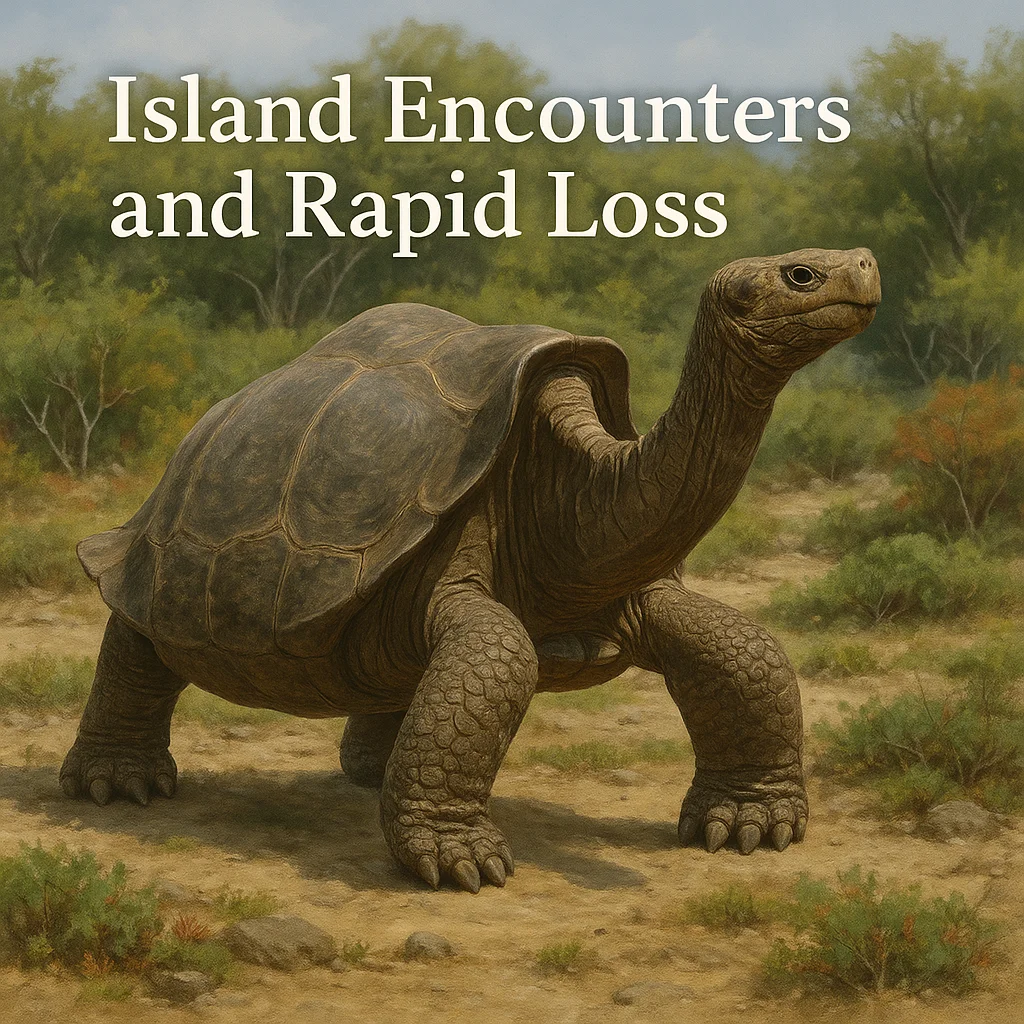
Closely related to other Galápagos tortoises, the Pinta Island tortoise played an integral role in its environment. Like its relatives, it was a slow-moving herbivore, but its unique shell shape allowed it to reach higher vegetation not accessible to other tortoises. This adaptive feature set it apart and defined its place in the ecosystem.
This article will explore where the Pinta Island tortoise lived, its daily life, what made it unique, when and why it disappeared, and the lessons we can learn from its extinction.
🧭 Where It Lived
The Pinta Island tortoise, as its name implies, was endemic to Pinta Island, one of the northern islands of the Galápagos archipelago. This remote island environment played a crucial role in the tortoise's evolution and specialization.
Pinta Island consists of varied habitats, including arid lowlands and lush highlands, where the tortoise roamed freely in search of food. The island's diverse vegetation, from cacti in the drier regions to grasses and shrubs in the wetter highlands, supported the tortoise's herbivorous diet.
Being restricted to a single island made the Pinta Island tortoise especially vulnerable. This limited distribution meant that any significant environmental or anthropogenic changes could quickly threaten its survival. In island ecosystems, such isolation often translates to higher extinction risk, as adaptations finely tuned to a specific habitat can become liabilities when conditions change.
🌿 Habitat and Daily Life
Pinta Island's climate is characterized by warm temperatures and distinct wet and dry seasons. The tortoise navigated these changes by following food availability across different parts of the island, showcasing its adaptability.
Its diet primarily consisted of grasses, leaves, and cacti, which it foraged slowly, often spending hours feeding. The tortoise played an essential ecological role by dispersing seeds, which helped maintain plant biodiversity on the island.
The tortoise's reproductive cycle was relatively straightforward. Breeding typically occurred once a year, with females laying a clutch of eggs in sandy nests. Hatchlings were vulnerable to predation, and adult tortoises themselves had few natural predators, barring significant disturbances to their habitat.
🧬 What Made It Unique
The Pinta Island tortoise stood out for its saddle-backed shell, an evolutionary adaptation that allowed for extended neck movement to reach tall plants. This characteristic physical trait exemplified the concept of adaptive radiation seen within the Galápagos tortoises.
Apart from its shell, the tortoise's longevity and slow metabolism contributed to its survival in fluctuating environments. It also demonstrated the ability to store water and survive periods without food, traits essential to its survival on the sometimes arid Pinta Island.
The tortoise had cultural significance as well, symbolizing the unique biodiversity of the Galápagos. It drew scientific interest from the time of Charles Darwin, who noted the variations among island tortoise populations in his studies on evolution.
⏳ When It Disappeared
By the mid-20th century, the Pinta Island tortoise was already considered rare. The last known individual, affectionately named Lonesome George, was discovered in 1971. Despite exhaustive searches, no other specimens were found.
Extinction in such cases is declared after thorough investigations confirm the absence of any surviving individuals. Scientists remained hopeful for years due to the tortoise's remote habitat, but ultimately, Lonesome George's death in 2012 marked the official extinction declaration.
This declaration, though conclusive, always allows for the possibility that undiscovered individuals or populations might exist, but without verifiable evidence, the species remains classified as extinct.
⚠️ Why It Went Extinct
The extinction of the Pinta Island tortoise was primarily driven by human activities and the introduction of non-native species. Habitat loss and fragmentation occurred due to the introduction of goats, which overgrazed vegetation and led to significant ecological changes on Pinta Island.
Introduced species like rats and feral dogs also posed a threat by preying on eggs and young tortoises, while competition for food with introduced goats reduced the availability of resources for the tortoises.
Additionally, the tortoises were hunted by humans in the past, contributing to their decline. Changes in climate or extreme weather events might have compounded these issues, but overgrazing and predation by invasive species played more direct roles in their extinction.
🧩 How We Know (Evidence and Records)
The evidence for the Pinta Island tortoise's existence and extinction comes from a variety of sources. Fossil records and subfossils help reconstruct their history and understand their evolutionary path.
Museum specimens, especially those collected during the 19th and early 20th centuries, provide tangible evidence of the tortoises and their physical traits. Field notes and photographs give insight into their behavior and environment.
Oral histories from sailors and early explorers supplement scientific records, while modern genetic studies help confirm the distinct lineage and identity of the Pinta Island tortoise.
🛡️ Could It Have Been Saved
Earlier intervention through habitat protection and the removal of invasive species might have helped prevent the extinction of the Pinta Island tortoise. Efforts to control or eradicate goats and other non-natives came too late to save Lonesome George's kind.
Captive breeding programs were considered but were unfeasible due to the lack of genetic diversity and other individuals. Such programs typically require more than one specimen to be successful.
The Pinta Island case highlights the need for proactive measures and timely action in conservation, emphasizing the importance of understanding ecosystems' intricacies before issues reach critical points.
🔁 Are There Any Survivors or Close Relatives Today
Though the Pinta Island tortoise itself is gone, several other tortoise species within the Galápagos archipelago share a common ancestry. These relatives continue to thrive on islands with lesser human intervention and active conservation efforts.
The closely related Española tortoise underwent a successful recovery through captive breeding and habitat restoration, serving as a testament to what could potentially have been achieved for the Pinta Island tortoise.
Ecological replacements, such as other herbivores, are few on Pinta Island, but efforts continue to restore balance using remaining native species and careful environmental management.
❓ Common Questions and Misconceptions
Was it hunted to extinction? While hunting played a role, invasive species and habitat change were more crucial drivers.
Why didn’t it adapt or move? The tortoise was specialized for island life, limiting its potential to relocate rapidly.
Could it still be alive somewhere? Scientific searches have been exhaustive, and no evidence supports this hope.
What does "declared extinct" actually mean? It means there's no scientific evidence of any surviving individuals.
What is the difference between endangered and extinct? Endangered species still have surviving populations, whereas extinct ones have none.
Why are island species so vulnerable? Their limited range and specific adaptations make them susceptible to rapid changes and external threats.
Are there efforts to bring it back? Current conservation focuses on protecting remaining species rather than de-extinction.
Could captive breeding have worked earlier? Possibly, if multiple individuals had been found before too much genetic loss occurred.
📌 Summary
- A giant tortoise species that lived on Pinta Island in the Galápagos
- Its habitat was confined to a single island with lush and arid regions
- Lifestyle included slow grazing on grasses and cacti
- Unique saddle-backed shell enabled it to reach tall vegetation
- Last known individual, Lonesome George, died in 2012
- Main extinction drivers: habitat loss, invasive species, limited range
- Scientific evidence from fossils, specimens, oral histories
- Closest relatives are other Galápagos tortoises
- Critical lesson: timely conservation action needed for isolated species
- The absence of proactive measures showcases extinction's permanence