🏞️ How Exploration Changed Biodiversity
🌍 What It Was
Exploration has deeply influenced biodiversity across the globe, often leading to changes that have negatively impacted various species. This article will explore how exploration activities, from the discovery of new lands to the colonization and industrial expansion, have altered animal populations, sometimes resulting in extinction.
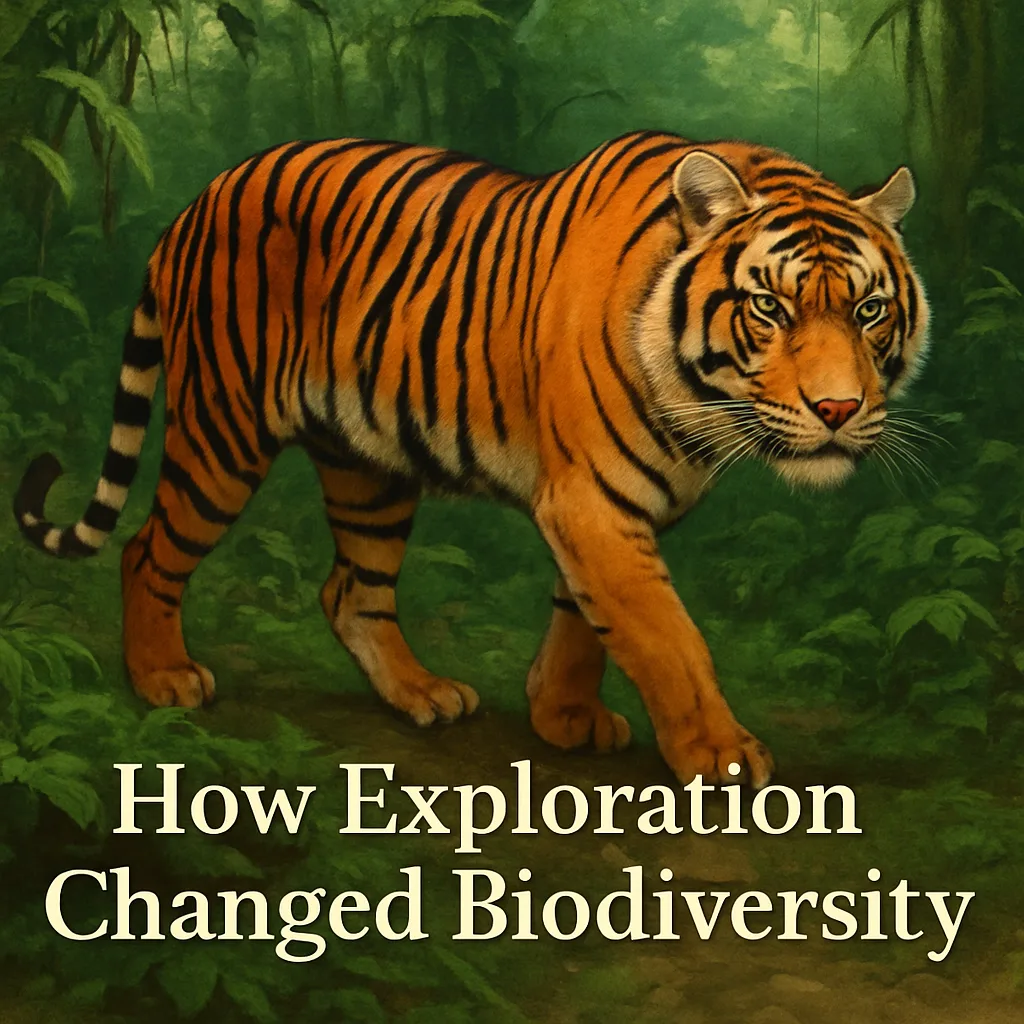
We will specifically look at a variety of species that have been affected over time. These range from large land mammals to endemic island species, each with unique characteristics distinguishing them from their close relatives. Through this, readers will understand more about these animals, their habitats, and how they have been influenced by human activities.
As we delve further, expect to learn about the regions these animals inhabited, the environmental factors they relied upon, the timing of their decline, and the reasons behind their disappearance. The interconnectedness of exploration, ecological disruption, and extinction will become evident.
🧭 Where It Lived
The geographic range of species affected by exploration is often diverse, spanning continents, islands, and unique ecological niches. For example, the Dodo, a famous victim of exploration-induced extinction, lived exclusively on the island of Mauritius. This isolation made it particularly vulnerable to changes introduced by human settlers.
The Great Auk, another species that vanished, lived across the North Atlantic, inhabiting areas from Canada to Northern Europe. As explorers expanded their voyages, these birds faced new threats. Their coastal habitats, particularly areas used for nesting and feeding, played a significant role in their lifecycle, demonstrating how habitat specificity can increase extinction risk.
Similarly, the Thylacine, or Tasmanian Tiger, was native to Tasmania. This marsupial predator roamed in forests and grasslands, and its survival was closely linked to these environments. As human exploration reached such isolated regions, the beam of exposure began to create challenges.
🌿 Habitat and Daily Life
The climates and environments that these species inhabited varied widely. Mauritius, where the Dodo lived, had a tropical climate with regular rainfall. This set the stage for a rich ecosystem sustained by dense forests. The Dodo primarily fed on fruits, seeds, and nuts, utilizing its strong beak to crack open tough shells. Its behavior was influenced by its isolation, which rendered it flightless and left it with few predators until humans arrived.
The Great Auk thrived in the cold, harsh climates of the North Atlantic. It hunted fish by diving into icy waters, demonstrating impressive swimming abilities. Auks nested in large colonies on remote islands, relying on communal defense strategies for protection. Yet, their reproductive rate was low, typically laying one egg per breeding season, making population recovery slow.
In contrast, the Thylacine roamed in temperate forest regions with substantial rainfall. As a carnivore, it preyed on small mammals and birds, utilizing stealth and its keen senses. Thylacines were reputed to have complex social structures within family groups, with care for young shared among members. Breeding typically occurred once a year, with pups staying in their mother's pouch until they matured further.
🧬 What Made It Unique
Several unique attributes defined these species. The Dodo's size and flightlessness are noteworthy, as were its stout legs and large hooked beak. These features were advantageous for ground foraging on fruits fallen from trees. The Dodo played a critical role in its ecosystem, likely aiding in seed dispersion through its diet.
The Great Auk's physical traits included a robust body, small wings adapted more for swimming than flying, and a black-and-white coloration ideal for predatory and defensive purposes alike. As a top predator in its marine environment, it contributed to the control of fish populations.
The Thylacine's similarities to both dogs and kangaroos intrigued many. It possessed muscular hind legs and a long, stiff tail. These provided balance and power during hunting pursuits. Its cultural significance extended to indigenous Tasmanian stories, yet it was misunderstood by European settlers who arrived later.
⏳ When It Disappeared
The decline of these species occurred at different times but generally followed the pattern of increased exploration. The Dodo was last seen in the late 1600s, with the last confirmed sightings in 1662. It officially became extinct shortly after as reports ceased.
The Great Auk faced a similar fate in the mid-1800s. The last confirmed sighting was in 1844, and it was declared extinct when expeditions failed to locate any surviving individuals.
The Thylacine's extinction recorded last wild sighting in 1930, with the final captive individual dying in 1936. Despite rumors of its existence, no concrete evidence has emerged, leading to its extinction declaration. Distinguishing "Extinct in the Wild" from entirely extinct is vital, though both signify a loss of natural sustainability.
⚠️ Why It Went Extinct
Each species faced a multitude of extinction pressures, often linked to habitat loss and fragmentation. As humans colonized, native forests and grasslands were transformed for agriculture, reducing available territory for species like the Dodo and Thylacine.
Overhunting and exploitation for resources also played significant roles. The Dodo was hunted by sailors for food, while the Great Auk was targeted for its feathers and meat. This unsustainable hunting dramatically reduced their populations.
Introduced species, such as rats, cats, and dogs, wreaked havoc on island ecosystems. These predators and competitors contributed to the Dodo's decline by preying on eggs and young birds. Diseases brought by domestic animals also weakened native populations, further compounding the problem.
Climate shifts and extreme weather events can exacerbate challenges for isolated populations, as occurred with increased cyclones in Mauritius during the Dodo's era, which destroyed nesting sites.
Pollution, although less immediate in historical extinctions, poses a growing threat to biodiversity, altering environments and poisoning food webs. Knowing that extinction often results from an interplay of several factors highlights the complexity involved in species survival.
🧩 How We Know (Evidence and Records)
The basis for understanding these extinctions comes from various evidence types. Museum specimens provide physical proof of past existence, such as Dodo bones and mounted Great Auk skins. These specimens are invaluable for study and preservation.
Fossils and subfossils reveal insights into prehistorical biodiversity, showing evolutionary progress and environmental changes. For species like the Thylacine, photographs and film recordings, along with detailed field notes, provide tangible connections to history.
Verification of species identity often involves genetic analysis, which aids in distinguishing species with similar appearances. Confirming extinction can be challenging, especially for elusive or nocturnal animals, but collaborative scientific efforts improve accuracy.
🛡️ Could It Have Been Saved
There are several conservation strategies that might have helped these species. Establishing protected habitats could have mitigated habitat loss effects, ensuring safe breeding grounds and food resources. Limitations on hunting and trade would have reduced direct human pressures.
Controlling invasive species, particularly on islands like Mauritius, would have alleviated competition and predation risks. For example, removing feral populations and creating invasive-free zones could have improved survival odds.
Captive breeding programs, though less practical for large populations, might have offered a last resort for genetic preservation. However, many conservation actions faced delay or insufficient attention, emphasizing that timing and commitment are key factors.
🔁 Are There Any Survivors or Close Relatives Today
While the Dodo has no direct living descendants, it belonged to the pigeon and dove family, sharing ancestry with species like the Nicobar pigeon. The Great Auk's closest relatives are the Razorbill and Puffin, seabirds with similar ecological niches.
The Thylacine was a marsupial with relations to species such as the Tasmanian Devil and Numbat, both of which remain in Tasmania today, fulfilling some ecological roles once occupied by the Thylacine.
In some cases, ecological replacements evolve over time in response to vacant niches, leading to adaptive behaviors seen in surviving species. While reintroduction programs have not been practical for these extinct animals, they offer hope for other endangered species under threat.
❓ Common Questions and Misconceptions
Was it hunted to extinction? Many species were overhunted, like the Great Auk for its plumage.
Why didn’t it adapt or move? Adaptation and migration depend on biological and ecological capacities, often constrained by isolation and environmental pressures.
Could it still be alive somewhere? Speculative sightings persist, but lack substantive evidence.
What does "declared extinct" actually mean? It signifies extensive search efforts yielded no population remnants.
What is the difference between endangered and extinct? Endangered species still exist but are at high risk of extinction, whereas extinct species no longer have living individuals.
Why are island species so vulnerable? Isolation limits genetic diversity and adaptive potential, making them highly susceptible to changes.
📌 Summary
- Exploration has reshaped biodiversity, sometimes causing extinctions.
- Species like the Dodo and Thylacine inhabited distinct geographic ranges.
- These species relied on specific habitat types, such as forests and coasts.
- Diet and behavior varied; e.g., Dodos ate fruit, while Auks hunted fish.
- Unique traits included the Dodo's flightlessness and the Thylacine's marsupial pouch.
- The Dodo disappeared by the late 1600s, the Great Auk by the mid-1800s, and the Thylacine by the early 1900s.
- Drivers of extinction were multiple, often involving habitat loss and overhunting.
- Evidence such as fossils and museum specimens forms the extinction record.
- Closest relatives include pigeons, puffins, and Tasmanian Devils.
- Conservation highlights the importance of timely action and habitat protection.
- Understanding past extinctions informs modern conservation efforts.